World's 10 Most Beautiful Palaces
The Alhambra in Granada draws more than three million annual visitors and ranks as Spain's most-visited tourist site. Versailles pulls about eight million. The Potala Palace stands at 12,000 feet on Marpo Ri Hill in Lhasa with walls up to 16 feet thick. Schönbrunn in Vienna runs to 1,441 rooms across the Habsburg summer residence. Buckingham Palace has been the official London residence of the British monarch since Queen Victoria moved in on July 13, 1837. The ten royal palaces below span Europe, India, Tibet, and Thailand, and cover a thousand years of construction between the Alhambra's 13th-century Nasrid foundations and the mid-18th-century crown of the Baroque era.
Lake Palace, India

Lake Palace sits on a four-acre bedrock island in the middle of Lake Pichola in Udaipur, Rajasthan, and was built between 1743 and 1746 as the summer retreat of Maharana Jagat Singh II of the Mewar dynasty. The palace covers the entire island in white marble and yellow sandstone, with inner courtyards, water gardens, and frescoed reception halls behind the lakefront façade. The complex was abandoned in the late 19th century, restored in the 1960s, and now operates as the Taj Lake Palace, one of India's best-known luxury heritage hotels. Guests reach the island by private boat from the City Palace ghat on the eastern shore.
Palais des Papes, France

The Palais des Papes in Avignon was the seat of the Roman Catholic papacy for 67 years between 1309 and 1376, when seven successive popes ruled the Western Church from southern France instead of Rome. The main palace complex visible today was built in two campaigns, the Old Palace under Benedict XII starting in 1335 and the New Palace under Clement VI completed by 1352, producing the largest Gothic palace in Europe at about 15,000 square metres of floor area. The building was designated a UNESCO World Heritage Site in 1995. The papacy returned to Rome under Gregory XI in 1376, the schism that followed split the church for decades, and the Avignon palace was eventually stripped of its furnishings during the French Revolution. Today it operates as a museum and convention venue.
Potala Palace, Tibet

Construction of the Potala Palace began in 1645 under the Fifth Dalai Lama, Ngawang Lobsang Gyatso, on the site of an earlier 7th-century fortress associated with Tibetan King Songtsen Gampo. The complex on Marpo Ri ("Red Hill") in Lhasa rises thirteen stories at an elevation of about 12,140 feet (3,700 m), with sloping stone walls up to 16 feet thick at the base, packed internally with copper and rubble to absorb earthquakes. The interior houses the White Palace (the historical residential and administrative section) and the Red Palace (the religious section, containing the tombs of eight Dalai Lamas including the famous gilded stupa of the Fifth). The Potala served as the winter residence of the Dalai Lama from its completion until the Fourteenth Dalai Lama left Tibet in 1959. It was designated a UNESCO World Heritage Site in 1994.
Schönbrunn Palace, Austria

Schönbrunn Palace runs to 1,441 rooms and served as the summer residence of the Habsburg dynasty from the mid-18th century until the dissolution of the Austro-Hungarian Empire in 1918. The current Baroque palace was redesigned under Empress Maria Theresa beginning in 1743, on the site of an earlier hunting lodge whose well gave the palace its name ("schöner Brunnen," beautiful spring). Emperor Franz Joseph I, who reigned for 68 years from 1848 to 1916, was born at Schönbrunn on August 18, 1830 and died there on November 21, 1916. The grounds contain the Tiergarten Schönbrunn, founded in 1752 as the imperial menagerie and now the oldest continuously operating zoo in the world. The palace and gardens were designated a UNESCO World Heritage Site in 1996 and draw around three million visitors annually to Austria's capital.
Palace of Versailles, France

Louis XIV established the French royal court at Versailles in 1682, abandoning Paris, and remained there until his death in 1715, transforming the modest hunting lodge of his father Louis XIII into the principal seat of French monarchy. Construction phases began in 1661 under architect Louis Le Vau, with subsequent expansion under Jules Hardouin-Mansart, who designed the Hall of Mirrors (1684) and the Royal Chapel (1710). Versailles remained the seat of the Bourbon court until the October 1789 march on the palace forced Louis XVI and Marie Antoinette back to Paris during the French Revolution. The Treaty of Versailles ending the First World War was signed in the Hall of Mirrors on June 28, 1919, choosing the same room where the German Empire had been proclaimed in 1871 after the Franco-Prussian War. The palace was added to UNESCO's list in 1979 and draws roughly eight million visitors a year, the highest of any palace on this list.
Winter Palace, Russia

The current Winter Palace, the fourth on the site, was completed in 1762 under Empress Elizabeth to designs by Italian Baroque architect Bartolomeo Rastrelli. The Romanov tsars used the building as their primary official residence in Saint Petersburg from then until the abdication of Nicholas II in March 1917, with the Bolshevik storming of the palace following in October 1917 (Old Style). The 1,500-room green-and-white facade running along the Neva embankment is one of the most-photographed buildings in Russia. Since 1922 the palace has housed the State Hermitage Museum, which now holds about three million items and attracts several million visitors a year, putting it among the most-visited art museums in the world alongside the Louvre.
Buckingham Palace, United Kingdom

Buckingham Palace has served as the official London residence of the British monarch since Queen Victoria moved in on July 13, 1837. The building started as Buckingham House, built for the Duke of Buckingham in 1703, was acquired by King George III in 1761 for Queen Charlotte, and was substantially reconstructed by John Nash beginning in 1825 under George IV. The palace contains 775 rooms across 108 metres of front facade, including 19 State Rooms used for official receptions, 52 royal and guest bedrooms, 188 staff bedrooms, and 78 bathrooms. About 50,000 invited guests attend state banquets, garden parties, and receptions inside the palace each year, separate from the State Rooms' Summer Opening, which has drawn over 500,000 paid visitors annually in recent record years. The Changing of the Guard ceremony at the palace forecourt takes place several mornings a week.
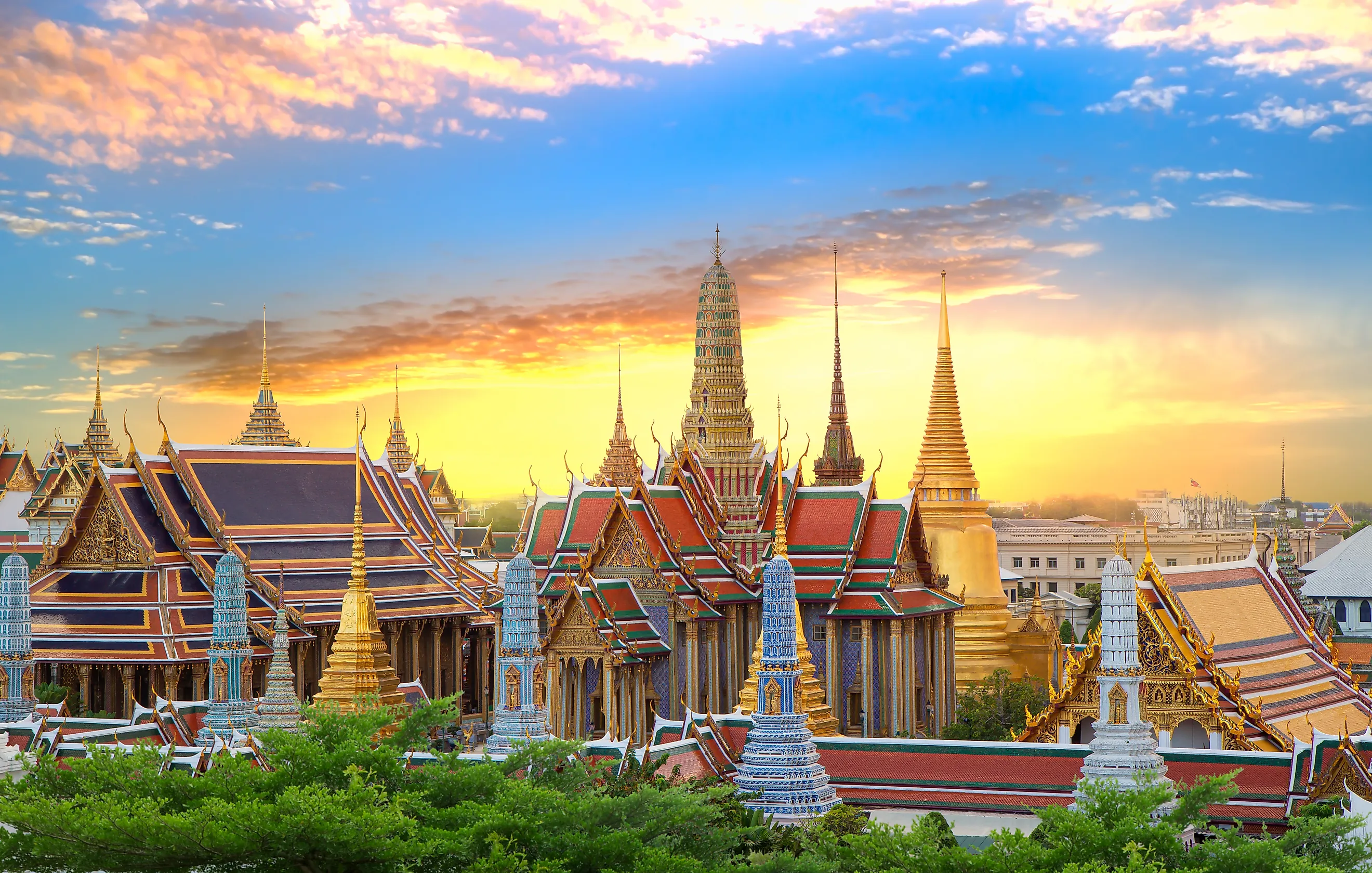
Grand Palace, Thailand

King Rama I founded the Grand Palace in 1782 as the seat of the new Chakri dynasty on the east bank of the Chao Phraya River in Bangkok. The walled complex covers about 218,400 square metres and includes the Outer Court (former government offices), the Middle Court (the Throne Hall and royal residences), and the Temple of the Emerald Buddha (Wat Phra Kaew), the holiest Buddhist site in Thailand. The palace was the principal royal residence until King Vajiravudh moved out in 1925, and successive Thai kings have lived in other palaces in the city since. The Grand Palace remains the official ceremonial royal venue, hosts state functions, and is open to the public for most of the year. The Emerald Buddha, a 26-inch jadeite statue carved from a single block, has been the kingdom's palladium since King Rama I installed it in 1784.
Château de Chambord, France

Construction of Château de Chambord began in 1519 under King Francis I and continued in phases for the next three decades, ending in 1547 (the year of Francis I's death). The château is the largest of the Loire Valley royal residences with 426 rooms, 282 fireplaces, and 84 staircases, including the double-helix central staircase often attributed to Leonardo da Vinci, who was working at the nearby royal court at Amboise in the years immediately before his death in 1519. The building is a defining example of French Renaissance architecture, mixing French medieval forms with Italian classical detail. Chambord was conceived as a hunting lodge rather than a primary residence, and Francis I spent only a few weeks there during his entire reign. It was added to UNESCO's World Heritage list in 1981.
Alhambra, Spain

The Alhambra in Granada draws more than three million visitors annually and is Spain's most-visited tourist site. The fortress-palace complex began as a fortified citadel under the Nasrid emir Muhammad I al-Ahmar starting in 1238, with the most celebrated palatial spaces (the Court of the Lions, the Hall of the Ambassadors, the Hall of the Two Sisters) added under Yusuf I (r. 1333-1354) and Muhammad V (r. 1354-1391) at the height of the Nasrid dynasty. The name comes from the Arabic al-Qal'a al-Hamra, "the red castle," after the iron-rich red clay of the hilltop. The complex passed to the Castilian crown after the 1492 conquest of Granada by Ferdinand II and Isabella I, with subsequent additions including the unfinished Renaissance Palace of Charles V (begun 1527). The Alhambra and the adjacent Generalife gardens were added to UNESCO's list in 1984, with the Albaicín old quarter added in 1994.
What the Ten Have in Common
Almost all the palaces above are now UNESCO World Heritage Sites; nine of the ten have been added to the list between 1979 and 1996. Most opened to public visit only after the monarchies that built them were abolished or relocated, with Buckingham Palace as the working-residence exception and the Grand Palace as the ceremonial-active exception. Visitor counts cluster between three and eight million a year for the busiest entries (Versailles, the Alhambra, Schönbrunn), reflecting the fact that royal palaces have become some of the most-visited paid tourist attractions in the world. The architectural span runs from 13th-century Nasrid stucco-work at the Alhambra to 18th-century Baroque at Schönbrunn and Versailles, with the Potala Palace standing apart as the only Buddhist religious-administrative complex on the list.