11 Bucket-List Small Towns In The United States
Carmel-by-the-Sea has no street addresses. Residents collect their post at the counter and give directions by cross street, and the town has never seen a reason to change. Jackson, Wyoming built four arches out of shed elk antlers and put them on its town square. Moab sits between two national parks and sells more mountain bike tyres than most cities.
A bucket-list town is not simply a pretty one. It has something no other place in the United States can offer, and usually something you have to turn up in person to understand. These eleven all hold under fifty thousand people, and they run coast to coast, from the Monterey Peninsula to the first sunrise in Maine.
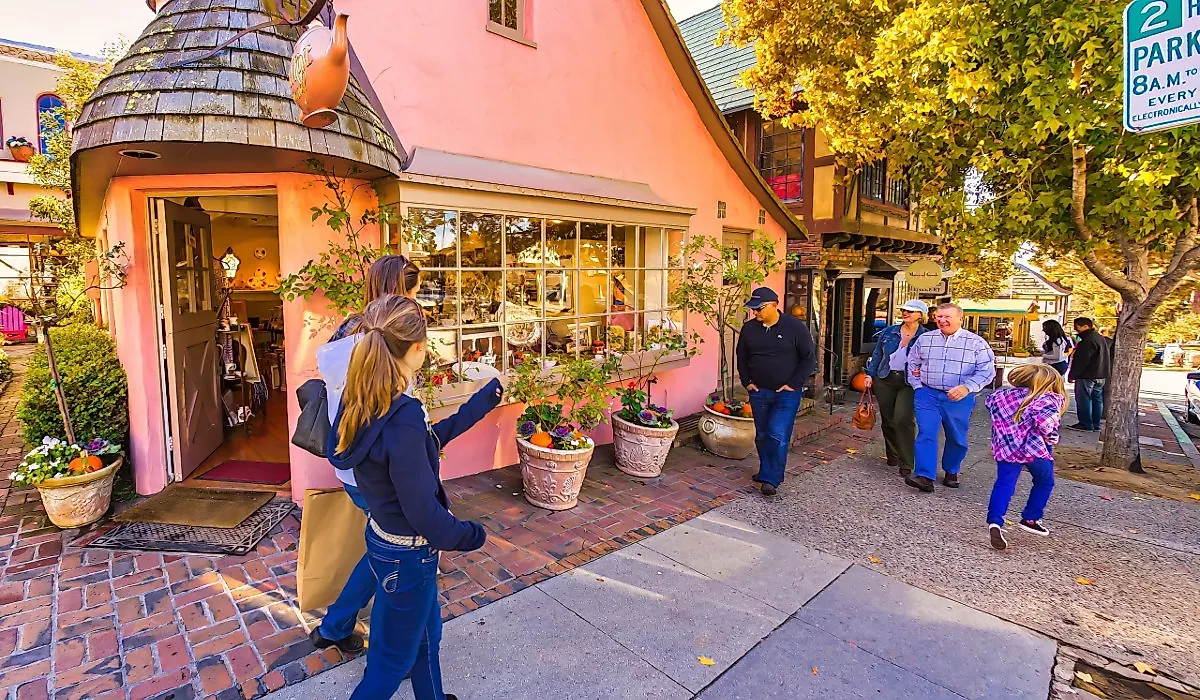
Carmel-by-the-Sea, California

The no-addresses rule is only the start. Carmel also has no street lights, no parking meters, and a bylaw requiring a permit to wear heels over two inches, written to head off lawsuits over pavement buckled by tree roots. The permits are free and nobody enforces it, but nobody repeals it either.
Carmel-by-the-Sea was founded in 1902 and became an artists' colony soon after, and it still runs more galleries per block than almost anywhere its size. The Carmel Mission Basilica, founded in 1771, holds Junípero Serra's grave.

Just south, Point Lobos State Natural Reserve has coastal trails above kelp forests and tide pools, and the painter Francis McComas called it the greatest meeting of land and water in the world. Evenings wind down at Aubergine, the Michelin-starred restaurant inside L'Auberge Carmel, a 1929 property now part of Relais and Châteaux.
Hood River, Oregon

The wind here is so reliable it built an industry. The Columbia River Gorge funnels air between the Cascades at a steady clip almost every afternoon, which is why Hood River is called the windsurfing capital of the world and why the water is full of sails and kites from spring through autumn.

Start with the drive up to Panorama Point for the valley and Mount Hood behind it. In autumn the Hood River Fruit Loop runs 35 miles through orchards, cider houses, and farm stands on ground that has been in fruit since the 1850s.
Afternoons suit the Western Antique Aeroplane and Automobile Museum, where the aircraft and cars are kept in working order and several still fly. Finish at pFriem Family Brewers on the riverside and watch the kiteboarders go past.
Jackson, Wyoming

The four arches on Jackson's town square are built from thousands of shed elk antlers, collected each spring by Boy Scouts from the National Elk Refuge just north of town. The elk drop them naturally, the Scouts gather them, and the arches get rebuilt as they weather.
That refuge is the other reason to come. Several thousand elk winter on it, and from December into March you can cross the feedground by horse-drawn sleigh and get close enough to hear them.
Grand Teton National Park begins minutes north, where the range rises straight off the valley floor with no foothills, which is why the Tetons photograph the way they do. Yellowstone's south entrance is an hour beyond. The National Museum of Wildlife Art sits on a bluff above the refuge with a collection worth an afternoon on its own.
Moab, Utah

Two national parks sit within forty minutes of the same main street, which no other town in America can claim. Arches holds more than 2,000 natural stone arches, the greatest concentration anywhere on earth, and Delicate Arch is on the Utah licence plate. Canyonlands is the opposite: enormous, empty, and split into districts that take hours to drive between.
Both are certified International Dark Sky Parks, so the night sky here is as much the attraction as the rock. Arches runs timed-entry reservations through the busy months, and they sell out, so book before you drive.
Moab itself grew from a uranium boom into the self-declared adventure capital of the west. The Slickrock Bike Trail is the ride that invented modern mountain biking as a destination sport, and rafting the Colorado through Westwater Canyon is the water equivalent. Go in spring or autumn; July routinely passes 100 degrees.
Sedona, Arizona

The rocks are red because of iron. Hematite in the sandstone has been oxidising for roughly 300 million years, and the formations around Sedona are the eroded remains of a coastline that sat here long before the Colorado Plateau lifted.
Cathedral Rock is the one everybody photographs, best at dusk from the Crescent Moon picnic area where Oak Creek reflects it. Bell Rock and Devil's Bridge, the largest natural sandstone arch in the area, are the other two names worth knowing.
Sedona has also been an International Dark Sky Community since 2014, with lighting ordinances to protect it. Slide Rock State Park, up Oak Creek Canyon, is a natural sandstone chute people have been sliding down since it was an apple farm. The town leans into the spiritual-vortex business, which you can take or leave; the geology needs no help.
Taos, New Mexico

Taos Pueblo has been continuously inhabited for more than a thousand years, making it one of the oldest living communities in the country and a UNESCO World Heritage Site. Families still live in the multi-storey adobe houses, which have no electricity or running water by choice, and sell work from their doorways.

The town below has been an art colony since 1915, when the Taos Society of Artists formed, and the Taos Art Museum at Fechin House holds the best of it inside a Russian-carved adobe built by the painter Nicolai Fechin himself.
Twelve miles northwest, the Rio Grande Gorge Bridge crosses a canyon roughly 600 feet deep, the seventh-highest bridge in the United States. Evenings end at Doc Martin's, in the adobe where the town's first doctor lived and where the art society was founded.
Galena, Illinois

Around 85 percent of Galena's buildings sit inside a National Register historic district, and the reason is economic collapse. Lead mining made the town rich before the Civil War, then the river silted up and the railroads went elsewhere, and nobody ever had the money to knock anything down.

The self-guided walking tour takes in the DeSoto House Hotel, open since 1855, where Abraham Lincoln spoke from the balcony, and the Ulysses S. Grant Home, given to the general by the citizens of Galena when he came back from the war in 1865. The rooms hold the family's original furnishings.
Chestnut Mountain Resort runs alpine slides and chairlifts above the Mississippi, and Galena is hilly enough that the main street has a flight of stairs built into it. Few places in the Midwest look less like the Midwest.
Bardstown, Kentucky

Bardstown calls itself the Bourbon Capital of the World, and the claim holds up: more than ten distilleries operate within a short drive, including Heaven Hill, Willett, Barton 1792, and Maker's Mark half an hour south. The Kentucky Bourbon Festival each September is the industry's own gathering.
The town is also the second-oldest in Kentucky, settled in 1780, with around 200 buildings on the National Register. The Old Talbott Tavern on the square has been serving since 1779 and claims Daniel Boone, Jesse James, and an exiled French king among its guests, with bullet holes in an upstairs mural that are attributed to James.
My Old Kentucky Home State Park preserves Federal Hill, the mansion that gave Stephen Foster his song title, and runs costumed tours. The Bourbon Capital of the World sign is painted directly on the pavement downtown, which tells you how seriously the town takes it.
Beaufort, South Carolina

The reason so much antebellum architecture survives in Beaufort is that the town fell to Union forces in late 1861 and spent the rest of the war occupied rather than burned. Founded in 1711, it is the second-oldest town in South Carolina, and the whole historic district is a National Historic Landmark.

The John Mark Verdier House has its original French wallpaper and family pieces, and the Beaufort History Museum covers the Yamasee, the Spanish and British colonial period, and Reconstruction, which began here earlier than almost anywhere. The Combahee River Raid of June 1863, guided by Harriet Tubman, launched from this waterfront and freed around 750 people in a night.
Henry C. Chambers Waterfront Park has swings facing the river, and Hunting Island State Park is sixteen miles out with a climbable lighthouse and the only publicly accessible beach in the area.
Key West, Florida

This is the end of the road. US 1 runs 2,369 miles from the Canadian border in Maine and stops at Key West, and the concrete buoy at Whitehead and South marks the southernmost point in the continental United States, closer to Havana than to Miami.
Ernest Hemingway lived at 907 Whitehead Street for most of the 1930s and wrote much of his best work there. The house keeps around sixty cats, many of them six-toed and descended from a ship's cat he was given.
The Overseas Highway getting here is the attraction in itself, 113 miles across 42 bridges including a seven-mile span over open water. Once you arrive, Mallory Square runs a sunset celebration every evening with buskers and street performers, and the Dry Tortugas, a Civil War fort on an island seventy miles further out, is reachable by ferry or seaplane.
Bar Harbor, Maine

From early October through early March, the sun reaches Cadillac Mountain before anywhere else in the United States. People drive up in the dark to be there for it, which is why the summit road runs on timed vehicle reservations from late spring onward and why those reservations sell out.

On Mount Desert Island, Bar Harbor is the gateway to Acadia. The Ocean Path runs easily from Sand Beach to Otter Cliffs past Thunder Hole, where an incoming tide compresses air in a sea cave and fires water back out with a bang.
The Abbe Museum is the other essential stop, and its core exhibit presents more than 12,000 years of Wabanaki history from Indigenous perspectives rather than archaeological ones. At low tide a gravel bar appears across to Bar Island, and you can walk to it, provided you watch the clock.
What Puts A Town On The List
The pattern across all eleven is singularity. Moab is the only town in America with two national parks at its door. Key West is where the road physically ends. Taos Pueblo has been lived in for a millennium, Carmel refuses to number its houses, and Cadillac Mountain gets the country's first light for five months of the year. None of these can be substituted with somewhere closer to home.
Two practical notes if you are planning around them. Arches and Cadillac Mountain both run timed-entry reservations that sell out well ahead, and Jackson, Moab, and Sedona all have a season you want and a season you do not: the desert towns are brutal in July, and Jackson's sleigh rides only run from December into March. Pick the month before you pick the flight.