11 Best Downtowns In The Great Lakes
The tell of a good Great Lakes downtown is that the street runs out at the water. Not near it, not a ten-minute drive from it: the shops end, and there is a pier. That happens a lot around the Great Lakes, because nearly every one of these places was a port, a fishing station, or a lumber landing before it was a destination, and a street built to get cargo to a dock turns out to be the right shape for wandering. These eleven do it best, and a few of them do it with goats on the roof.
Fish Creek, Wisconsin

Come at dusk and you will smell the kerosene before you see it. The Door County fish boil ends with a boil-over: the cook throws fuel on the fire, the pot erupts in a column of flame, and everyone gets whitefish. Pelletier's on Main Street does it nightly through the season, and it is the most theatrical dinner on this list.
Fish Creek sits on the Door Peninsula where the highway simply becomes Main Street and runs west to Sunset Beach Park. Founder's Square, the historic shopping quarter along the bluff, holds galleries and cafes in buildings from the late 1800s, and the 1875 Alexander Noble House Museum runs tours through its period rooms. Grab a cone at Dippy's afterward and walk the two blocks north to the marina.
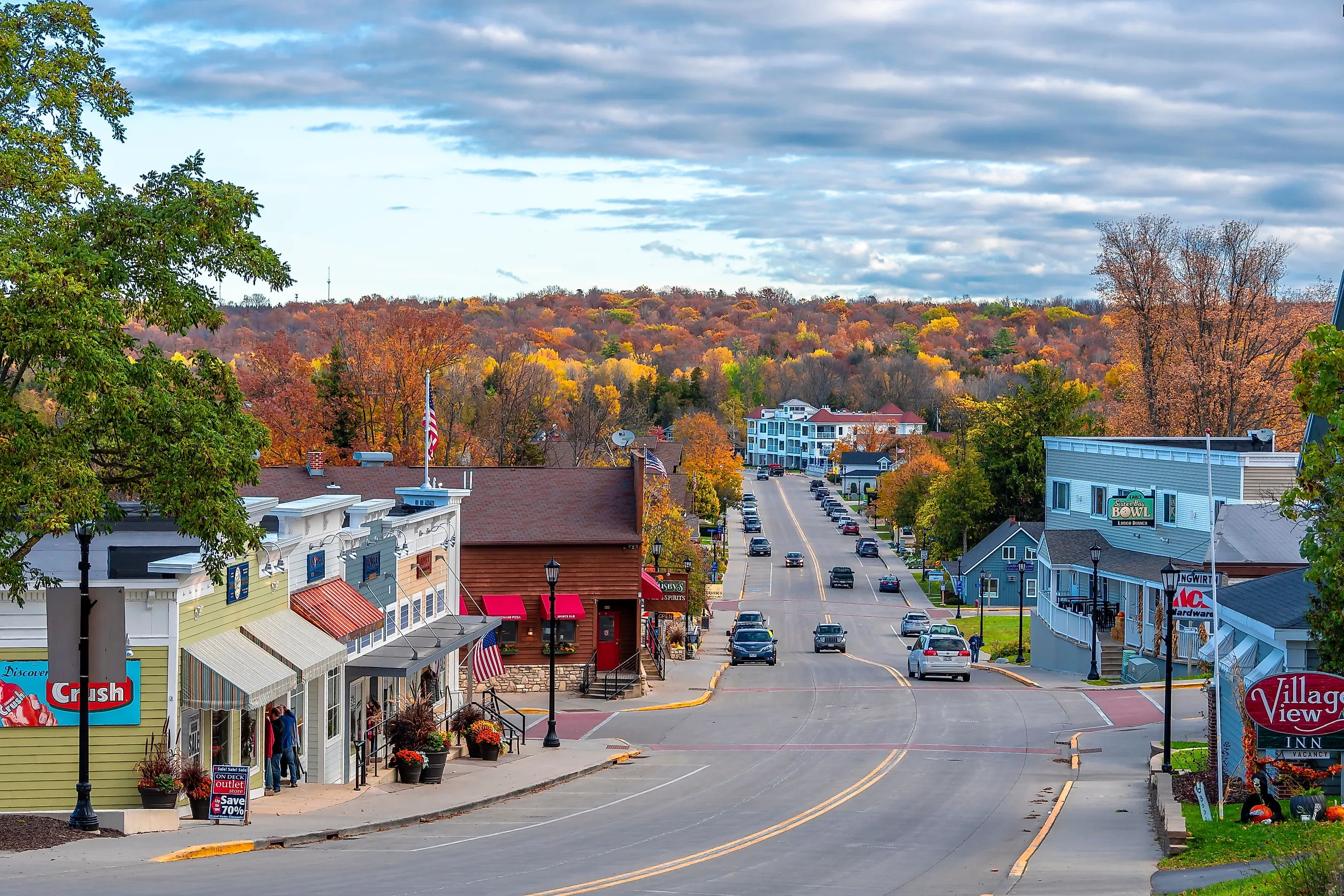
Sister Bay, Wisconsin

There are goats on the roof. Al Johnson's Swedish Restaurant has kept a herd grazing on its sod roof since the early 1970s, they are trademarked, and there is a live webcam. This is the single most photographed thing on the Door Peninsula and it is entirely deliberate.
Underneath the novelty is a genuinely good waterfront, roughly 1,900 feet of it public, facing Green Bay on the Door County side that gets the sunsets. Door County Creamery makes its cheese from its own goats, a different herd, and Frykman Studio Gallery handles the art. Fall Fest takes over three days in October when the peninsula's foliage peaks, and the Country House Resort and Open Hearth Lodge cover the overnight.
Grand Haven, Michigan

Since 1962 this town has been shooting water forty feet into the air to music every summer night. The Grand Haven Musical Fountain was the largest of its kind in the world when it was built, sits on Dewey Hill across the river from downtown, and the whole boardwalk turns to face it at dusk.
Grand Haven started as a fur trading post in 1834 at the mouth of the Grand River on Lake Michigan, and the paved 1.5-mile boardwalk now runs the whole way from the shops at Chinook Pier out to the state park, the pier, and the two lighthouses. The Tri-Cities Historical Museum is free. Morning Star Cafe handles brunch, and the Harbor House Inn puts you within walking distance of all of it.
Holland, Michigan

The sidewalks downtown are heated. A snowmelt system runs beneath them, which is why people are walking Eighth Street in January while the rest of Michigan stays indoors. That is the kind of decision a town makes when it is serious about its downtown.
Dutch immigrants founded Holland in 1847, and De Zwaan, the 250-year-old mill shipped over from the Netherlands in 1964, is the only authentic working Dutch windmill in the United States. It still grinds flour you can buy. The town sits on Lake Macatawa with Lake Michigan just west, New Holland Brewing pours downtown, the Holland Museum covers the founding, and Window on the Waterfront adds 30 acres of trails and tulips. Come in early May for Tulip Time and book months out.
Saugatuck, Michigan

The arts centre here is a former pie factory, and the town has been an artists' colony since the Art Institute of Chicago opened its Ox-Bow summer school on the dunes in 1910. That is why a village of about a thousand people supports this many galleries.
The commercial district curls along the bend of the Kalamazoo River, with Uncommon Coffee Roasters on the Village Square for the morning and the Saugatuck Center for the Arts programming theatre, exhibitions, and a farmers market. The hand-cranked chain ferry has been pulling passengers across the river since the 1830s and is still the quickest way to the dune stairs. Everything eventually points at Oval Beach.
Traverse City, Michigan

This town grows more tart cherries than anywhere else in the country and has organised its entire personality around it. Cherry Republic on Front Street sells cherry salsa, cherry mustard, cherry wine, and cherry products you did not know were possible. The National Cherry Festival takes the waterfront for a week each July.
Traverse City sits between the East and West Arms of Grand Traverse Bay, which means Front Street has water at both ends. The 1916 State Theatre was restored under Michael Moore and still runs his film festival. Clinch Park handles the beach, the Village at Grand Traverse Commons fills a vast former state asylum with shops and restaurants, and the Dennos Museum Center on the college campus holds one of the country's better Inuit art collections. Amical does European cooking downtown.
Grand Marais, Minnesota

The name is French for big marsh, which undersells it considerably. Grand Marais wraps a natural harbour on Lake Superior, the deepest of the Great Lakes, at the far end of the North Shore where the Gunflint Trail heads inland toward the Boundary Waters.
The Grand Marais Art Colony opened in 1947 and is the oldest in Minnesota, which set the tone for the galleries and studios along Broadway Avenue. Walk it east and you reach Artist's Point, a rocky spit beside the breakwater with the lighthouse at the end and Superior on three sides. The Angry Trout Café works out of an old fish house on the harbour, and Dockside Fish Market sells what came in that morning.
Two Harbors, Minnesota

Iron built this town and the evidence is impossible to miss: the ore docks still stand over the harbour, enormous timber and steel structures that loaded taconite onto lake freighters out of the Mesabi Range. The first shipment left here in 1884.
Downtown runs to outdoor gear, galleries, and gift shops, and stays busy year-round because the North Shore does. The Depot Museum covers the Duluth and Iron Range Railroad in the old station, Castle Danger Brewery has the taproom, and Cedar Coffee Company has a dog-friendly patio. The red Two Harbors Lighthouse, lit in 1892, is Minnesota's oldest continuously operating light and runs self-guided tours. Gooseberry Falls State Park is thirteen miles up the shore and Split Rock Lighthouse a few miles past that.
Michigan City, Indiana

Indiana gets 45 miles of Great Lakes shoreline, and Michigan City has the best downtown on it. The town sits at the south tip of Lake Michigan next to Indiana Dunes National Park, and the South Shore Line still runs electric commuter trains right into it, which is a rare way to arrive at a beach.
Washington Park holds a zoo with big cats and alligators, which is an unusual thing to find on a beach, and the 1858 Old Lighthouse Museum guards the mouth of Trail Creek with self-guided tours and maritime exhibits. The 1857 Barker Mansion shows how the railcar money lived. Michigan Boulevard is the main street, with breweries, a winery, and the Lakefront Art Festival in late August. The Great Lakes Grand Prix brings offshore powerboats to the water each summer.
Put-in-Bay, Ohio

Everyone gets around by golf cart. Put-in-Bay occupies South Bass Island in Lake Erie, reachable only by ferry, private boat, or small plane, and the rental carts outnumber the cars by a wide margin. They call it the Key West of the North and in July that is not much of a stretch.
Downtown is a few blocks of bars, docks, and shops facing the harbour, with Perry's Victory and International Peace Memorial rising 352 feet behind it to mark Oliver Hazard Perry's 1813 win in the Battle of Lake Erie. Take the elevator up. Crystal Cave, under Heineman's Winery, is billed as the world's largest geode and is lined with pale blue celestine. The season runs April to October, after which the island goes very quiet.
Elora, Ontario

Metcalfe Street crosses the Grand River mid-block, which gives Elora's downtown something rare: a point where you stop, lean on a railing, and look down at moving water. The buildings are local limestone, quarried nearby in the 1800s, and the streetscape has been kept rather than replaced.
The Elora Mill sits right at the falls in the middle of the village, now a hotel. A short walk away the Elora Gorge drops 22 metres through the rock, and the Elora Quarry next door is a spring-fed swimming hole in an abandoned limestone pit. This is the one Ontario entry on the list, and it is a reminder that the Great Lakes have two countries on them and the Canadian side has the better stonework.
What They All Get Right
Four things turn up on nearly every one of these. The street ends at water, because every one of these towns was a working port first. There is one genuinely strange attraction, whether that is goats on a roof, a flaming fish boil, a windmill shipped from the Netherlands, or a 352-foot column on an island you reach by ferry. There is an arts scene out of proportion to the population, usually because a colony or a school landed there a century ago. And there is a festival that closes the road at least once a year.
Michigan takes four of the eleven slots, which is arithmetic rather than favouritism: the state touches four of the five lakes and holds more freshwater coastline than any other. If you are planning a route, Door County pairs Fish Creek and Sister Bay in a single afternoon, the Michigan west coast links Holland, Saugatuck, and Grand Haven within an hour, and Grand Marais and Two Harbors sit on the same North Shore drive.