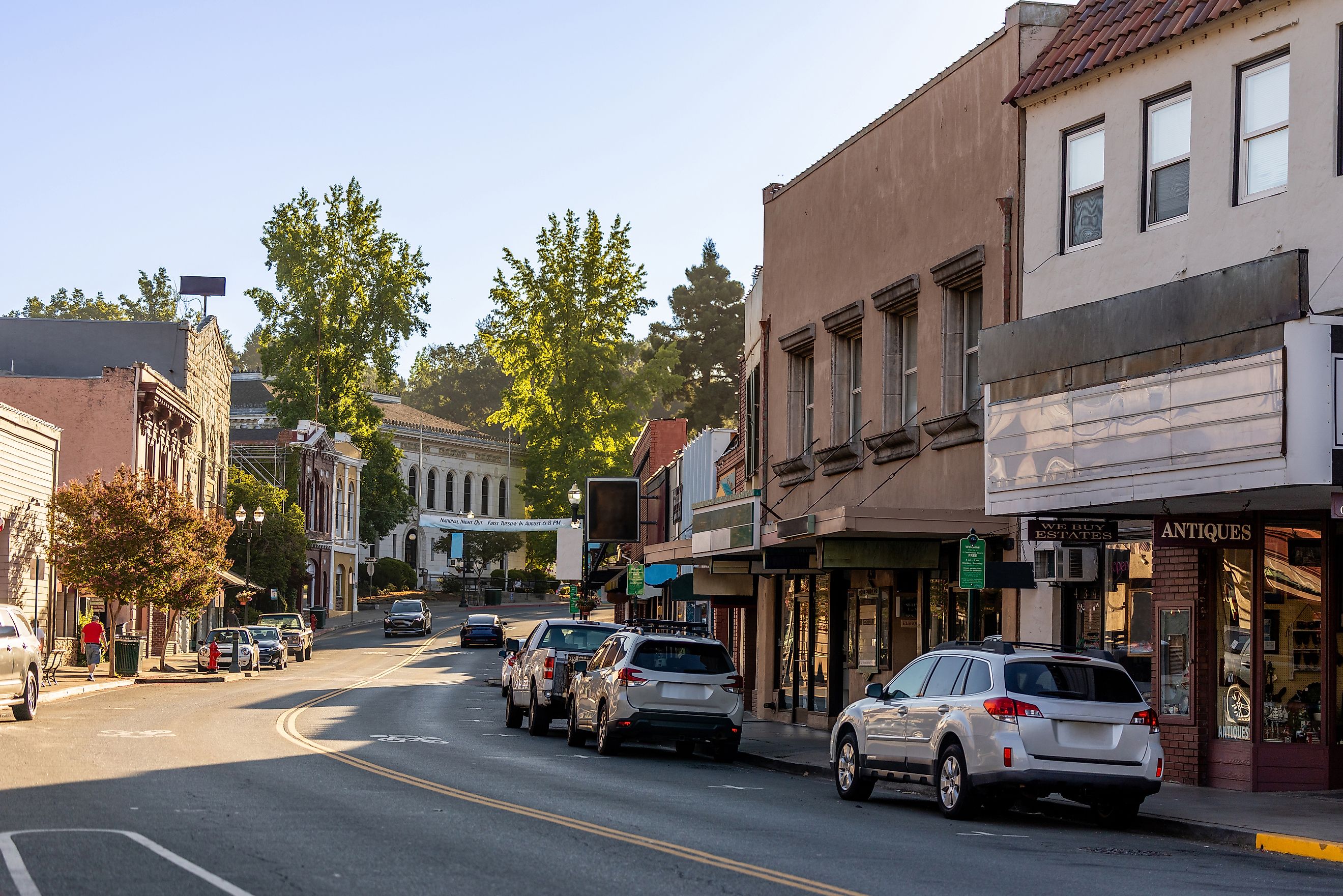
10 Prettiest Main Streetscapes In Northern California
Northern California's downtowns change considerably depending on where the road leads. Along the Lost Coast, Ferndale's Main Street has elaborate Victorian buildings painted in greens, blues, reds, and creams. Farther inland, brick storefronts and old hotels recall the Gold Rush in places such as Placerville and Nevada City. Head toward the Sierra Nevada, and Truckee's historic commercial district sits beside an active railroad corridor with mountains beyond the rooftops.
Many of these streets still function as the center of town rather than a preserved attraction that people simply photograph and leave. Old theaters show movies, former libraries hold local museums, and restaurants and shops occupy buildings that have stood for generations. Here are ten Northern California main streets where the view from the sidewalk deserves as much attention as the attractions nearby.
Placerville

The first thing many people notice on Placerville's Main Street is a steel tower that rises from an island in the middle of the road, where a fire bell once hung. Placerville's bell arrived in 1865 after three fires tore through the business district in 1856, and residents needed an effective way to call volunteer firefighters. The current steel structure went up in 1898 to replace an earlier wooden tower, and the original bell now sits in the El Dorado County Museum. Around it, Main Street retains rows of historic commercial buildings from Placerville's years as a Gold Rush center.
Placerville's mining history becomes much more literal at Gold Bug Park and Mine. The park has an actual hard-rock gold mine that the public can enter on a self-guided audio tour, along with the Hendy Stamp Mill and a blacksmith shop. Those who would rather stay above ground can use the park's trails. The El Dorado Trail is another option near town, with a paved section running through Placerville. During harvest season, many travelers also use Placerville as a base for visiting the farms, orchards, bakeries, and wineries associated with Apple Hill Growers in the surrounding foothills.
Ferndale

Main Street in Ferndale looks different from almost anywhere else on this list. Ornate Victorian buildings stand shoulder to shoulder, with bay windows, elaborate cornices, decorative trim, and storefronts painted in colors that make individual buildings easy to pick out. The architecture reflects the prosperity that dairy farming brought to the Eel River Valley during the late 1800s.
There is plenty to notice without leaving Main Street. The Golden Gait Mercantile occupies a historic storefront filled with old-fashioned goods, while the Ferndale Museum on Shaw Avenue contains photographs, documents, and artifacts tied to the Eel River Valley. It is a useful stop for understanding why such elaborate buildings appeared in a rural corner of Humboldt County. A walk uphill through the Ferndale Cemetery gives a different perspective on the town. Historic headstones climb the slope, and higher points look back toward Ferndale and the surrounding farmland. For the Pacific Ocean, Centerville Beach is a short drive west of town, where cliffs and open coastline replace Main Street's elaborate facades.
Nevada City

Broad Street does not cut neatly through Nevada City. It bends and rises with the Sierra Nevada foothills, passing brick storefronts, wooden balconies, old commercial buildings, and mature trees. The changing elevation is part of what makes the street so photogenic. Looking uphill produces a completely different downtown view from looking back toward the lower end of Broad Street.
Firehouse No. 1 is difficult to miss. The building sits a block off Broad Street on Main Street, where its ornate Victorian facade and bell tower have made it one of Nevada City's recognizable buildings. It has housed the Nevada County Historical Society's museum since 1947. Back on Broad Street, the Nevada Theatre has roots dating to 1865 and continues to host movies, theatrical productions, concerts, and community events. Downtown also sits close to Deer Creek. The Miner's Trail begins near the lower portion of Broad Street and follows the creek before connecting with other local trails. Nevada City has also developed the Sugarloaf trail system above downtown, giving hikers another perspective on the historic district and the wooded hills surrounding it.
Sutter Creek

Buildings sit close to the road on Main Street in Sutter Creek, where the surrounding hills leave little room for a sprawling downtown. Brick walls, wooden balconies, covered porches, old hotels, and narrow storefronts line the commercial district. The creek that gave the community its name runs nearby. One block away from the restaurants and shops is a surviving piece of California's industrial history. Knight Foundry, established in 1873, preserves water-powered machinery once used to manufacture equipment for mines and other industries. The nonprofit that operates the foundry opens it for scheduled tours and demonstrations.
The Sutter Creek Visitor Center on Main Street is worth a stop for its historic photographs and local artifacts. From there, travelers interested in Amador County wine can head toward the Shenandoah Valley, where vineyards spread across the foothills northeast of town. Sutter Creek is especially appealing in the evening, when lights from businesses along Main Street illuminate the narrow downtown corridor and the surrounding hills become less visible.
Grass Valley

Downtown Grass Valley has changed the role of one of its most important streets. Mill Street now includes a pedestrian plaza, replacing regular vehicle traffic with outdoor seating, landscaping, public space, and room to walk between businesses. Historic facades still frame the street, so the redesign did not erase its Gold Rush-era appearance. Nearby Main Street adds another set of historic buildings. The Holbrooke Hotel, whose history reaches back to the 19th century, remains one of the better-known downtown landmarks. The Art Deco Del Oro Theatre is much younger and stands on Mill Street. Its tall neon tower and decorative facade have become another recognizable part of central Grass Valley.
The mining operation that helped shape the community sits less than two miles from downtown. At Empire Mine State Historic Park, trails pass former mining buildings, equipment, gardens, and the estate associated with the mine's owners. Underground workings once extended for hundreds of miles beneath the surrounding area, although visitors remain above ground. Back on Mill Street, restaurant tables and pedestrians now occupy spaces where cars once dominated the road.
Truckee

Freight trains passing behind historic buildings are part of the downtown scenery in Truckee. Commercial Row and Donner Pass Road run alongside the railroad corridor, where brick and wooden buildings recall the period when rail transportation helped turn Truckee into an important Sierra Nevada community. The Truckee Railroad Museum could hardly have a more appropriate address. Housed inside a caboose next to the historic depot, the museum covers the transcontinental railroad, logging railroads, and the role trains played in bringing travelers into the Sierra.
A few blocks away, the Old Jail Museum occupies a stone building dating to 1875. Its thick walls and original cells tell a rougher side of Truckee's early history. The scenery changes again along Donner Pass Road west of downtown. Donner Memorial State Park reaches the shore of Donner Lake and contains the park visitor center, which opened in 2015 to replace the old Emigrant Trail Museum. Exhibits cover the Donner Party, the Washoe people, Chinese railroad construction, and early travel over Donner Pass.
Healdsburg

Instead of one long commercial strip, downtown Healdsburg revolves around a green square. Healdsburg Plaza occupies an entire block, with mature trees, lawns, benches, and walkways surrounded by restaurants, shops, galleries, and tasting rooms. The arrangement makes it easy to move between the plaza and the surrounding streets.
A former Carnegie library now houses the Healdsburg Museum and Historical Society on Matheson Street. Exhibits trace the history of Healdsburg and the surrounding region, including the people and industries that shaped the community before its modern association with wine. The Russian River is also close to downtown. Healdsburg Veterans Memorial Beach occupies a stretch of riverbank south of Healdsburg Avenue. During the warmer months, its river access gives travelers an easy change of pace after several hours among the shops and tasting rooms around the plaza.
Sonoma

Sonoma Plaza is enormous compared with the central squares found in many California towns. The eight-acre plaza occupies the heart of downtown, with lawns, mature trees, paths, and historic buildings spread around its perimeter. Some of California's most important early landmarks stand on its northeastern side. Mission San Francisco Solano, founded in 1823, was the last and northernmost of California's 21 missions. Nearby Sonoma Barracks served Mexican military forces during the 19th century. Both now belong to Sonoma State Historic Park.
Several additional park properties sit within walking distance, including the Toscano Hotel complex and Blue Wing Inn. General Mariano Guadalupe Vallejo's home, Lachryma Montis, is farther from the plaza but remains part of the same state historic park. The plaza itself is not merely a space between attractions. Families use its lawns and playground, while restaurants, tasting rooms, and stores fill the surrounding blocks.
Calistoga

Mountains appear at the end of several sightlines along Lincoln Avenue in Calistoga, giving downtown a setting unlike the flatter communities farther south in Napa Valley. The street has mostly low-rise buildings, with restaurants, shops, tasting rooms, and spa businesses spread along the commercial blocks. Just off Lincoln Avenue, the Sharpsteen Museum explains how Calistoga developed from an early resort community into the town seen today. One of its most memorable displays is a detailed diorama depicting Calistoga during the 1860s. Museum founder Ben Sharpsteen worked as an animator, producer, and director for Walt Disney Studios before establishing the museum.
Calistoga's geothermal activity is visible at Old Faithful Geyser of California on Tubbs Lane. The geyser erupts periodically throughout the day, while the grounds also contain geological exhibits and picnic areas. Wine history adds another reason to leave Lincoln Avenue for a few hours. Chateau Montelena occupies a stone winery building north of downtown and became internationally known after its Chardonnay won the white-wine category of the 1976 Judgment of Paris.
Mendocino

Few Main Streets end with scenery like Mendocino's. Historic wooden buildings line one side of the road, while grassy coastal bluffs and the Pacific Ocean spread out on the other. Water towers rise above portions of the village, a reminder of a time when residents needed to store their own water. Mendocino Headlands State Park wraps around the community rather than sitting several miles outside it. Trails cross the bluffs directly across from parts of Main Street and lead toward ocean overlooks, rocky coves, and views of sea arches.
The Ford House Visitor Center and Museum stands on Main Street facing the headlands. Built in 1854 for Jerome Ford, the house now contains information about the area's natural environment and history. A model inside shows what Mendocino looked like in 1890. Several blocks away, the Kelley House Museum focuses on local history and the logging industry that helped create the community. Afterward, there is no need to drive elsewhere for a coastal view. Cross Main Street, follow one of the headlands trails, and the rooftops of Mendocino soon appear behind the grassy bluffs.
Northern California From The Sidewalk
There is no single Northern California version of Main Street. Ferndale has ornate Victorian facades built with dairy wealth, while Nevada City's Broad Street rises through Gold Rush-era buildings in the foothills. Trains still pass the old commercial buildings in Truckee. In Mendocino, the opposite side of Main Street opens directly onto Pacific headlands. Some of the best details are even more specific: Placerville's 1865 fire bell, the machinery inside Sutter Creek's Knight Foundry, Grass Valley's car-free section of Mill Street, and Sonoma's mission standing across from an eight-acre public plaza.