9 Old-World Towns to Visit in California's Sierra Nevada
The Sierra Nevada foothills are lined with towns that owe their existence to the California Gold Rush. Gold was discovered at Sutter's Mill in 1848, and within months, thousands of prospectors flooded the region. The towns they built are still standing. Grass Valley's Empire Mine produced 5.8 million ounces of gold over a century of operation. Columbia was California's fifth-largest city at its peak. Nevada City's National Exchange Hotel and Nevada Theatre have been in continuous use since the 1800s. These nine towns preserve that history through museums, mines, courthouses, and main streets that haven't lost their character.
Grass Valley

Grass Valley sits in Nevada County, about an hour northeast of Sacramento. Gold was discovered at Gold Hill in October 1850, and the town that grew around the mines incorporated a decade later. Cornish tin miners made up three-quarters of the population between 1860 and 1895, and that heritage still shapes the town's character, from the annual Cornish Christmas celebration to the twinning relationship with Bodmin, Cornwall.
The Empire Mine State Historic Park is the main draw. The mine operated from 1850 to 1956, produced 5.8 million ounces of gold, reached over 11,000 feet deep, and carved 367 miles of tunnels underground. Visitors can tour the Bourn Cottage estate and its 19th-century gardens, explore mining buildings, and see scale models of the underground workings. The Holbrooke Hotel, a California Historical Landmark, anchors downtown with what is considered one of the oldest continuously operating saloons in the state. The North Star Mining Museum, housed in a former powerhouse, adds more mining-era context to a town that wears its history well.
Columbia

Columbia was known as the "Gem of the Southern Mines." Gold was found here in 1850, and within weeks the population hit 5,000. By its peak, it was California's fifth-largest city. Between 1850 and the early 1900s, roughly $87 million in gold was extracted from the surrounding hills. Major fires in 1854 and 1857 leveled much of the original town, and merchants rebuilt in brick and iron, which is why so many structures survived.
Columbia State Historic Park, established in 1945, preserves the central district as a National Historic Landmark. Some businesses still operate along the main street, and visitors can take stagecoach rides, watch blacksmithing demonstrations, and listen to live music in a historic saloon. The Columbia Cemetery, where miners and early settlers are buried, provides a sobering look at the era's realities. New Melones Lake, a reservoir in the Sierra Nevada foothills nearby, adds camping, boating, biking, and equestrian trails for those who want to pair history with time outdoors.
Nevada City

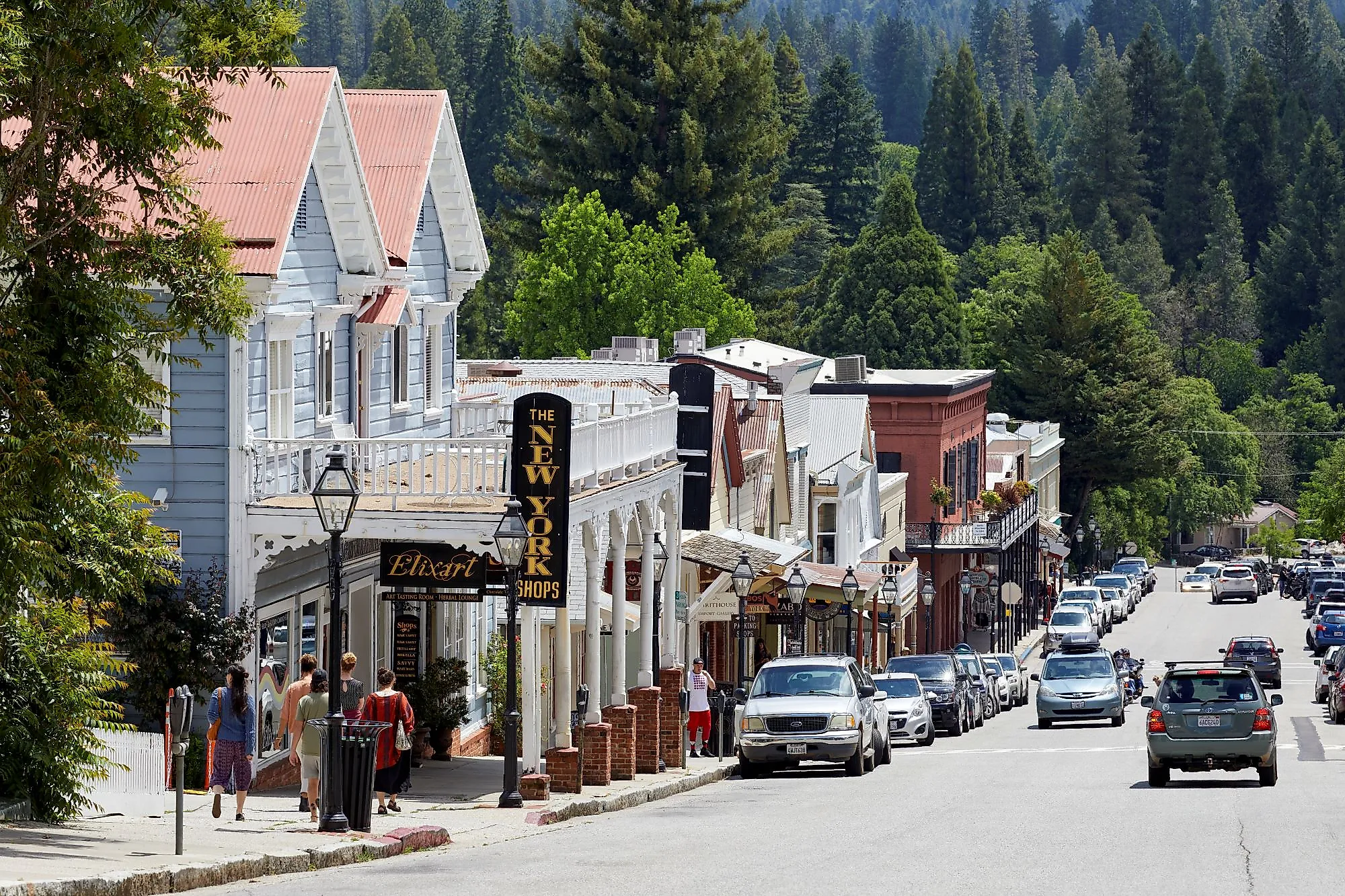
Nevada City was settled in 1849 during the Gold Rush and quickly became one of the state's most important mining towns. The National Exchange Hotel, a Victorian-era landmark, still operates in the heart of downtown. The Nevada Theatre, one of the oldest continuously operating theatres on the West Coast, hosts films, plays, live performances, and musical acts. Mark Twain is among the notable figures who performed there.
The Firehouse No. 1 Museum, a renovated Victorian firehouse in downtown, houses Gold Rush-era artifacts including photographs, mining tools, and historical documents. The Independence Trail, built along an old mining ditch, is recognized as the nation's first wheelchair-accessible wilderness trail, with views of the Yuba River and surrounding forest that also make it popular with hikers and birdwatchers. Broad Street is the center of daily life, lined with vintage shops, art galleries, and cafes. Three Forks Bakery and Brewing Co. is a local favorite with a weekly rotating menu of locally sourced dishes.
Sonora

Sonora was founded by Mexican miners who named it after their home state in Mexico. It grew into a booming center of industry and trade in California's Mother Lode before the easily accessible gold ran out. The Tuolumne County Museum and History Center, housed in a former county jail, preserves that era with old mining tools, personal items from early settlers, and photographs. The jail cells have been kept intact, giving visitors a feel for the building's original function.
St. James Episcopal Church, known locally as the "Red Church," is one of Sonora's most photographed landmarks, with Gothic Revival architecture dating to 1859. The Dragoon Gulch Trail, located in the heart of town, offers views of oak woodlands and wildflowers, and is open to hikers, bikers, and dog walkers. Sonora works as a base for exploring the broader Mother Lode region, with Yosemite National Park accessible to the east.
Mariposa

Mariposa takes its name from the Spanish word for butterfly, after explorers in 1806 encountered thousands of them in the area. The town rose as a Gold Rush boomtown around 1849-1850 and became the county seat by 1851. The Mariposa County Courthouse, constructed in 1854, is among the oldest operating courthouses in California, with hand-hewn beams and vintage furnishings that have survived multiple renovations.
The Mariposa Museum and History Center, founded in 1957, covers the Gold Rush era with a reconstructed Stamp Mill demonstrating how miners crushed ore, along with exhibits on Native American culture, Spanish settlement, and local history. The Mariposa Creek Trail offers an easy walk through local plant and wildlife habitat. Yosemite National Park, with its granite cliffs, waterfalls, and giant sequoias, is a short drive east via State Route 140, making Mariposa one of the most convenient gateway towns to the park.
Murphys

Murphys was founded in 1848 by John Marion Murphy and Daniel Martin Murphy, and roughly $20 million in gold was extracted from the area during the rush. Fire destroyed the town three times (1859, 1874, 1893), but it kept rebuilding. Today the tree-lined main street is filled with 19th-century buildings, boutique wineries, and cafes.
Ironstone Vineyards, just south of town, displays a crystalline gold leaf specimen described as one of the largest of its kind, alongside Gold Rush artifacts in the Heritage Museum. The winery also hosts a summer concert series and an annual Concours d'Elegance car show. The Murphys Historic Hotel, one of the oldest continuously operating hotels in California, counts Ulysses S. Grant and Mark Twain among its past guests. Nearby, Calaveras Big Trees State Park protects groves of giant sequoias, including the "Discovery Tree" on the North Grove Trail that first introduced the species to non-Native visitors.
Downieville

Downieville sits at the confluence of the Downie River and the North Fork of the Yuba River. Gold was discovered here in September 1849, and by 1850 the town had 15 hotels, four bakeries, four butcher shops, and numerous saloons. The population peaked at over 5,000 in 1851 before declining sharply. It survives today as the county seat of Sierra County, one of California's least populated counties.
The Downieville Museum occupies an 1852 stone building that originally served as a general store. Its original iron doors and window shutters are still intact, and the collection includes mining tools, pioneer portraits, and photographs spanning over 160 years. The rivers remain central to the town's appeal, with gold panning, swimming, and fishing all accessible from town. Downieville has also become known in mountain biking circles for its rugged backcountry trails, adding a modern draw to a place that otherwise feels like it stopped at the 19th century.
Placerville

Placerville started as "Dry Diggin's," named for the mining technique used by early prospectors. It earned the grimmer name "Hangtown" in 1849 after vigilante hangings on Main Street, and was officially incorporated as Placerville in 1854, when it was California's third-largest city. That history lives on in a downtown where buildings over a century old line Main Street alongside cafes, shops, and local businesses.
The Belltower on Main Street is one of Placerville's most recognizable landmarks, a reminder of the town's firefighting heritage. Gold Bug Park and Mine, a hard-rock mining site from the Gold Rush era, offers self-guided audio tours through the tunnels and gem panning for visitors. Hiking trails surround the mine. Placerville's location on US Route 50, between Sacramento and Lake Tahoe, makes it a natural stopping point for travelers, but the downtown is worth more than a quick pass-through.
Quincy

Quincy is the county seat of Plumas County, deep in the northern Sierra Nevada, with a population of about 1,630. It started as a Gold Rush settlement and has held onto a quiet, independent character ever since. The Plumas County Museum covers the area's logging, mining, and agricultural history through artifacts, equipment, and photographs.
The outdoors are the main draw. Feather River Canyon, with its cliffs, waterfalls, and wildlife, offers canoeing, kayaking, biking, and hiking, with hidden waterfalls tucked into the terrain. The Quincy trail network provides paths for both serious hikers and casual walkers through the surrounding forest. Feather River College serves the local community. Quincy's remoteness is part of the appeal: it's a small mountain town that hasn't been reshaped by tourism and doesn't seem inclined to start.
These nine towns share a Gold Rush origin, but each has aged differently. Grass Valley kept its Cornish heritage and its mine shafts. Columbia froze itself in amber as a state park. Nevada City turned its main street into an arts district. Murphys added wine. Downieville added mountain biking. What they have in common is architecture, landscape, and history that feels earned rather than staged. The Sierra Nevada foothills are full of places that started with a gold strike and became something more permanent.