The State Parks That Were Once Private Estates
Before they became state parks, these properties were private retreats belonging to wealthy and connected individuals like the actor Will Rogers and billionaire Howard Hughes. They were grand homes, but also personal estates once filled with gardens, ranches, and gathering spaces. Facing uncertain futures, preservation efforts transformed these properties into public parks where their stories could continue. Today, you can watch a polo match or tour a Gilded Age Tudor revival, gaining access to a legacy left by the families who once lived there.
Will Rogers State Historic Park, California

Before opening its gates to the public, Will Rogers State Historic Park was an 186-acre mountain ranch where actor and humorist Will Rogers escaped the spotlight and embraced his cowboy lifestyle. Beginning in 1922, Will Rogers shaped the rugged Santa Monica Mountains into more than just a ranch, becoming a reflection of his cowboy lifestyle away from Hollywood. The property featured a 31-room ranch house, working stables, riding arenas, and Los Angeles's only regulation-size outdoor polo field. It was a place fit for family, friends, and fellow entertainers to gather.
After Rogers's unexpected death from a 1935 plane crash, his wife, Betty, cared for the estate before donating it to California in 1944. She wanted the world to experience the landscape and lifestyle he loved. Today, the park invites visitors to walk the historic grounds, hike to Inspiration Point, enjoy picnics, and watch public polo matches. Although the recent 2025 Palisades Fire destroyed the ranch house and stables, the surrounding landscape continues to preserve Rogers's connection to the land.
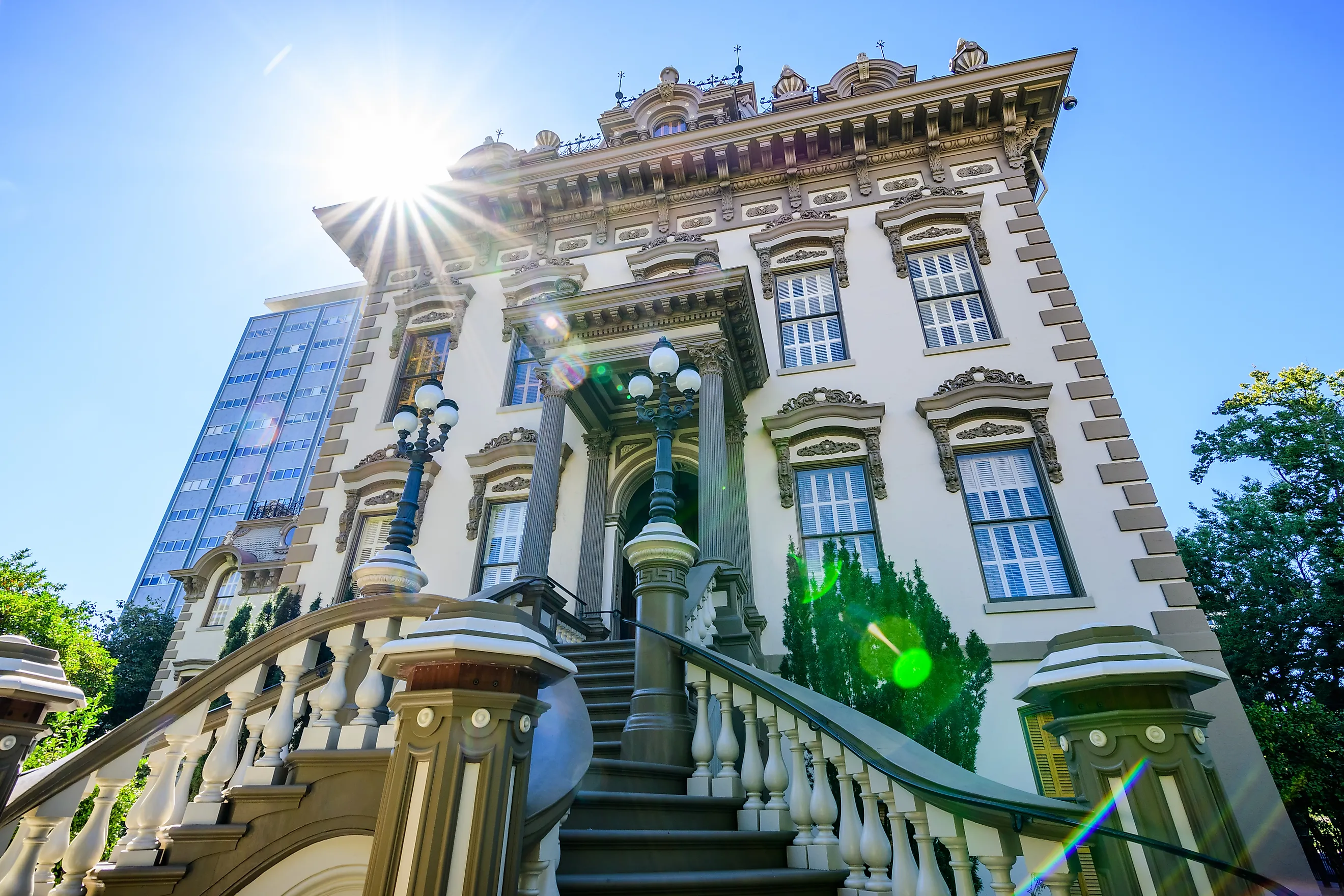
Leland Stanford Mansion State Historic Park, California

The story of Leland Stanford Mansion State Historic Park began in 1856 with a modest Sacramento residence that would later become the elaborate Victorian home of railroad tycoon and California Governor Leland Stanford. Governor Leland Stanford and his wife, Jane, expanded it into a 19,000-square-foot showpiece with intricate woodwork, soaring ceilings, and elaborate interiors.
The mansion was more than a family home. It served as the governor's office for Stanford and two of his successors before the State Capitol was completed in 1874, placing it at the center of California's political dynasty. It was donated to the Catholic Church in 1900 and served as a children's home for 8 decades. The state then acquired it in 1978 and later restored it. Visitors can now step inside its preserved rooms, walk the gardens, and encounter a place where the state's personal and political stories still meet.
Caumsett State Historic Park Preserve, New York

Caumsett State Historic Park Preserve was the 1,750-acre private estate of businessman Marshall Field III, the department store tycoon and founder of the Chicago Sun-Times. Starting in 1921, Field transformed the property into a self-sufficient country estate with a grand manor, polo barns, livestock operations, and its own power and water systems. Designed by architect John Russell Pope and the famous Olmsted Brothers firm, the estate reflected the elegance of Long Island's Gold Coast era.
After his death, the future of the estate shifted from a private retreat to a public treasure. New York State acquired the property in 1961, maintaining both its classic structures and vast landscapes. Today, the former country estate offers a look into its past while providing space for outdoor exploration. Visitors can wander wooded paths, bike along the coastal routes, ride horseback through the grounds, or fish along the shoreline. What was once a secluded private world is now a place where history and nature coexist.
Planting Fields Arboretum State Historic Park, New York

Insurance executive William Robertson Coe and his wife, Mai Rogers Coe, purchased Planting Fields Arboretum, a 409-acre country estate, in 1913. The massive property included formal gardens, greenhouses, and the impressive 65-room Tudor Revival Coe Hall, built after the original mansion was lost to a fire. Renowned landscape architects, including the Olmsted Brothers, helped shape the grounds into one of Long Island's finest private oases.
To ensure the property would be protected, William Coe established a foundation in 1952 before eventually donating the home to New York State. Today, visitors can tour Coe Hall, exploring walking paths lined with rare trees and plants, attend seasonal events and educational programs, or photograph the incredible architecture that reflects Long Island's Gilded Age history.
Harkness Memorial State Park, Connecticut

Situated on the Connecticut shoreline, Harkness Memorial State Park began as the private summer home of philanthropists Edward and Mary Harkness, heirs to the Standard Oil fortune. The estate, known as Eolia, was a 42-room Roman Renaissance Revival mansion with orchards, a working farm, and gardens created by landscape architect Beatrix Jones Farrand. Rather than serving only as a peaceful escape by the sea, the property also supplied fresh food for the Harkness family.
Following Mary Harkness's death in 1950, the estate was donated to Connecticut and opened as a state park two years later. Today, visitors can tour the home and attend seasonal events such as the mid-summer garden party and the annual kite-flying day.
Spring Mountain Ranch State Park, Nevada

What is now Spring Mountain Ranch State Park began as a frontier cattle operation before evolving into a secluded retreat favored by several notable owners. Established in 1876 as Sandstone Ranch, the property supplied beef to nearby mining communities before later becoming home to radio personality Chester "Chet" Lauck, actress Vera Krupp, and billionaire Howard Hughes.
In the early 1970s, the property was threatened by plans for a large residential development, but strong public opposition and a county zoning denial led Nevada to purchase the 528-acre estate and protect it as a public park. Today, visitors can tour the historic buildings, hike trails leading into Red Rock Canyon, picnic under cottonwood trees, or enjoy the summer outdoor theater performances.
Once Private, Now Shared
There is a private history that unfolds at Will Rogers's cowboy ranch tucked into the Santa Monica Mountains, or the oceanfront beauty of Harkness Memorial on the Connecticut coastline.
These estates were never meant to become ordinary public spaces, yet they were given a second life. Once reserved for the ambitious and elite, you can now imagine what it was like to be a governor or a famous philanthropist for a day.