What Lives In The Canopy You Never See From The Ground
Some of the world's tallest trees rise more than 370 feet into the sky, creating an ecosystem above the forest floor that most visitors never notice. High among those branches, birds hunt, flying squirrels glide, and salamanders spend their entire lives without touching the ground. Even the limbs themselves can support miniature gardens of mosses and ferns. Many of these hidden ecosystems exist within America's national forests. Managed by the USDA Forest Service, these forests balance recreation with wildlife habitat, timber harvesting, grazing, and other uses across millions of acres.
California's Giant Trees Shelter Hidden Communities

Some of the country's richest canopy ecosystems exist among California's towering trees, although two famous species are often mistaken for one another. Coast redwoods, found along northern California and southern Oregon, are the tallest trees on Earth, with some rising more than 370 feet. Giant sequoias grow farther inland in the Sierra Nevada and hold a different record as the world's largest trees by volume.
Over centuries, fallen leaves and decaying wood collect on massive limbs, forming pockets of soil where ferns, mosses, lichens, and even small shrubs can grow. These suspended gardens trap moisture and shelter insects that, in turn, attract birds and small mammals. One of the canopy's most remarkable residents is the wandering salamander. Unlike most salamanders, which depend on streams or damp ground, this species spends nearly its entire life among moss-covered redwood branches, where it hunts insects and rarely descends to the forest floor.

The canopy also provides nesting sites for marbled murrelets, an unusual seabird that feeds in the Pacific Ocean but flies inland to lay a single egg on the broad limbs of ancient trees. Northern spotted owls hunt beneath these massive canopies, relying on mature forests with multiple layers of limbs that support a healthy population of rodents and other prey.
Tongass National Forest Is a Rainforest in the Sky

Stretching across approximately 16.7 million acres in southeast Alaska, Tongass National Forest is the largest national forest in the US and the largest intact coastal temperate rainforest on Earth. Its landscape of glaciers, mountains, fjords, and dense forests creates one of North America's most complex canopy ecosystems.
Lofty Sitka spruce and western hemlock form dense layers that capture heavy coastal rainfall, creating cool, damp conditions where mosses and lichens flourish. Those thick blankets of vegetation provide food and shelter for countless insects, which become meals for songbirds moving through the upper canopy.

Bald eagles frequently build enormous nests high above the forest floor, returning to the same trees year after year and adding new material until some nests weigh hundreds of pounds. Red squirrels dart between branches collecting spruce cones, while northern flying squirrels emerge after dark to glide through the forest in search of fungi and berries.
Although visitors often focus on Tongass's waterfalls or glaciers, much of the forest's wildlife remains overhead. The canopy serves as a network of feeding grounds, nesting sites, and travel routes overlooked by hikers below.
Some Animals Spend Most of Their Lives Above The Ground

Northern flying squirrels use a membrane stretched between their legs to glide remarkable distances between trees, steering with their tails before landing on another trunk. Spending so much time in the canopy helps them avoid predators while searching for fungi, seeds, buds, and nuts hidden among the limbs.
Another surprising canopy specialist is the red tree vole of the Pacific Northwest. These tiny rodents build nests high in Douglas firs and feed almost exclusively on conifer needles. Some individuals may spend nearly their entire lives in a single tree, making them one of North America's most specialized forest mammals.

Pacific martens are equally comfortable high above the forest floor. These agile predators race through interconnected branches in pursuit of squirrels and birds, using the canopy almost like a network of elevated highways. Mature forests with large trees provide the connected habitat they need to hunt and avoid larger predators.
High in the branches, shelter is just as important as food. Cavities in mature trees provide secure shelter where raccoons, squirrels, bats, and many birds raise their young beyond the reach of many predators.
Birds Rule The Canopy

Birds occupy different levels of the canopy. Woodpeckers cling to trunks and large limbs while searching beneath bark for insects. Their excavated cavities later become nesting sites for bluebirds and owls, along with other wildlife that cannot carve their own homes. Colorful songbirds, including Townsend's warblers and scarlet tanagers, weave through leafy branches searching for caterpillars and spiders. Dense foliage offers both food and protection, allowing many species to raise their young in relative safety.

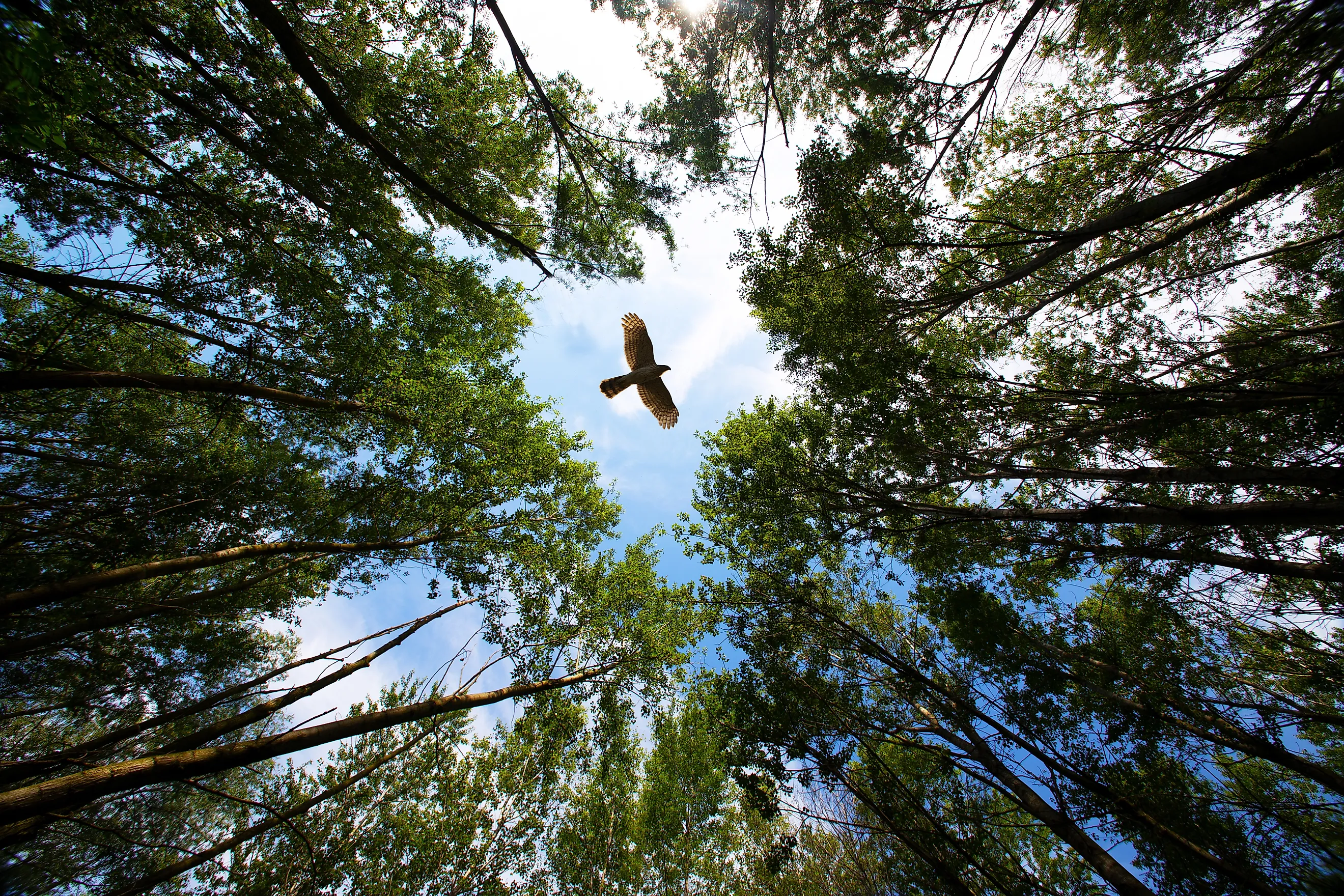
Birds of prey use the canopy differently. Bald eagles and hawks select the tallest trees for nesting and hunting, gaining unobstructed views across rivers and forests. Owls often remain beneath the upper canopy during daylight hours before emerging at dusk to hunt rodents moving through the lower canopy or along the forest floor. Because different birds occupy distinct levels of the forest, scientists often describe the canopy as a vertical neighborhood where multiple species share the same woodland without competing for exactly the same resources.
Tiny Creatures Keep the Canopy Alive

Caterpillars feed on leaves throughout the growing season, converting plant material into food for birds, mammals, reptiles, and amphibians. Beetles tunnel beneath bark, helping break down dead wood while creating food for woodpeckers and other insect-eating birds. Spiders quietly regulate insect populations by building webs between limbs, while native bees and other pollinators visit flowering trees and shrubs growing high above the ground. Even ants contribute by recycling organic matter and dispersing seeds throughout the forest.

Scientists have discovered that much of a forest's biodiversity exists in the canopy itself. In some forests, researchers have identified entirely new insect species simply by studying branches that have never before been examined closely. What appears from below to be a quiet collection of leaves is actually one of the busiest environments in the entire ecosystem.
Fire Helps Build Tomorrow's Canopy

Some of today's oldest canopies exist because earlier fires made room for them. Giant sequoias provide one of the best examples. Their thick bark protects mature trees from many low-intensity fires, while heat helps open cones and release seeds. Fire also clears dense undergrowth, allowing sunlight to reach the forest floor where young seedlings can take root.

Burned trees continue supporting wildlife long after the flames disappear. Standing dead trees, known as snags, quickly become nesting sites for woodpeckers, which later create homes for owls, bats, squirrels, and other cavity nesters. Insects move into scorched wood, attracting even more birds and helping forests begin the next stage of recovery. Today, many national forests use prescribed fire to reduce hazardous fuel buildup while restoring natural ecological processes. Rather than destroying forests, carefully managed fire often helps create the diverse habitats that canopy wildlife depends upon.
Looking Up Reveals A Hidden Forest
Most hikers spend their time watching the trail ahead, but some of the forest's most fascinating wildlife lives overhead. High in the canopy, salamanders hunt among moss-covered limbs, birds raise their young, and countless insects keep the entire ecosystem functioning. National forests protect millions of acres where wildlife, recreation, and sustainable management exist side by side. Be it the lofty redwoods of California or the rain-soaked spruce forests of Alaska, the canopy remains one of the least visible yet most vibrant parts of the American landscape.