Where People Are Moving To In Croatia In 2026
Croatia's population growth is increasingly concentrated in a handful of regional corridors rather than evenly distributed across the country. While many municipalities continue to lose residents through natural decline, official estimates from the Croatian Bureau of Statistics show that several communities around Zagreb and along parts of the Adriatic coast added population between 2023 and 2024 through sustained migration.
The strongest gains occurred in municipalities that combine good transportation links with expanding housing markets, growing business districts, or established tourism economies. County-level migration data released for 2025 reinforce the same trend, with Zagreb County recording Croatia's largest positive balance of internal migration, followed by several Adriatic counties. Many new residents are concentrating in a relatively small number of municipalities that offer convenient access to employment, modern infrastructure, and expanding residential neighborhoods.
Velika Gorica

Population estimates for Velika Gorica increased from 62,634 residents at the end of 2023 to 63,841 one year later, the largest nominal population gain recorded by any Croatian city that year. Much of that increase came through migration. Official statistics recorded strong gains from both domestic and international migration, producing an estimated population increase of more than 1,200 residents during 2024.
The city's location immediately south of Zagreb explains much of its appeal. Residents can reach the Croatian capital in less than half an hour by road, while Franjo Tuđman Airport sits within the municipal limits, making Velika Gorica one of the country's most accessible employment centers outside Zagreb itself. New residential construction has expanded steadily around neighborhoods such as Rakarje and Kurilovec, reflecting demand from commuters seeking larger homes without leaving the capital region entirely. Commercial growth has followed, with retail centers, logistics companies, and business parks continuing to expand along the main transportation corridor. Although many newcomers work in Zagreb, Velika Gorica has increasingly developed its own economic identity, supported by employment in aviation, logistics, and the service sector.
Dugo Selo

Dugo Selo recorded one of Croatia's strongest annual population increases between 2023 and 2024. Official estimates show that the municipality grew from 18,627 to 19,163 residents, an increase of nearly 3% in a single year. Unlike many Croatian municipalities, Dugo Selo also recorded a small positive natural increase alongside substantial domestic and international migration, giving it one of the country's healthiest demographic profiles.
Located about 13 miles (21 km) east of Zagreb, Dugo Selo has become an increasingly attractive destination for commuters seeking easier access to the capital without paying Zagreb's housing prices. Frequent rail service connects the municipality with Zagreb's main railway station, while the nearby A3 motorway provides quick access by car. Residential development has accelerated during the past several years, particularly around the railway corridor, where new apartment buildings and family housing have expanded the urban footprint. Outside the town center, the vineyards of Martin Breg remain a popular recreational destination, giving residents convenient access to wine trails and countryside views only minutes from their homes. The combination of transportation, housing availability, and quality of life has helped sustain Dugo Selo's rapid growth.
Sveta Nedelja

Few municipalities illustrate Zagreb's suburban expansion more clearly than Sveta Nedelja. Population estimates increased from 19,318 residents at the end of 2023 to 19,779 by the close of 2024, representing one of Croatia's fastest percentage growth rates among medium-sized municipalities. Migration accounted for almost all of that increase, with the municipality continuing to attract residents from elsewhere in Croatia and abroad.
Situated immediately west of Zagreb, Sveta Nedelja benefits from direct access to the A3 motorway and one of Croatia's strongest concentrations of technology and advanced manufacturing companies. The municipality is perhaps best known internationally as the home of Rimac Technology, whose research and production facilities at Kerestinec have transformed the local economy and attracted highly skilled workers to the area. New residential neighborhoods have developed alongside business expansion, allowing many employees to live close to their workplaces while remaining within easy reach of central Zagreb. Despite the economic growth, Sveta Nedelja still preserves a quieter suburban atmosphere than the capital, with Lake Orešje and surrounding cycling routes providing popular outdoor recreation for longtime residents and newcomers alike.
Zaprešić

Zaprešić continued its steady population growth in 2024, increasing from 24,254 residents at the end of 2023 to 24,572 one year later. Although its annual increase was smaller than that recorded by some neighboring municipalities, official migration data show that the city maintained a positive migration balance driven primarily by domestic movement into western Zagreb County.
Located about 11 miles (17 km) northwest of central Zagreb, Zaprešić has long functioned as one of the capital's principal commuter communities, but it has gradually developed into an employment center in its own right. Excellent access to the A2 and A3 motorways, together with regular rail service to Zagreb, allows residents to commute in either direction while businesses benefit from efficient freight connections across northwestern Croatia. Residential construction has expanded on the city's outskirts in recent years, accompanied by new retail and commercial development around the western entrance to the city. Even with that growth, Zaprešić retains an identity distinct from Zagreb. The historic Novi Dvori Jelačićevi estate, once owned by Ban Josip Jelačić, remains one of the city's best-known landmarks and anchors an extensive park that continues to serve as an important public gathering space.
Kaštela

Official population estimates indicate that Kaštela grew from 38,899 residents at the end of 2023 to 39,618 by the close of 2024, adding more than 700 residents in a single year. Migration accounted for the overwhelming share of that increase, continuing a pattern that has made Kaštela one of the fastest-growing municipalities along Croatia's central Adriatic coast.
Rather than functioning as a single historic town, Kaštela consists of seven interconnected coastal settlements stretching for nearly 11 miles (17 km) between Split and Trogir. That geography has made it particularly attractive to residents seeking more housing options while remaining within commuting distance of Split's employment market. The city also benefits from immediate access to Split Airport, the Adriatic Highway, and Marina Kaštela. Those connections support work in transportation, tourism, and marine industries. New apartment construction and residential neighborhoods have expanded throughout the municipality, particularly near Kaštel Stari and Kaštel Novi. Despite its rapid growth, Kaštela continues to preserve landmarks such as Vitturi Castle in Kaštel Lukšić, whose Renaissance architecture reflects the defensive settlements that gave the municipality its name and still shape its waterfront character today.
Solin

Solin added another 428 residents between the end of 2023 and 2024, bringing the official estimate from 25,590 to 26,018. Unlike many Croatian municipalities experiencing natural population decline, Solin also recorded a positive natural increase alongside continued gains in migration, reinforcing its position as one of the country's healthiest demographic performers.
Immediately northeast of Split, Solin occupies a strategic location where major transportation routes, employment centers, and residential districts converge. Many newcomers work in nearby Split while choosing Solin for its expanding housing market and slightly lower residential costs. The municipality has also developed a strong local economy supported by manufacturing, commerce, and public services, reducing its dependence on commuting alone. New housing developments have continued to spread across neighborhoods on the city's northern side as demand has increased. Solin's identity, however, extends well beyond suburban growth. The extensive archaeological remains of Salona, the ancient capital of the Roman province of Dalmatia, occupy the western edge of the city and provide one of Croatia's most significant archaeological landscapes. The nearby Jadro River, whose spring supplies drinking water to much of the surrounding region, further reinforces Solin's importance as both a historical and modern population center.
Vodice

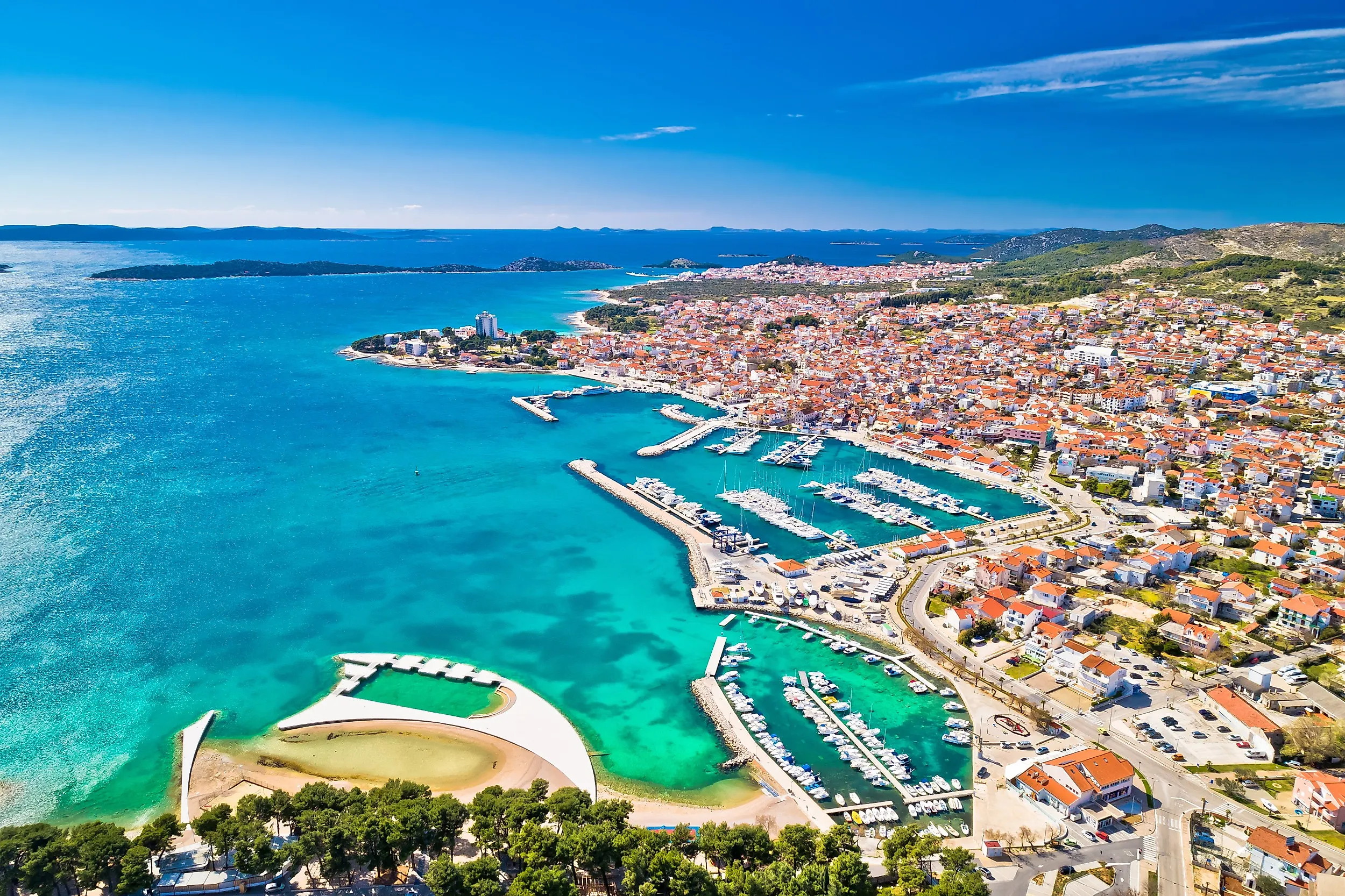
No municipality in this article recorded a faster percentage increase than Vodice. Official population estimates rose from 9,179 residents at the end of 2023 to 9,559 in 2024, an increase of 380 residents, or 4.14%, giving the town the highest annual growth rate among the municipalities analyzed. Migration accounted for nearly all of that increase, reflecting a broader pattern of population gains across Croatia's central Adriatic coast.
Unlike many seasonal tourist destinations, Vodice has developed into a year-round community with a diversified local economy. Tourism remains the dominant industry, but construction, hospitality, retail, and small business activity continue well beyond the summer months. The town's location between Šibenik and Biograd na Moru also places residents within easy reach of larger employment centers while allowing them to remain in a smaller coastal community. Residential construction has expanded steadily during the past decade as new apartment buildings and family homes have appeared on the edges of the historic center. Although population growth has transformed parts of the municipality, the waterfront promenade, marina, and regular ferry connections to Prvić Island continue to anchor daily life and preserve the maritime character that has long defined Vodice.
Zadar

Zadar remained one of Croatia's largest population gainers during 2024. Official estimates increased from 72,716 residents at the end of 2023 to 73,749 one year later, adding 1,033 residents. Migration was overwhelmingly responsible for that increase. Although the city recorded a slight negative balance in domestic migration, international migration more than offset those losses and continued to support Zadar's overall population growth.
Several factors help explain why Zadar continues attracting new residents. The city serves as northern Dalmatia's principal administrative, educational, and commercial center, providing a broader employment base than many smaller coastal communities. Recent investment in residential construction has expanded housing across neighborhoods such as Višnjik and Novi Bokanjac, while improvements to road infrastructure and Zadar Airport have strengthened connections with the rest of Croatia and Europe. Tourism also remains an important economic driver, although newcomers increasingly arrive for permanent employment rather than seasonal work alone. At the same time, Zadar retains the historic character that has long distinguished it. The Roman Forum, the medieval peninsula, the Sea Organ, and the Greeting to the Sun installation continue to shape the city's waterfront, illustrating how population growth has occurred alongside the preservation of one of Croatia's best-known urban landscapes.
Where Croatia Is Growing
The latest Croatian Bureau of Statistics data suggest that the country's population growth is becoming increasingly concentrated in a handful of well-defined regional corridors. Municipalities surrounding Zagreb continue attracting residents seeking better housing opportunities while remaining connected to the capital's labor market, whereas communities along the central Adriatic combine domestic migration with substantial international inflows supported by tourism, services, and expanding local economies. At the same time, many municipalities elsewhere in Croatia continue facing natural population decline and weaker migration balances.
For local residents, these trends are likely to shape everyday life during the coming years. Continued growth in municipalities such as Velika Gorica, Dugo Selo, Kaštela, and Vodice will increase demand for housing, transportation infrastructure, schools, and public services. If current migration patterns continue, Croatia's population growth is likely to become even more concentrated around its largest metropolitan regions and the most economically dynamic sections of the Adriatic coast.