10 Most Overlooked Michigan Towns For 2026
Ionia has the largest sandstone building in the county, and hardly anyone outside the courthouse steps knows it. Rogers City is home to the biggest limestone quarry on the planet, yet it rarely lands on a list of weekend destinations. Negaunee stands on the iron range where Michigan mining began, in the shadow of Marquette a few miles east. These ten towns get overlooked for one shared reason: their residents kept working instead of building a tourist trade, and the landmark left from that work in each one is the reason to look again.
Niles, Michigan

Niles sits on the Berrien and Cass county line, where a French mission and trading post operated from 1691 to 1781. Four national flags flew over it in turn, which is where the nickname City of Four Flags came from. No fort survives. A 20th-century landfill buried the site so completely that its exact location was lost, until archaeologists from Western Michigan University relocated it in 1998 at the invitation of a local group called Support the Fort.
What visitors find instead is a seven-ton boulder at Bond and Fort streets, moved there in 1912 from a nearby farm and paid for largely with nickels collected from schoolchildren. The grave of Father Claude Allouez lies just north. On East Main Street, two buildings make up the Niles History Center: the Fort St. Joseph Museum, in a carriage house since 1939, and the 1882 Chapin Mansion, which was city hall from 1933 to 2012. Railroad-depot gardens planted in 1893 grew flowers for dining cars, the source of a second nickname, the Garden City.
South Haven, Michigan

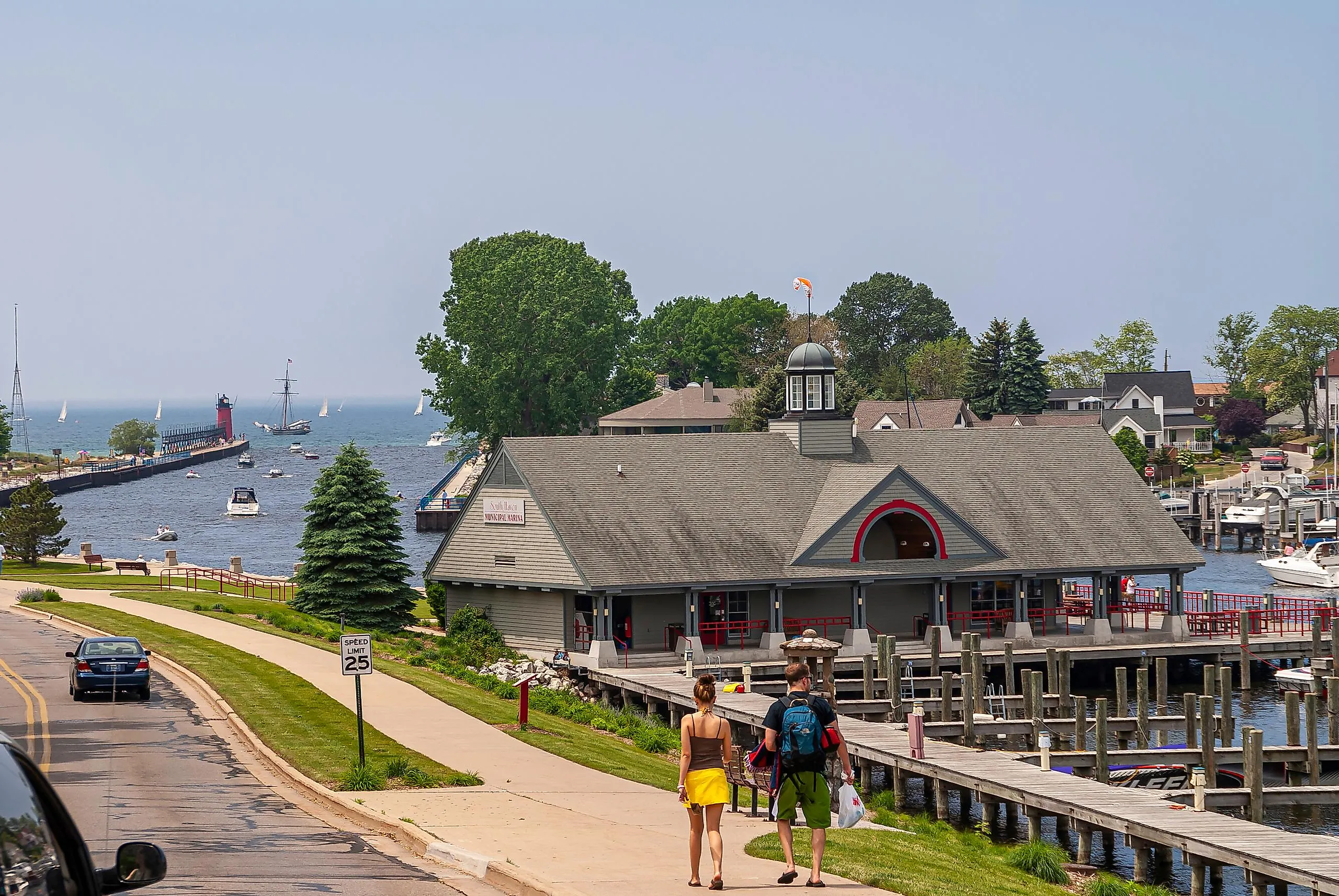
South Haven stands at the mouth of the Black River, where it meets Lake Michigan in Van Buren County. Crews shipped lumber cut upriver by boat to Chicago and Milwaukee, and when the timber ran out, growers planted the cleared land in peaches, apples, and later blueberries, the crop behind the town's Blueberry Capital title. Fruit and passengers moved through the same harbor, and the harbor is where the evidence sits.
A wooden light first marked the south pier in 1872. The red steel tower there now was built in 1903 and moved 425 feet to the end of the pier in 1913, and its original elevated catwalk is one of only four still standing in Michigan. The federal government transferred ownership to the Historical Association of South Haven in 2012. Along the river, the Michigan Maritime Museum holds the boatbuilding collection, including Friends Good Will, a working replica of an early-1800s square-rigged sloop. The 1872 keeper's house on Michigan Avenue, transferred to the city in 2000, is now the museum's Great Lakes research library.
Charlotte, Michigan

Charlotte still has a whole block of 19th-century Eaton County government on its original ground. The 1885 Eaton County Courthouse stands in the middle of the square, its cornerstone laid in 1883 and its doors opened two years later. Fire gutted the interior in 1895. Crews rebuilt it from the surviving blueprints, which had come through the fire inside lead-lined safes.
County business ran here until 1976, when the offices moved to a complex a mile north, and a nonprofit took over the grounds in 1993. Two older structures stand on the same square: the 1845 courthouse, a modest frame building that predated it, and the 1873 Sheriff's Residence. Inside the 1885 courthouse, the 9-foot Lady of Justice tops out 118 feet above the lawn.
Grand Ledge, Michigan

Sandstone ledges rise from both banks of the Grand River at the other end of Eaton County, and they are the source of the town's name. Excursion trains once brought crowds to see them. A state historical marker records the Seven Islands Resort running from 1870 to 1910, when visitors came for steamboat rides, mineral wells, a vaudeville theater, and a roller coaster. For a time this was one of the busiest resort areas in lower Michigan.
The trade ended once automobiles let travelers go farther. One building from those resort years stands on South Bridge Street. The Grand Ledge Opera House opened in 1884 as a roller rink for resort visitors, then became an opera house in 1886. A furniture business filled it from 1928 onward, until the Mapes family donated it to the historical society in 1984. Fitzgerald Park is 78 acres of the ledges, with three miles of trails. Climbers use the rock at Oak Park instead, because county rules reserve the Fitzgerald ledges for viewing.
Ionia, Michigan

Ionia's courthouse was built from the ground underneath it. The Ionia County Courthouse is the largest structure ever built of Ionia sandstone. Quarrymen cut the stone locally at the W. K. Woodward Quarry, and W. E. Avery of Detroit laid it in the walls. County offices moved in during January 1886, and the building was dedicated that July, at a cost of $42,380 paid by a special tax levy. Fourteen marble fireplaces survive inside, along with a walnut and butternut staircase.
A few blocks away, the Ionia Theatre has a briefer story. Builders finished it in 1931 for vaudeville, modeled on New York's Roxy, with an orchestra pit and eight dressing rooms, and rigging that could fly more than 16 sets from the stage. Vaudeville had ended by opening night. A screen went up on one of the flies, and the original arc projector is still on display in the lobby. Bertha Brock Park, nearly 200 acres of rolling ground, has a trout stream running through it.
Marine City, Michigan

Marine City is named for its trade, and the trade came first. Shipyard crews in St. Clair County built wooden vessels for the Great Lakes. At the height of the work, when the place was still called Newport, this ranked among the largest shipbuilding towns on fresh water. Sugar, salt, logging, and barrel making were the other trades around the yards.
Captains who sailed the finished boats built their houses nearby, and the Victorian frontages remain. Freighters still pass close enough to watch from the waterfront parks, where eight mosaics based on drawings of 1800s ships stand facing the water. The Mariner Theater dates to 1927, when it opened for vaudeville, and its builders left their signature in the tile work around the two front windows. Live performance returned in July 2013 with the 98-seat Snug Theatre. After sold-out runs, the same owners put the Riverbank Theatre into a former bank.
Rogers City, Michigan

The economy of Rogers City depends on a hole in the ground so large that astronauts have photographed it from orbit. Geographers at Michigan State University call the Calcite Quarry the largest limestone quarry in the world. Its worked area runs roughly 4 miles by 1.5 miles beside Lake Huron, and its operators ship between 7 and 10.5 million tons a year.
Shipping began in 1912, and people have driven out to look almost as long. A federal minerals yearbook counted nearly 50,000 visitors a year at the company lookout by the late 1950s. Two overlooks remain for that purpose: Quarry View, south of town on US-23, and Harbor View, at the end of Calcite Road. In the Presque Isle County seat itself, the Great Lakes Lore Maritime Museum is devoted to the shipping side. Volunteers reinstalled the restored Calcite Light after Carmeuse donated the beacon to the city in 2015.
Cheboygan, Michigan

The Cheboygan Opera House is in the same building as city hall, the police department, and the fire department. The village council approved that arrangement in August 1877, and the same combination is in place today. Fire destroyed the place twice, in 1886 and again in 1903. The town rebuilt both times, and on the second occasion crews followed the earlier drawings specifically to preserve the acoustics. The theater has 582 seats and reopened in 1984 after roughly two decades dark.
Farther up the same Lake Huron shore road, the Cheboygan County seat has a second landmark. The Cheboygan Bascule Bridge carries US-23 across the river on a 70-foot movable span. Crews finished it in 1940, the last bascule bridge built in the state before the end of the Second World War. It replaced a swing bridge in service since 1877, the same year as the opera house. The Coast Guard icebreaker Mackinaw is home-ported here.
Ishpeming, Michigan

Ishpeming has two histories, and iron begins both. Scandinavian immigrants brought skiing to the mining country of Marquette County. A 1957 state marker records the first ski club in Michigan here, formed in 1887, with its opening public meet on February 25, 1888, where the longest jump measured 35 feet.
The Ishpeming Ski Club has run that tournament every year since, past its 135th, off five hills at Suicide Hill Ski Bowl, and 13 of its members have made Olympic teams. The US Ski and Snowboard Hall of Fame moved into its current quarters in 1992, under a roof pitched like a ski jump. The mining half survives at the Cliffs Shaft Mine Museum. In 1919, company president William Mather decided the replacement headframes ought to look like something, given how visible they would be. He hired the architect George Maher, whose pair of Egyptian Revival towers still stands over the skyline.
Negaunee, Michigan

Half of Negaunee was lost to the mines underneath it. Tunnels ran below the streets of this Marquette County town, the ground began to subside, and residents abandoned roughly half the city across the 20th century. The west end, where the town started, is called Old Town now.
The Iron Ore Heritage Trail runs through it, past street signs that still divide neighborhoods no longer there. Basements gape open under moss, and staircases climb toward empty lots. Locals call the abandoned ground the caving grounds. Jackson Mine was where it all started, the first iron mine in the Lake Superior region. The pit began as a mountain of ore 150 feet high, worked by fewer than a dozen men. Cornish miners brought double-jacking, a drilling method for three people: two swinging sledges while a third, often a boy, held the drill steady. At the old Carp River forge site, the Michigan Iron Industry Museum documents the range's history, and admission is free.
Where the Work Is Still Visible
No town named here tops 14,000 residents, and none has a gift-shop district. What they have is evidence: blueprints from a safe at Charlotte, an arc projector in the Ionia lobby, staircases at Negaunee that climb to nothing. Each detail belongs to a town where people kept doing the work and kept the buildings they did it in. Michigan has plenty of towns built to sell a weekend. Charlotte, Ionia, and Negaunee are records of how a town gets built in the first place.