11 Unforgettable Small Towns to Visit in Michigan
Michigan is a prime example of a state where small towns thrive, thanks to their enduring charm. The shoreline alone explains why. More than 3,000 miles of Great Lakes coastlines create places where roads stop, ferries replace bridges, and entire towns orient themselves toward water rather than highways. That is why Petoskey allows fossil hunting on public beaches, Saugatuck still relies on a hand-cranked chain ferry, and Port Austin offers no land route to Turnip Rock at all.
The unforgettable small towns to visit in Michigan on this list are defined by those constraints. Each town grew around something specific, navigation, geology, architecture, or a working craft, and never fully moved past it. A car-free island, a functioning Dutch windmill, a professional magic town, and an alpine-style downtown all exist here not as concepts, but as working systems. These 11 places stand out because they never separated daily life from the things that made them unique.
Mackinac Island

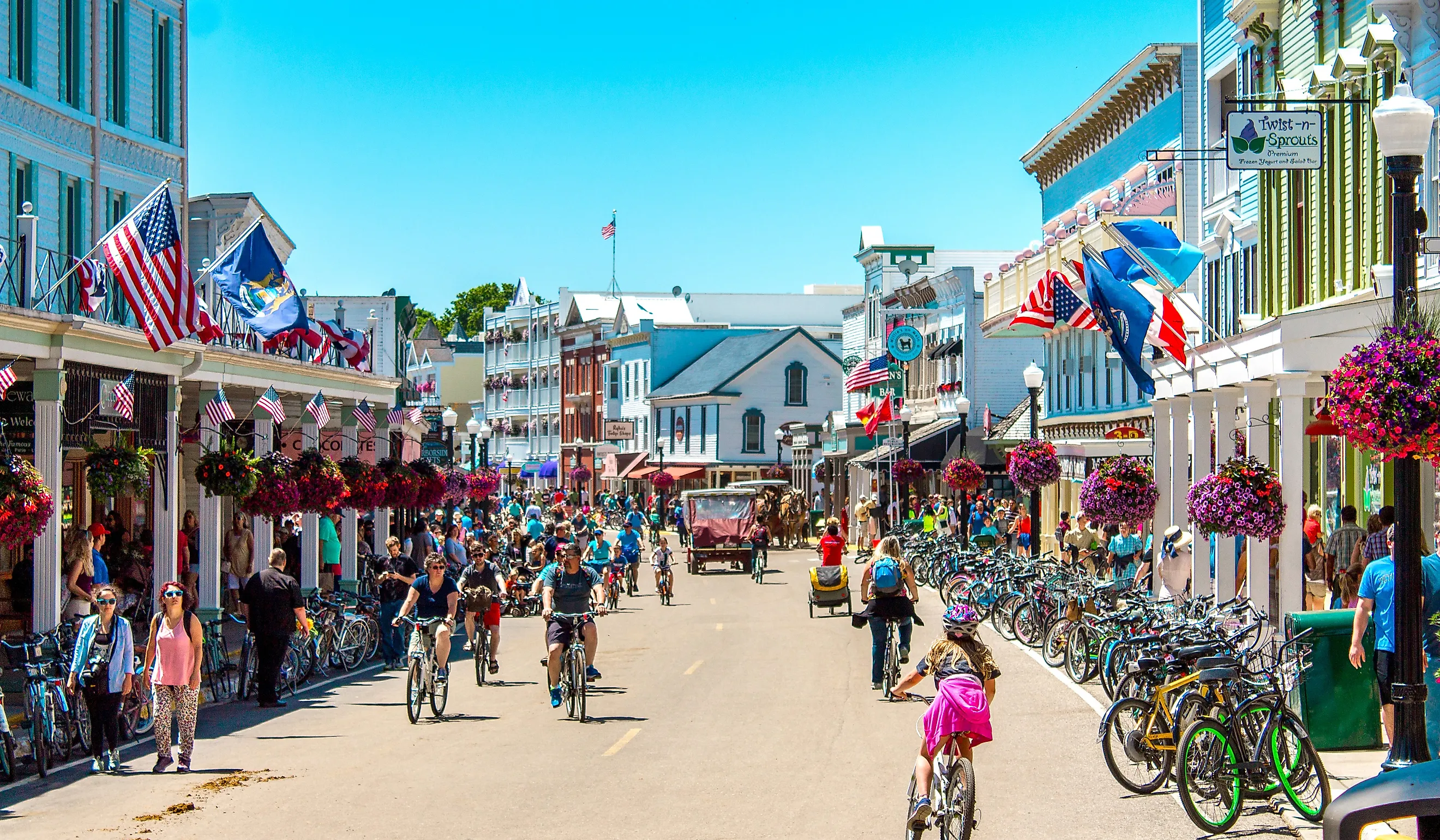
Mackinac Island sits in the Straits of Mackinac, where Lake Huron and Lake Michigan meet. No private cars are allowed. Movement happens on foot, by bicycle, or by horse-drawn carriage. This single rule shapes daily life. The most recognizable landmark is the Grand Hotel, known for the longest porch in the world at 660 feet. The porch faces the straits and is lined with white rocking chairs.

Much of the island is protected as Mackinac Island State Park, which covers over 80 percent of the land. The park has more than 70 miles of trails. These include the eight-mile perimeter road that circles the island along the water. History is concentrated at Fort Mackinac, built in 1780 and still standing on a bluff above town. Visitors can walk through original buildings, see daily demonstrations, and look down over the harbor.
Saugatuck

Saugatuck developed as a river port and never outgrew its footprint. The defining experience is the Saugatuck Chain Ferry, the last hand-cranked chain ferry still operating in the United States, from May to September. It pulls itself across the Kalamazoo River using a submerged chain and human power.

The Saugatuck Center for the Arts anchors the cultural side of town. It hosts rotating exhibitions, small concerts, and community events throughout the year. The space focuses on regional artists and working creators, which makes the work truly stand out. Above the town sits Mount Baldhead Park, accessed by a staircase of more than 280 steps. The climb is short but steep. At the top, the view looks over the river, the harbor, and the clustered rooftops below. The park includes wooded walking paths that loop back toward town, making it easy to pair movement with rest.
Frankenmuth

Frankenmuth was settled by German Lutheran immigrants in the mid-1800s, and the town buildings still follow a deliberate Bavarian style. The wonder is Bronner’s CHRISTmas Wonderland, a 320,000-square-foot store that operates year-round. It is officially the largest Christmas store in the world. Inside, themed rooms represent dozens of countries, ornament styles, and traditions. A dedicated ornament personalization station lets visitors add names and dates on the spot. Outside, the grounds include a Silent Night Memorial Chapel and decorated walkways. There is nothing else like this in the United States at this scale or permanence.

Food culture defines Frankenmuth as much as retail. Zehnder’s of Frankenmuth and the Bavarian Inn Restaurant are both family-run institutions in demand for traditional chicken dinners served in fixed courses. Meanwhile, River Place Shops sits along the water with small specialty stores and benches facing the river.
Charlevoix

Charlevoix curves around Round Lake, with Lake Michigan just beyond the channel. The most unusual feature is the group of homes designed by architect Earl Young. Known locally as the Mushroom Houses, these stone cottages were built from the 1920s through the 1970s using local boulders, curved rooflines, and hand-crafted details. No two structures are the same.

A short walk leads to Michigan Beach Park, where a wide shoreline and breakwall provide open lake views without long hikes or elevation changes. History is at its height at the Charlevoix Historical Society’s Harsha House Museum. Contents focus on local industries, boating history, and the town’s architectural development, including Earl Young’s work.
St. Ignace

St. Ignace faces Lake Huron at the northern end of the Mackinac Bridge and operates as a working waterfront town rather than a resort façade. Its most unusual natural aspect is St. Anthony’s Rock, a limestone sea stack rising near the shoreline just east of town. Formed by wave action from ancient glacial lakes, it is one of the few inland formations of its kind in the country. The shoreline is best experienced along the Huron Boardwalk, a paved walking path that runs parallel to the water near downtown.

Local history finds its way at the Museum of Ojibwa Culture. You can read more on Anishinaabe life, seasonal movement, and treaty history specific to the Straits region. Additionally, Straits State Park is within city limits. Short trails and pull-off viewpoints make it accessible without committing to long hikes.
Holland

You can experience Dutch culture with the De Zwaan Windmill in Holland. Built in 1761 and relocated from the Netherlands in the 1960s, it remains fully operational. Visitors can walk inside and see each level, from the millstones to the wooden gearing. It is the only authentic Dutch windmill in the United States, not a replica. Surrounding the windmill, Windmill Island Gardens includes maintained canals, footbridges, and seasonal flower beds. The design reflects working Dutch landscapes rather than decorative parks.

Closer to downtown, Holland State Park is where Lake Macatawa opens into Lake Michigan. The beach is wide and maintained for daily use rather than events. A concrete pier extends more than half a mile into the lake, guiding foot traffic past breaking waves and channel traffic toward the Big Red Lighthouse at the pier’s end.
Negaunee

Negaunee is located about 15 miles west of Marquette in Marquette County and was incorporated in 1873 after large-scale iron ore deposits were developed in the area. The town’s most singular attraction is the Upper Peninsula Luge Track. It is the only natural-track luge course in the States. Unlike artificial refrigerated tracks, this one follows the natural slope of the land and operates seasonally when conditions allow.
If mining is your groove, then head to the Michigan Iron Industry Museum. It gives context on iron extraction, labor systems, and how ore from this region shaped industrial growth in the Midwest. Meanwhile, Teal Lake defines the town’s western edge. The lake includes accessible shoreline points and short paths used for fishing and evening walks.
Midland

Midland plays it differently, featuring the longest canopy walk in the United States. Dow Gardens’ Canopy Walk is an elevated walkway that extends approximately 1,400 feet. The structure rises gradually to nearly 40 feet above ground, allowing visitors to move through the upper forest layer rather than alongside it. Dow Gardens also includes more than three miles of maintained walking paths, formal gardens, and wetland areas. The Whiting Forest section focuses on native plant systems rather than ornamental displays, which makes the experience educational without being instructional.

Architectural history adds another layer through the Alden B. Dow Home and Studio, a National Historic Landmark. Designed by Alden B. Dow, a student of Frank Lloyd Wright, the structure features cantilevered roofs, curved forms, and custom materials developed on-site. Simultaneously, the Pere Marquette Rail-Trail passes directly through the city, connecting neighborhoods to the riverfront and commercial core. The trail supports daily walking and cycling rather than long-distance tourism.
Petoskey

Petoskey’s most distinctive activity happens at ground level. Along the Lake Michigan shoreline, visitors are legally allowed to search for Petoskey stones, fossilized coral formed over 350 million years ago, on designated public beaches. These hexagon-patterned stones are Michigan’s state fossil, and few places in the United States allow casual fossil hunting in an urban setting. The best-known access points are Petoskey State Park Beach and Bayfront Park, where wave action continuously exposes new stones after storms and seasonal ice movement.

Bear River Valley Recreation Area is where a former industrial corridor was converted into a managed river channel. The area includes controlled whitewater features designed for kayaking and canoeing, making it one of the few small towns in the United States with an in-town whitewater system. On the other hand, the Little Traverse Historical Museum focuses less on tourism nostalgia and more on regional systems. Original artifacts, maps, and rail equipment explain why Petoskey became both a transportation and collecting center.
Port Austin

Port Austin is at the tip of Michigan’s Thumb, where Lake Huron opens into wide, exposed water. Visitors will have the time of their lives at Turnip Rock, a wave-carved limestone stack located just offshore along the Lake Huron shoreline. Its narrow base and wider top were formed by years of erosion, creating a silhouette that is geologically uncommon in the Great Lakes. The rock is accessible only by kayak or private boat.

Closer to town, Port Austin Reef Light stands at the harbour entrance. The lighthouse marks a dangerous reef system and remains an active navigational aid. It is visible from shore and reinforces the town’s functional relationship with the lake rather than a symbolic one. Public shoreline access continues at Bird Creek Park, where shallow water, rocky edges, and short walking paths provide a grounded alternative to open-lake paddling.
Gaylord

Gaylord’s defining feature was thoughtfully and deliberately built. In the 1960s, the city undertook a coordinated redesign to transform its downtown into an Alpine-style district, making it the largest intentional architectural rebranding of its kind in the United States. Gaylord City Elk Park is beautiful. It includes a fenced elk enclosure, viewing platforms, and educational signage that explains elk restoration in northern Michigan.
Cultural context is at the center of the Gaylord Area Council for the Arts, which operates rotating exhibitions, workshops, and performances in the heart of town. Meanwhile, the North Central State Trail passes through Gaylord, following a former rail corridor and connecting the city to surrounding forests and smaller towns. The trail supports walking, biking, and snowmobiling, keeping movement integrated rather than seasonal.
What makes these towns linger is how directly they involve the visitor. In Petoskey, the shoreline becomes an activity rather than a view. On Mackinac Island, distance is measured in footsteps and ferry schedules, not traffic lights. As a group, these unforgettable small towns to visit in Michigan show a side of the United States where travel still requires participation. You walk more. You discover unexpected history. You notice details. And when you leave, it is not only a landmark you remember, but the way each town asks you to slow down.