7 Italy Towns Where Time Stands Still
Italy reads like a layered manuscript, its history written first by the Etruscans, then by the Romans, later by the rise of Florence, and eventually by the Roman Baroque movement. You can still read those layers in the towns built into the hills and cliffs of the peninsula. In Orvieto, a cliffside stronghold rests on Etruscan foundations carved straight into the rock. In San Gimignano, stone towers that once measured one family's wealth against another's still break the skyline. The towns that follow, scattered across Tuscany, Umbria, Puglia, and Campania, hold onto their past while making room for the present.
San Gimignano, Tuscany

Fourteen stone towers still stand over San Gimignano, the survivors of 72 that rival noble families once raised as status symbols, earning the town its nickname, the "Manhattan of the Middle Ages." The settlement began as an Etruscan village and grew wealthy during the Middle Ages on its position along the Via Francigena, the trade and pilgrimage route that ran between Canterbury and Rome. The tallest survivor is the Torre Grossa, reached from the top floor of the Palazzo Comunale, with views over the surrounding hills from 54 meters up. Inside the Collegiate Church of Santa Maria, fresco cycles cover the walls with scenes from the Bible. A few steps away, the two adjacent spaces of Galleria Continua rotate contemporary art and sculpture through regularly changing exhibitions. San Gimignano 1300 takes the opposite approach to history, recreating the town in a miniature clay model of how it looked in the 14th century.
Pitigliano, Tuscany

By the 16th century, Pitigliano had become a refuge for Jewish families fleeing persecution, which earned this southern Tuscan town its nickname, "Little Jerusalem." Its roots run far deeper, back through Etruscan settlement to prehistoric times, and the town clings to a volcanic tuff cliff. What remains of the Jewish quarter is still cut into the tuff: a ritual bath, a matzah oven, and a synagogue that has been carefully restored and now draws visitors. The Etruscans worked the same soft stone long before, carving the Vie Cave, sunken roads that run between cliff walls more than 20 meters deep. The walls still carry inscriptions left by Etruscans and Romans across two and a half millennia, and the roads still lead on foot to the neighboring towns.
The town's 16th-century aqueduct carried water from the surrounding rivers and remains one of Pitigliano's defining structures, its arches framing views of the water below. The path from the aqueduct leads to the Orsini Palace, begun by the Aldobrandeschi family between the 11th and 12th centuries and finished by Romano Orsini, who completed the rest of the fortress complex. Its museum now fills 21 rooms with frescoes, paintings, chalices, crosses, and the castle's original oil mill. Closer to the old Jewish Ghetto, a handful of small shops remain, among them a bakery selling unleavened bread.
Orvieto, Umbria

Orvieto was the last Etruscan stronghold to fall to Rome, holding out from its tuff cliff until a long siege ended in its capture in 264 BC. The same defenses that made the conquest so difficult later sheltered medieval popes who fled the political turmoil of Rome. The old town still sits atop the cliffs while modern Orvieto spreads out below, connected by a bus or a funicular. Walking up is possible too, though the paths climb steeply.
The Albornoz Fortress has guarded the town since the 14th century, and its massive stone walls remain open to the public, visible from both the cliff top and the valley floor. Nearby stands the Pozzo di San Patrizio, the well built on the order of Pope Clement VII, where two spiral staircases descend into the shaft under guiding lights. Above ground, the old streets lead to the Orvieto Duomo, whose chapels and frescoes anchor the historic center, and on to the Piazza del Duomo and the Torre di Maurizio, a clock tower that has struck the hour for centuries.
Assisi, Umbria

Two famous sons define Assisi. The Latin poet Propertius was born here around 50 to 45 BC, when the town was a thriving Roman settlement, and Saint Francis was born here in 1182, turning Assisi into a center of pilgrimage and an early home of Christian philosophy and proto-Renaissance art. The Basilica of Saint Francis is the town's centerpiece, two churches stacked one atop the other, their walls and arched ceilings carpeted in frescoes. The cycles took shape across the late 13th and early 14th centuries, and the Crucifixion long associated with Giotto helped pull Italian painting toward the human emotion that later artists would build on.
The saint's tomb lies in a crypt beneath the church and is open to visitors. The Piazza del Comune holds two more landmarks, the Temple of Minerva and the Torre del Popolo, the temple being the oldest structure in Assisi at roughly two thousand years old, built in the first century BC. The Torre del Popolo rewards the climb with a wide view over the town and its green hills. For a higher vantage still, a sunrise hot air balloon ride drifts over the rooftops and the surrounding vineyards.
Alberobello, Puglia

The dry-stone trulli of Alberobello were a tax dodge before they were a postcard. Built without mortar in the 14th century, the cone-roofed huts could be pulled down quickly when a royal inspector approached and a settlement risked the Kingdom of Naples' tax on new construction. The trick worked well enough that the trulli became the town's signature, and Alberobello is now a UNESCO World Heritage Site whose state of preservation surprises most first-time visitors. The Casa d'Amore, built in 1797, broke the pattern as the first local structure to use mortar, marking the end of feudal rule. The Sant'Antonio Church is a trullo in disguise, a 1920s building shaped to blend in rather than stand apart. The Rione Monti district packs more than a thousand trulli along its lanes, and the rooftop terraces behind some of the souvenir shops make a fine place to watch the sun go down over the stone cones.
Polignano a Mare, Puglia

Founded as a Greek settlement around the 4th century BC, Polignano a Mare grew into a trading post on the Via Traiana, the Roman coastal highway, and the cliff paths that fishermen and traders once walked still thread the town. Only 30 kilometers from Alberobello, it draws crowds today yet keeps its old character intact. The Centro Storico runs on cobblestone streets, with flowers spilling over balconies and the sea filling the gaps between buildings. The Piazza Vittorio Emanuele II holds the Chiesa Matrice Santa Maria Assunta, whose 22-meter bell tower and clock tower rise above the square. Past it, the Belvedere su Lama Monachile opens onto the bay where the water turns turquoise, and from the Pietra Piatta a grand staircase drops down to the rocks below, a good spot for a picnic at sunset. Boats run along the cliffs and into the sea caves, where the clear water is the main draw.
Positano, Campania

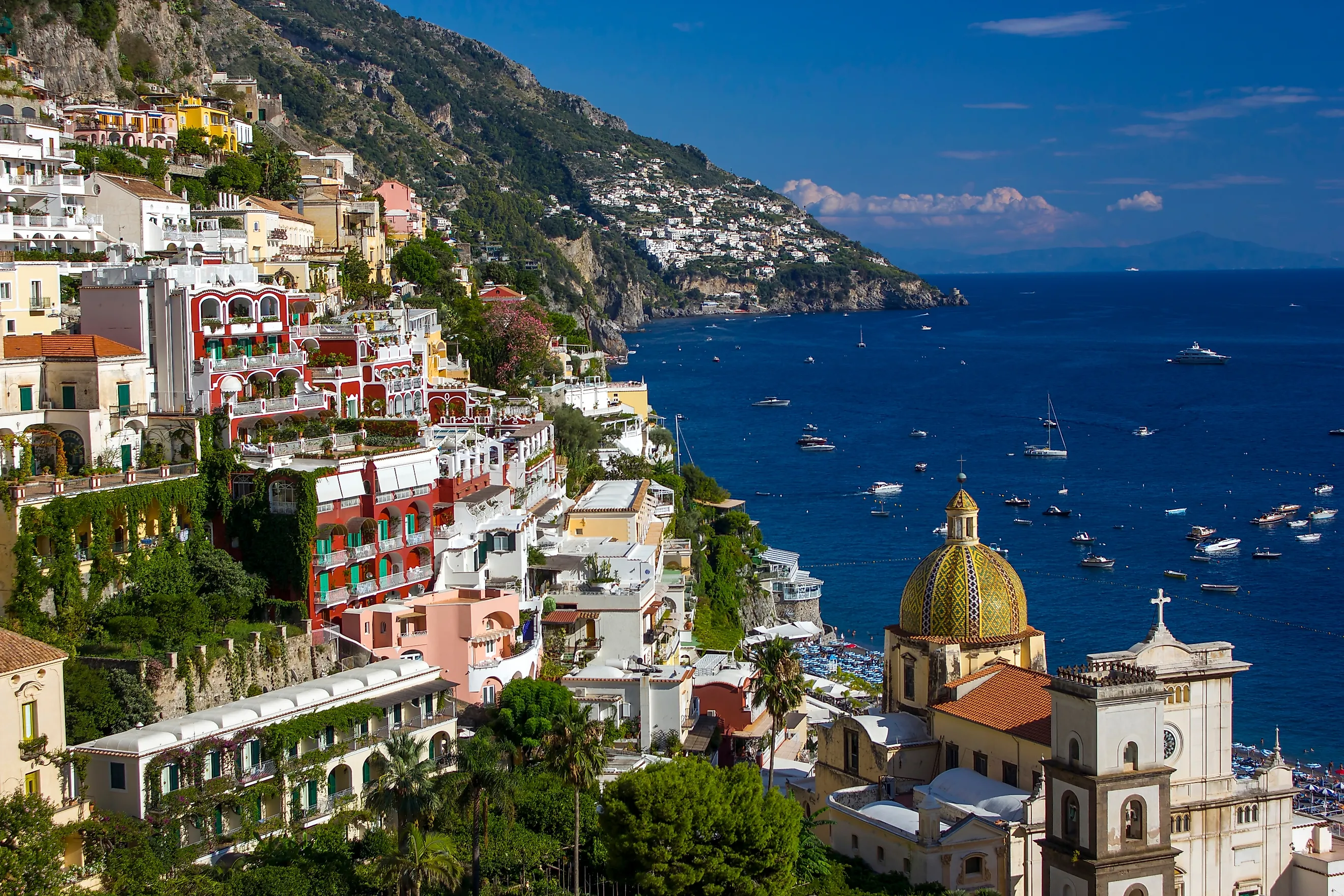
Positano was a trading port for the Amalfi Republic in the Middle Ages, then a quiet fishing village, until the writers and artists who arrived in the 1950s fell for its vertical geography and put it back on the map. In 2026, it remains one of Italy's most sought-after coastal towns, all pastel villas stacked above the sea. The Chiesa di Santa Maria Assunta sits near the top of the climb down to the water and holds a 13th-century Byzantine icon of the Black Madonna and Child, said to have been carried here by Benedictine monks. Below the church, the main beach of Spiaggia Grande comes as a surprise to anyone expecting golden sand, its shore a dark pebbled gray that comes from the area's volcanic geology, though the water is clear and good for swimming. Boat tours work the Amalfi Coast from here, some calling at the Furore Fjord and the Emerald Grotto, while the Path of the Gods runs the cliffs from Bomerano, where hikers share the trail with mountain goats and long views over the Mediterranean Sea.
Leave The Clock Behind In Italy
What links these towns is less their age than their continuity. The cobblestone streets, the cliffside churches, and the views over the sea and the countryside have changed little across centuries, and the daily round of buying and selling, working and resting still plays out in the same piazzas. Standing in one of them, you are doing roughly what an Etruscan trader or a medieval pilgrim did in the same spot. The people who live here now tend to share that history readily, which is part of why a visit to any of these towns tends to outlast the time you actually spend there.