10 Best Towns In Switzerland For Retirees
Switzerland's reputation for high living costs scares off many would-be retirees. But tucked into the country's river valleys, lakeshores, and mountain foothills are dozens of small towns. There, the francs stretch further, the pace slows down, and a cantonal or regional hospital is never more than a short drive away. This list sticks to municipalities with fewer than 50,000 residents, each with a median home price at or near the Swiss national mark, real cultural weight (castles, abbeys, museums, and UNESCO sites, not just pretty facades), and at least one hospital or clinic within town limits or a short jaunt away. According to RealAdvisor, the median apartment price across Switzerland sits at CHF 864,772 as of August 2026. That's the yardstick used throughout, and every entry below comes in at or around that figure. Switzerland placed third in the 2026 Global Peace Index, making it one of the highest-ranked countries retirees might consider. Grab a Kafi Luz, brush up on your French, German, or Italian, and see which corner of Switzerland might be worth calling home.
Payerne, Vaud

Payerne sits in the Broye district of western Switzerland, between Lake Neuchâtel and Lake Murten. At the end of 2025 it had a population of 10,938. The town's centrepiece is the Abbey Church of Payerne, considered one of the most important Romanesque buildings in the country. Founded as a Cluniac priory in the 10th century, the Abbey still stands largely intact. A short walk away, the Reformed Church of Notre-Dame and the half-timbered Ancien Tribunal anchor an old town built around the carved civic fountain, Fontaine du Banneret. Housing here runs well under the national mark: the median apartment price is CHF 584,697, according to RealAdvisor. For healthcare, the Hôpital Intercantonal de la Broye (HIB) operates a full acute-care site right in Payerne, with an emergency department staffed around the clock. The surrounding Broye region is dairy and grain country, flat and easy to cycle, with Lake Neuchâtel's shoreline a short drive north. It's a quieter, more agricultural alternative to the resort towns that dominate most Swiss retirement lists, and the cantons of Vaud and Fribourg nearly meet at its doorstep.
Estavayer-le-Lac, Fribourg

Estavayer-le-Lac is the smallest entry on this list and one of the most unusual. It has been the main village of the merged commune of Estavayer since 2017, and the commune counted 10,812 residents at the end of 2025. The Museum of Estavayer-le-Lac and its Frogs, a 19th-century collection of taxidermied frogs posed in miniature domestic dioramas by naturalist François Perrier, is an odd but beloved local attraction. The medieval core is still protected by fortified walls and towers, anchored by the Chenaux Castle and the Gothic Collegiate Church of Saint-Laurent. This is the kind of old-town streetscape that lands it on lists like WorldAtlas's roundup of Switzerland's most unforgettable main streets. Median apartment prices here run to CHF 630,449, comfortably under the Swiss average. Retirees who need medical care are covered by the Hôpital Intercantonal de la Broye, which operates a site in Estavayer-le-Lac, alongside its main campus in Payerne. One detail worth knowing before you commit: the Estavayer emergency service operates during the day, while the round-the-clock emergency department is located across the cantonal border in Payerne. The town itself is on Lake Neuchâtel, the largest lake entirely within Switzerland, with a lakeside promenade and a small marina that fill with sailboats in summer.
Bulle, Fribourg

Bulle is the gateway to the Gruyère region and, with 27,276 residents as of the end of 2025, one of the larger towns on this list. Pivot points include Baillival Castle, begun in 1291 by the bishops of Lausanne and completed around 1331, which has kept its official role and now houses the district prefecture and court. The Musée Gruérien sits just off the main square. It chronicles the folk art, farming traditions, and cheese-making history the region is famous for. The Notre-Dame de Compassion Chapel and the historic Halle Landi market hall round out a compact, walkable center. Median apartment prices sit at CHF 710,015, still below the national figure. The HFR Riaz hospital, part of the cantonal hôpital fribourgeois network, is a few minutes north in Riaz and provides acute and emergency care for the Gruyère district. Bulle makes a practical base for day trips to the medieval village of Gruyères and the dairies behind the region's food traditions, without the prices that come with actually living there. The surrounding foothills also show up on lists of Switzerland's most breathtaking towns.
Delémont, Jura

The capital of Switzerland's youngest canton, Delémont, had 12,991 residents at the end of 2025 and ranks as one of the more affordable on this list. You can enter the old town through two surviving gates, the Porte au Loup and the Porte de Porrentruy. Once inside, the Prince-Bishops' Castle, rebuilt between 1716 and 1721, sits alongside Saint-Marcel Church in the medieval old town. The Musée Jurassien d'Art et d'Histoire covers the canton's art and history in more depth. The Vorbourg Chapel, a pilgrimage site first built in the 11th century and rebuilt more than once after the Basel earthquake of 1356, clings to a ledge above the Birse about three kilometres (two miles) outside town. Median apartment prices here run to just CHF 475,411, one of the lowest figures on this list and well under the Swiss median. The Hôpital du Jura operates its main acute-care site in Delémont itself, making it a practical choice for retirees who want full hospital access. Delémont also sits at the foot of the Jura Mountains, a range of forested limestone ridges that draws hikers and cross-country skiers from across French-speaking Switzerland.
Le Locle, Neuchâtel

Le Locle, population 10,912 at the end of 2025, is half of a UNESCO World Heritage Site along with neighbouring La Chaux-de-Fonds. Its 19th-century grid-planned streets were built especially for the watchmaking trade and inscribed by UNESCO in 2009. The Château des Monts, an 18th-century mansion, now houses the Musée d'Horlogerie du Locle. It is considered one of the finest watch museums in the world. Below town, the Moulins Souterrains du Col-des-Roches showcase restored underground mills carved into the rock, once used to grind grain and press oil. The reformed church anchoring the older part of town succeeded a chapel of Saint Mary Magdalene recorded in 1321, and it still carries the front tower added when the building was enlarged between 1521 and 1525. Median apartment prices are the lowest on this list at CHF 320,640, reflecting the region's post-industrial economy. Healthcare needs a closer look than most entries here: the Le Locle site of the Réseau hospitalier neuchâtelois handles rehabilitation and follow-up treatment rather than acute care, and emergencies go to La Chaux-de-Fonds, the next town up the valley. It's a genuinely unusual choice for retirees who want a small town with a big cultural pedigree, and one that regularly earns Le Locle a spot on rankings of the best places to live in Switzerland.
Solothurn, Solothurn

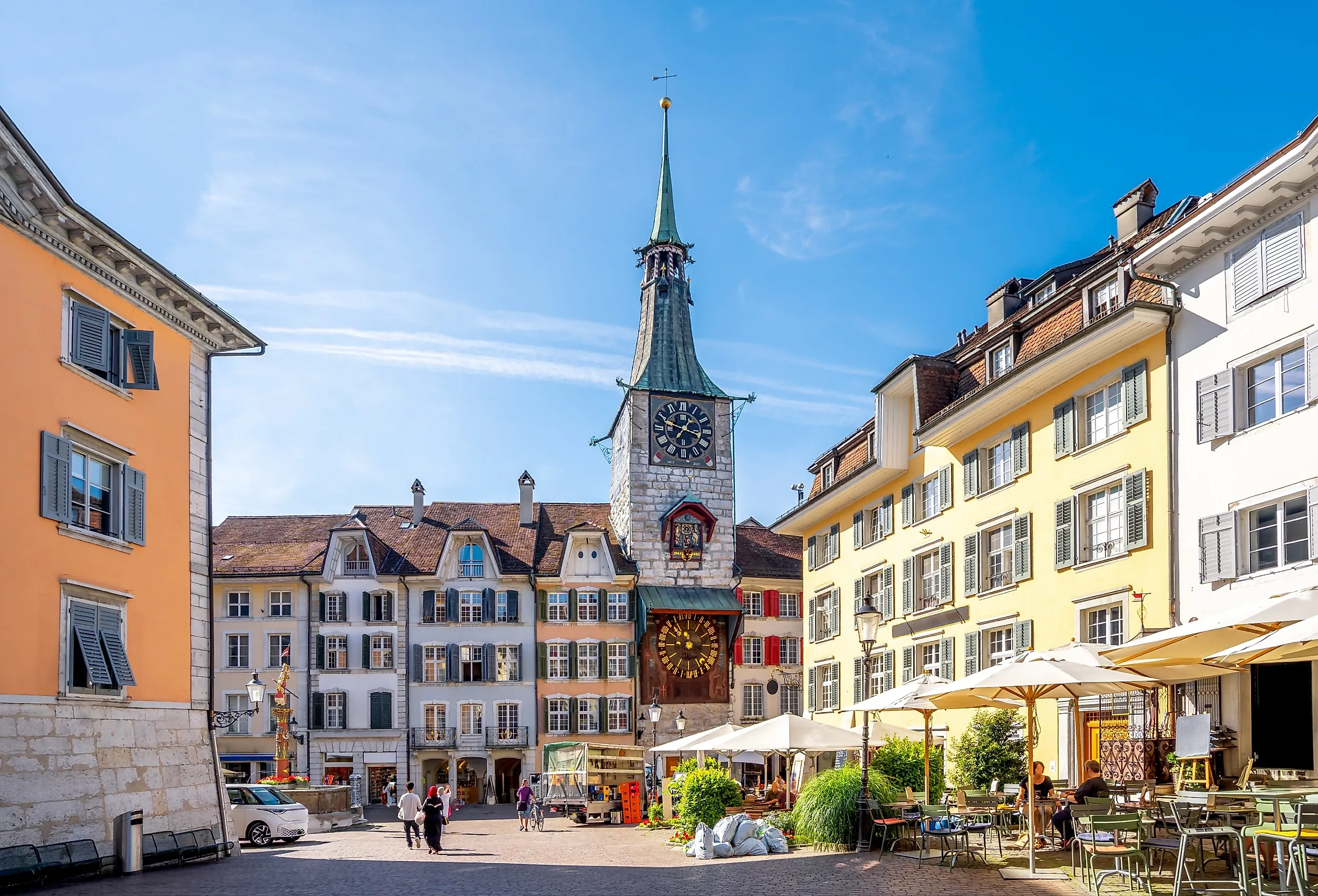
Solothurn, the baroque capital of its namesake canton, had 16,830 residents at the end of 2025. Locals call it the "eleventh town": the number 11 recurs throughout its architecture, with eleven altars and eleven bells at St. Ursus Cathedral, eleven fountains, and eleven towers scattered through the old town. The center was rebuilt between 1530 and 1792 and won the Wakker Prize in 1980 for its Baroque preservation. Along the Aare River it blends Italian, French, and Swiss architectural styles. The Historical Museum, housed in the former municipal armoury, and the medieval Basel Gate each fill an afternoon. Median apartment prices come in at CHF 763,872, below the Swiss average. The Bürgerspital Solothurn, run by the cantonal Solothurner Spitäler (soH) network, provides acute and emergency care within the town itself. It moved into a new main building in 2021. With walkable riverside promenades and an old town small enough to cross on foot, Solothurn draws retirees who want architecture over lake views.
Burgdorf, Bern

Burgdorf, with 17,577 residents at the end of 2025, is close enough to the capital for day trips but far cheaper to live in. Sitting on a bluff above the Emme River in the canton of Bern, Burgdorf Castle dominates the skyline. Berthold V of Zähringen had the present red-brick complex built around 1200, on a site fortified since at least 1080, and it is the best-preserved Zähringen castle in the country. The castle houses a museum highlighting the town's medieval and Bernese history. The late-Gothic Swiss Reformed City Church, built between 1471 and 1490, anchors the old town below. The Museum Franz Gertsch, dedicated to the Swiss photorealist painter, is a rare piece of major contemporary art outside the big cities. Median apartment prices are CHF 597,397, well below the national figure. For medical care, Spital Emmental operates a full hospital site in Burgdorf, covering the surrounding Emmental district. Just outside town, the Emme has carved a series of sandstone cliffs known as the Gysnauflühe, a favourite short walk for residents looking for a view over the valley. The town also serves as an unofficial gateway to Emmental cheese country, with dairies and cheese-making demonstrations scattered through the surrounding countryside.
Frauenfeld, Thurgau

The capital of Thurgau, Frauenfeld, had 27,201 residents at the end of 2025 and a median apartment price of CHF 820,540, still under the Swiss national figure. Frauenfeld Castle, a late-baroque and classical building, now houses the canton's Historical Museum, while the Museum of Archaeology and Natural History of Thurgau explores the region's deeper past. The 18th-century Rathaus anchors the old town, the whole of which is listed in the federal Inventory of Swiss Heritage Sites. Every summer, the Grosse Allmend grounds on the edge of town host Openair Frauenfeld, one of Switzerland's largest hip-hop and music festivals. For healthcare, Kantonsspital Frauenfeld, run by Spital Thurgau AG, sits directly in town and serves as the canton's primary hospital. The town itself sits on the Murg River near its junction with the Thur, and flat, gentle riverside paths link the old town to the castle grounds and beyond. As the seat of a German-speaking canton, Frauenfeld splits the difference between small-town affordability and the amenities of a cantonal capital.
Kreuzlingen, Thurgau

Kreuzlingen, population 23,550 at the end of 2025, sits directly on the shore of Lake Constance and butts up against the German border town of Konstanz. Seeburgpark, part of the International Lake Constance Gardens network, offers lakefront walking paths, a small petting zoo, and a public beach. The ruins and grounds of Seeburg Castle sit nearby. The former Augustinian Chorherrenstift of St. Ulrich is one of the town's oldest surviving religious buildings. Median apartment prices run to CHF 894,373, close to the national figure of CHF 864,772, making it the highest on this list. That cost is still a fraction of what lakefront property costs in Geneva or Zug. Retirees have access to Klinik Seeschau, a clinic located in Kreuzlingen itself, with the larger Kantonsspital Münsterlingen a short drive along the lakeshore. The cross-border position makes it easy to explore both sides of Lake Constance, Swiss vineyards on one shore and German castle towns on the other, without ever needing a car for more than a day trip.
Bellinzona, Ticino

Bellinzona, the capital of Italian-speaking Ticino, is the largest town on this list at 45,828 residents at the end of 2025. It's notably more affordable than its glamorous Ticino neighbours, Lugano, Locarno, and Ascona. Its headline attraction is the Castles of Bellinzona, a trio of fortifications: Castelgrande, Montebello Castle, and Sasso Corbaro. These, together with the town's defensive walls, earned UNESCO World Heritage status in 2000. Montebello houses an archaeological museum, while Sasso Corbaro preserves a 17th-century wooden interior. In the old town, the Collegiate Church of SS. Pietro e Stefano is worth a look, and every Saturday the central piazzas fill with the Bellinzona Saturday Market, one of the largest in Ticino. Median apartment prices here are CHF 637,587, well under the Swiss average. For healthcare, the Ospedale Regionale di Bellinzona e Valli (Ospedale San Giovanni) operates in town as the region's main hospital. As the capital of Italian-speaking Ticino, Bellinzona also gives retirees a genuinely different cultural rhythm than the German- or French-speaking towns elsewhere on this list. Its castle-topped skyline is a regular fixture on rankings of Switzerland's most beautiful cities. It's a rare case of a UNESCO-listed town center that's genuinely affordable to retire in.
Small Towns, Big Savings: Switzerland Beyond The Postcards
While these ten towns may not show up on a typical Switzerland itinerary, that's kind of the point. Skip the lakefront mansions of Geneva and the ski-chalet prices of Zermatt. There's a version of Switzerland (Romanesque abbeys, watchmaking museums, baroque old towns, and castle ruins) that's within reach of an ordinary retirement budget, including a hospital or clinic never far from home. Whichever canton calls loudest, from the French-speaking Broye valley to the Italian piazzas of Bellinzona, these towns prove that Swiss quality of life is accessible.