9 Switzerland Towns With Unforgettable Main Streets
In Switzerland, a "Hauptgasse" or "Grand-rue" is a town's main street: cobbled lane, market square, lakeside promenade, or pedestrian high street, depending on the region. The nine main streets below run the full geographic and architectural range, from painted medieval façades on the Rhine to a Ticino lakefront in the Italian-speaking south to the working pedestrian centers of car-free alpine resorts. Each one is the structural and social heart of its town, and walking each is the most efficient way to read the place.
Stein am Rhein

Stein am Rhein sits on the Rhine just downstream of Lake Constance, in the canton of Schaffhausen. The stretch of Understadt running into Rathausplatz is the heart of the old town, and is best known for its painted half-timbered houses, including the Weisser Adler (1542) and Sonne (1591) buildings, both decorated with elaborate exterior frescoes. The Rathaus (town hall) on Rathausplatz dates to the 16th century and anchors the square. The annual Märlistadt season, when the old town is decorated with festive scenes drawn from fairy tales, runs from early December through early January.
Just off the central square, Museum Lindwurm is housed in a 19th-century burgher's residence and presents the daily life of a middle-class household around 1850. For a longer walk, the Hohenklingen Castle trail leads up the hill above town in about 30 minutes and gives a clear view back over the painted facades and the river.
Appenzell

Appenzell's Hauptgasse is short and dense. The street is lined with painted gabled houses, traditional storefronts selling Appenzeller Biber gingerbread and the canton's famous unfiltered beer, and the painted Rathaus, which served as the cantonal seat for centuries and now houses local government offices. The town is the capital of Appenzell Innerrhoden, the smallest and one of the most traditional Swiss cantons, where the open-air assembly Landsgemeinde still meets in late April to vote by show of hands.
The Museum Appenzell, just off Hauptgasse, covers Appenzell folk traditions including embroidery, painted furniture, alpine descents, and yodeling. Pfarrkirche St. Mauritius, the parish church next door, dates to the 11th century in its earliest form and was rebuilt in late Gothic style; the present bell tower is one of the oldest structures in the Innerrhoden region.
Andermatt

Andermatt sits in the Urseren Valley at the foot of the Gotthard Pass, historically one of the most strategic mountain crossings in Europe and now the meeting point of three major Alpine passes (the Gotthard, Furka, and Oberalp). Gotthardstrasse runs through the village center, lined with chalets, family-run hotels, and the kinds of outdoor shops that have served generations of pass travelers and skiers.
The village rail station sits at the lower end of Gotthardstrasse and serves as a stop on the Glacier Express between Zermatt and St. Moritz, with the operator's official 2026 service break running October 11 to December 4. The Gütsch-Express gondola, an 8-seat lift running from the station via Nätschen up to Gütsch, is the main winter ski access. The village fountain known as the Bärenbrunnen, in front of the town hall, traces its base to 1581, although the present bear-topped column was carved in the 1950s.
Zermatt

Zermatt is car-free; visitors arrive by train from Visp or Täsch and walk straight out of the station onto Bahnhofstrasse. The street is the busiest part of the village, lined with sport shops, restaurants, watch and souvenir stores, and hotel terraces, and it leads south into Oberdorfstrasse and the older village core. Glimpses of the Matterhorn open up between the rooftops as the street climbs.
The Matterhorn Museum, also called Zermatlantis, is built largely underground beneath the Kirchplatz on the main street and reconstructs the village's pre-tourism past with original timber houses, mountaineering exhibits, and artifacts from the 1865 first ascent of the Matterhorn, including the broken rope from the descent on which four climbers fell to their deaths. The Matterhorn Glacier Paradise cable car, the highest in the Alps, departs from the southern end of the village.
Wengen

Wengen sits on a sun-facing terrace at 1,274 meters above the Lauterbrunnen Valley in the Bernese Oberland, reachable only by the Wengernalp Railway from Lauterbrunnen. The village is car-free, and Dorfstrasse runs through its center, linking hotels, shops, and chalets with the Jungfrau, Eiger, and Mönch on the skyline.
The Wengen-Männlichen aerial cableway, with 2026 operating seasons posted on the Jungfrau Region website, climbs from the village edge to the Männlichen ridge at 2,222 meters, opening up the Männlichen-Kleine Scheidegg ridge walk in summer and a wide range of intermediate ski terrain in winter. The Wengernalp Railway continues from Wengen up to Kleine Scheidegg, where it meets the Jungfrau Railway to the Jungfraujoch. The Lauberhorn downhill course, host of one of the World Cup's oldest and longest ski races (run annually since 1930), drops directly above the village.
Gruyères

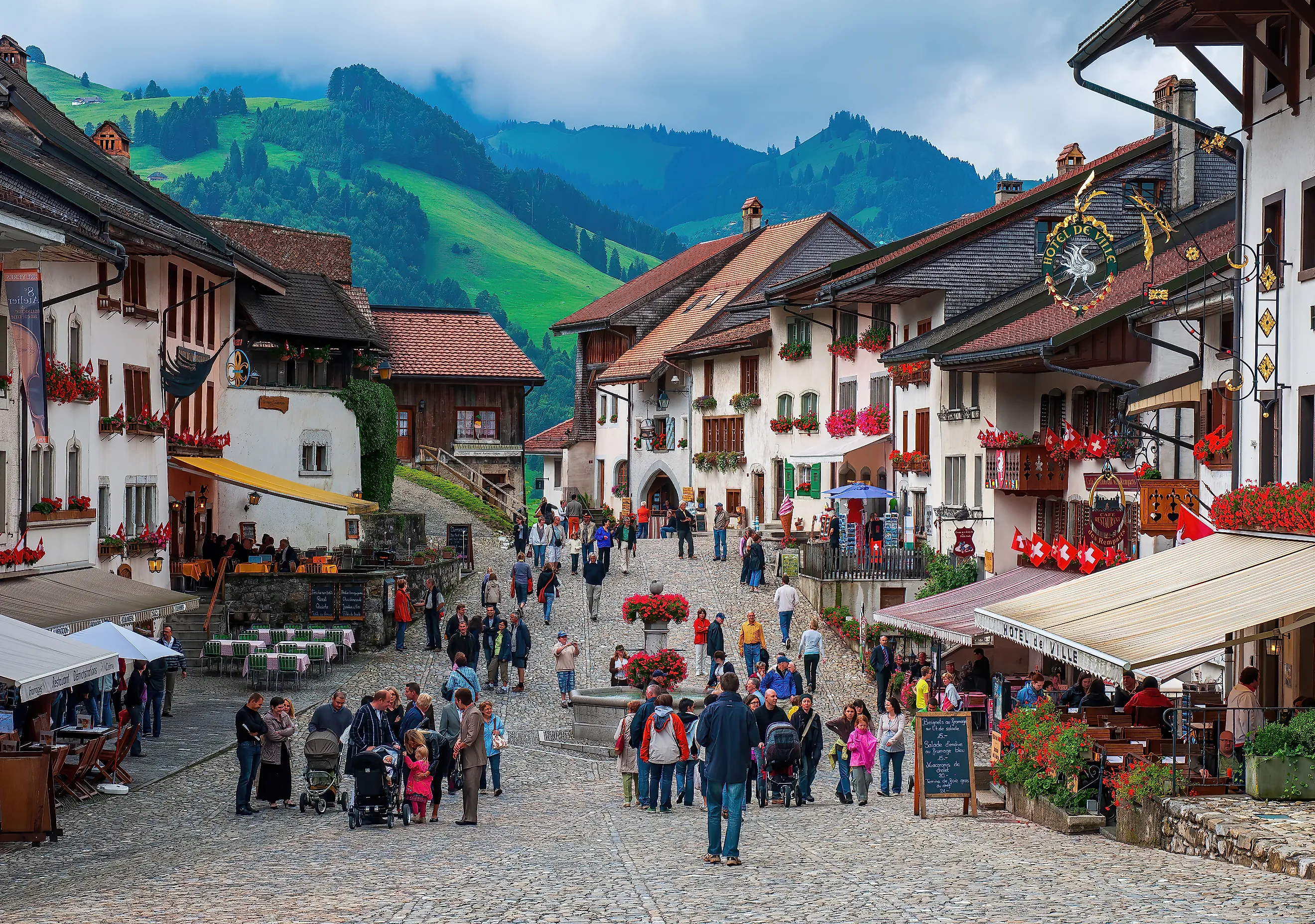
Gruyères is a fortified hilltop village in canton Fribourg, surrounded by the rolling pre-alpine pastureland that gives Gruyère cheese its name. Cars are kept at the parking lots below the walls; visitors walk up Rue du Bourg, which becomes Rue du Château at the top of the village. The street is cobbled, fountained, and narrow, and runs about 200 meters from the main gate to the castle.
Gruyères Castle, built between 1270 and 1282 and inhabited by 19 successive Counts of Gruyères until 1554, sits at the end of the climb. The castle museum covers eight centuries of Fribourg history and the surrounding cheese-and-pastoral economy. Mid-village, the HR Giger Museum holds the personal collection of the Swiss surrealist artist who designed the Alien creature for Ridley Scott's 1979 film, and the Giger Bar across the lane carries the same biomechanical aesthetic into a working café. La Maison du Gruyère, the cheese demonstration dairy at the foot of the hill, completes the visit.
Murten

Murten (Morat in French) is a bilingual lakeside town on Lake Murten in the canton of Fribourg. The old town consists of three parallel streets running east-west, with Rathausgasse and Hauptgasse forming the main commercial spine. Both streets feature continuous arcaded buildings, a Bernese architectural pattern carried over from the town's long period under Bernese rule. The complete medieval ring wall surrounding the old town can be walked on top, with views over the red-tiled rooftops and the lake.
Murten is best known historically for the 1476 Battle of Murten, where the Swiss Confederates defeated Charles the Bold of Burgundy, a turning point in the Burgundian Wars. The Murten Museum (Museum Murten), in a converted lakeside watermill, presents the battle and the town's history. Murten Castle, just west of Rathausgasse, was built in the late 13th century by Peter II of Savoy; the residential wing dates from a 1755 reconstruction and now houses the prefecture of the Lake District. The castle tower is open seasonally from late June through late October.
Ascona

Ascona is in the Italian-speaking canton of Ticino, on the western shore of Lago Maggiore, just south of Locarno. Piazza Giuseppe Motta, the lakefront promenade, runs along the harbor for several hundred meters and is closed to vehicle traffic. Palms, café terraces, and pastel-painted facades give the street a more Italian character than anywhere else in Switzerland, which is geographically accurate: Ascona sits at 196 meters above sea level, the lowest town in the country.
Ascona was a center of early-20th-century counterculture and avant-garde art; the Monte Verità movement (founded 1900 above the town) drew European writers, dancers, and reformers including Hermann Hesse and Carl Jung. The Museo Comunale d'Arte Moderna on Via Borgo holds works by Marianne von Werefkin, Paul Klee, and other artists associated with the period. The Festival JazzAscona in late June, and the New Orleans-themed concerts that line the lakefront for ten days each summer, are the largest annual events. Boats from the harbor connect the town to the Brissago Islands botanical garden in season.
Solothurn

Solothurn is widely regarded as Switzerland's best-preserved Baroque town, a result of the city's wealth as the residence of the French ambassador to Switzerland from 1530 to 1792. Hauptgasse runs through the pedestrian-only old town and is anchored at its eastern end by St. Ursus Cathedral. The town has a documented obsession with the number 11: it was the 11th canton to join the Swiss Confederation in 1481, and 11 churches and chapels, 11 historic fountains, and 11 towers stand in the old town.
St. Ursus Cathedral was built between 1762 and 1773 to a design by Gaetano Matteo Pisoni and his nephew Paolo Antonio Pisoni, both from Ascona, and is considered the most important early-neoclassical building in Switzerland. The 11 theme runs through it: three flights of 11 steps lead up to the entrance, the interior holds 11 altars, and the 66-meter tower contains 11 bells. The Old Arsenal (Altes Zeughaus) on Zeughausplatz, just off Hauptgasse, holds one of Europe's largest collections of historical armor and weapons, much of it captured from the Burgundian Wars. Saturday market days fill the old town with regional produce, cheese, and bread.
Thun

Thun sits at the outflow of Lake Thun on the river Aare, at the gateway to the Bernese Oberland. The old town's defining feature is the Hochgasse: Obere Hauptgasse and Untere Hauptgasse, the two main streets, are split into upper and lower levels, with the upper sidewalks running across the rooftops of the lower row of shops. The arrangement is unusual in Europe and developed because medieval merchants needed pedestrian access above the spring floods of the Aare.
The Hauptgasse leads upward toward Schloss Thun, the 12th-century Zähringen castle that crowns the hill above the old town. The castle museum, in the original keep, holds Bernese tapestries, weapons, and exhibits on the town's history; the four corner turrets give a panoramic view of the lake, the city, and the Stockhorn and Niesen mountains. From the riverside, the Aare flows clear from the lake through the city, and the riverbank promenade is a daily walking route for residents.
What These Streets Have In Common
The nine streets above are not interchangeable. Stein am Rhein and Gruyères are about painted medieval architecture; Appenzell and Murten about scale, arcades, and slow walking; Andermatt, Zermatt, and Wengen about the working life of an alpine resort; Ascona about Ticino's southern climate and avant-garde history; Solothurn and Thun about how a larger historic town can keep a working main street as the social and commercial center. In each case, the street is the reason to visit, and a slow walk along it is enough to read the town's structure, history, and economy without ever stepping into a museum.