5 Most Snake-Filled Bodies Of Water In Kansas
Kansas is home to 42 established snake species, an unusually diverse assemblage for a Great Plains state. At least five species are distinctly classified as semi-aquatic, including the plain-bellied watersnake (Nerodia erythrogaster), the western ribbonsnake (Thamnophis proximus), and Graham's crayfish snake (Regina grahamii).
The Kansas Poison Center identifies six types of venomous snakes of concern in the state: the timber rattlesnake (Crotalus horridus), prairie rattlesnake (Crotalus viridis), western diamondback rattlesnake (Crotalus atrox), western massasauga (Sistrurus tergeminus), eastern copperhead (Agkistrodon contortrix), and northern cottonmouth (Agkistrodon piscivorus). Kansas recognizes the cottonmouth from only two valid specimens collected in Cherokee County in 1991, and no reproducing population has been confirmed. Statewide, snakes emerge in April and stay active into October before retreating underground for winter.
These five Kansas wetlands and waterways have documented records of semi-aquatic snakes or other snake species that regularly swim or forage near water.
Cheyenne Bottoms Wildlife Area

Several snake species inhabit the roughly 20,000-acre Cheyenne Bottoms Wildlife Area, which occupies part of a natural basin of approximately 40,000 acres in Barton County and is managed by the Kansas Department of Wildlife and Parks. The larger natural basin covers roughly 40,000 to 41,000 acres, while dikes and water-control structures divide the state-managed portion into a series of marsh pools. These pools created a permanent marsh habitat that draws snakes.
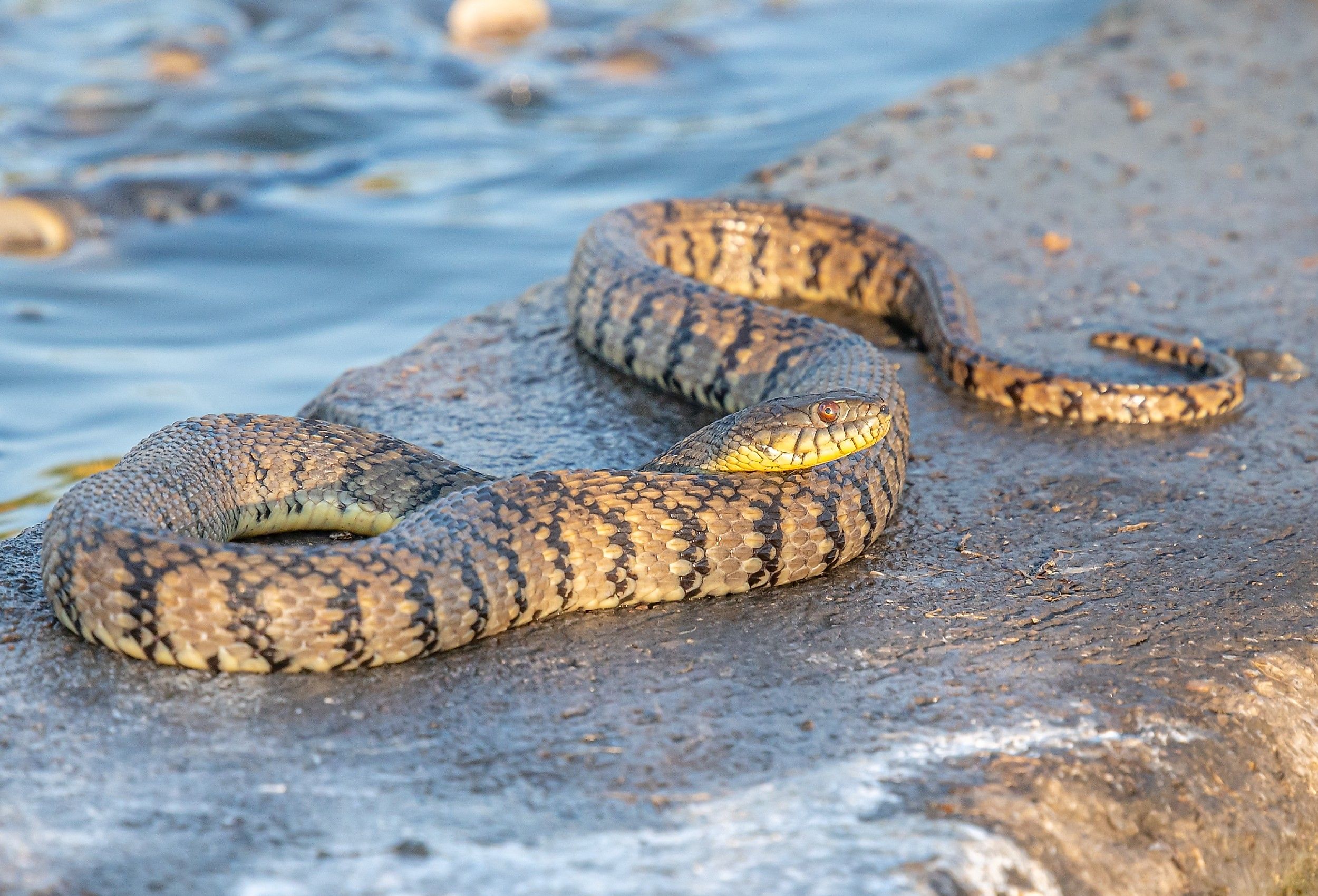
Diamondback watersnakes (Nerodia rhombifer) are well documented in the still-water ditches at Cheyenne Bottoms, a large, heavy-bodied species that often attaches its tail to overhanging shoreline vegetation while dipping its head underwater to grab fish. Graham's crayfish snake, the common watersnake (Nerodia sipedon), the common gartersnake (Thamnophis sirtalis), and the western massasauga are present in this wildlife area as well.

Watersnakes and gartersnakes forage in and around the marsh, while Graham's crayfish snakes are generally associated with muddy wetland margins where crayfish are available. As temperatures fall, these species retreat to protected sites such as animal burrows, crevices, and other underground shelters, with the precise refuge varying by species.
Western massasaugas use marsh edges and nearby grasslands, where they prey on small vertebrates and shelter in crayfish burrows or other underground retreats during winter and flooding.
Visitors walking the dikes may occasionally see a watersnake or gartersnake basking near the water. Officials advise extra caution in grassy areas near the marsh, since the massasauga's coloring allows it to blend into the wetland's dense vegetation.
Quivira National Wildlife Refuge

Several semi-aquatic snakes inhabit the marshes of Quivira National Wildlife Refuge, a 22,135-acre expanse of rare inland salt marsh in Stafford County. This area is fed by salty groundwater rather than any ocean tide. Rattlesnake Creek crosses the refuge and supplies water to its major wetland complexes, including Big Salt Marsh and Little Salt Marsh.
Refuge checklists have documented the venomous western massasauga at Quivira, along with several nonvenomous snakes associated with wetlands. Quivira and the surrounding Stafford County wetlands fall within the documented ranges of several water-associated snakes, including the western ribbonsnake, Graham's crayfish snake, and diamondback watersnake. Primarily terrestrial species recorded in the region include the eastern hognose snake (Heterodon platirhinos) and plains gartersnake (Thamnophis radix), both of which may enter water but are not as aquatic as watersnakes.

Watersnakes, garters, and ribbonsnakes here favor the shallow, vegetated fringes of the marsh units, where they hunt small fish and amphibians that concentrate in the same shallows the refuge manages for waterfowl. The eastern hognose sticks to the moist, sandy regions of the refuge, where they use their shovel-like snout to uncover their primary prey, buried toads. They will also swim across the open water between hunting grounds.
The elevated boardwalk along the refuge's Migrant's Mile Trail crosses directly over one of these marsh units, giving visitors a clear vantage point for spotting a snake in the water below.
Baker University Wetlands

The Baker University Wetlands presents prime wetland habitat for a range of water-loving snakes. The area consists of 927 acres of restored wetland and small ponds on the Wakarusa River floodplain just south of Lawrence in Douglas County. Baker Wetlands provides suitable habitat for watersnakes, ribbonsnakes, gartersnakes, and moisture-loving terrestrial species such as Dekay's brownsnake. The Dekay's brownsnake primarily targets slugs and earthworms in the water-saturated soils right along the muddy shorelines. One strategy plain-bellied watersnakes use to hunt for amphibians and fish underwater is by swimming with their body in a half-circle to corral their prey as they move.
Watersnakes here sun themselves on branches and logs overhanging the water. When out of the water, they spend a significant portion of their active daylight hours thermoregulating. To do this safely away from land-based predators, they frequently climb onto overhanging tree limbs, branches, brush, and fallen logs directly over the water. If threatened, they simply drop directly into the water below to escape.
Visitors can use a network of named loops, boardwalks, and connector paths that local tourism sources describe as totaling more than 11 miles. In warm weather, visitors may see watersnakes basking on branches or logs near Baker Wetlands' boardwalks and ponds.
Marais des Cygnes National Wildlife Refuge

In the 7,500-acre Marais des Cygnes National Wildlife Refuge, snakes inhabit the largest contiguous stand of flooded bottomland hardwood forest left in Kansas. The Marais des Cygnes River periodically floods parts of the refuge, inundating bottomland forest and old fields while also supplying riverine and wetland habitat. The refuge's flooded forests and ponds provide habitat for copperheads and several water-associated snakes found in the Marais des Cygnes drainage, including ribbonsnakes and watersnakes. Western ribbonsnakes are highly agile, and they move with speed and precision throughout the flooded bottomlands to catch frogs. Despite being less aquatic, copperheads will readily cross bodies of water and utilize wooded swamps and damp marsh edges to hunt amphibians.
Ribbonsnakes and watersnakes work the shallow wetland units and old river oxbows for frogs and small fish, taking advantage of habitat that floods and recedes on a schedule that supports a diversity of prey. Visitors may encounter snakes along the refuge's open woodland routes or near its river, farm ponds, and old mine pits, although sightings are never guaranteed.
Shoal Creek and the Spring River

Common watersnakes are the most consistently documented snake along Shoal Creek and the nearby Spring River in Cherokee County, the extreme southeastern corner of Kansas, where the landscape shifts toward the rockier, Ozark-influenced terrain of neighboring Missouri.
Records compiled by the Kansas Herpetofaunal Atlas include common watersnakes observed basking along Shoal Creek during unusually cold conditions. This same stretch of the state carries a rarer distinction: the only two verified specimens of the cottonmouth ever confirmed in Kansas both came from Cherokee County, one from a pull-off along the Spring River and the other from nearby Shawnee Creek. Cottonmouths often swim with much of the body and head visible above the surface, but swimming posture alone should not be used to identify a snake.
Herpetologists who maintain the state's official reptile and amphibian records are careful to note that cottonmouth reports from other parts of Kansas consistently turn out to be misidentified common watersnakes, which share a similar dark, heavy-bodied look. Both cottonmouths and watersnakes can dive and swim underwater, so identification should rely on several physical features rather than aquatic behavior alone.
With only two confirmed records on file, the cottonmouth's actual status in Cherokee County remains poorly understood. Any snake encountered along the area's public creek access points is, by the numbers, far more likely to be a common watersnake than anything venomous.
Kansas's Snakes Thrive in the State's Wetlands
These marshes, wetlands, and rivers span nearly the full width of Kansas, from the salt-fed basins of the central Great Bend Prairie to the hardwood bottomlands and rocky creeks along the state's eastern and southeastern borders. Each location offers a different combination of open water, marsh, forest, or shoreline cover, ideal for snakes. Whether navigating open currents or stalking the muddy shoreline margins, each snake relies on the unique cover and high prey concentrations these habitats provide.