How Far Up Chesapeake Bay Bull Sharks Have Been Found
In August 2013, two bull sharks, each about 8 feet long and 220 pounds, came up in fishing nets in Maryland's part of Chesapeake Bay, about 200 yards from people swimming. Five years later, a waterman pulled a 310-pound bull shark out of the bay by accident.
Most sharks that swim into the Chesapeake from the Atlantic stay in its saltier southern reaches. Bull sharks can live in fresh water, and some keep swimming north. Pound nets have held full-grown adults in the middle of the bay, and a state park beach near Annapolis was cleared in 2014 for one that was never found. How far up the bay they get depends partly on how much fresh water the rivers send down to it.
Bull Sharks Enter Through the Bay's Salty Virginia Mouth

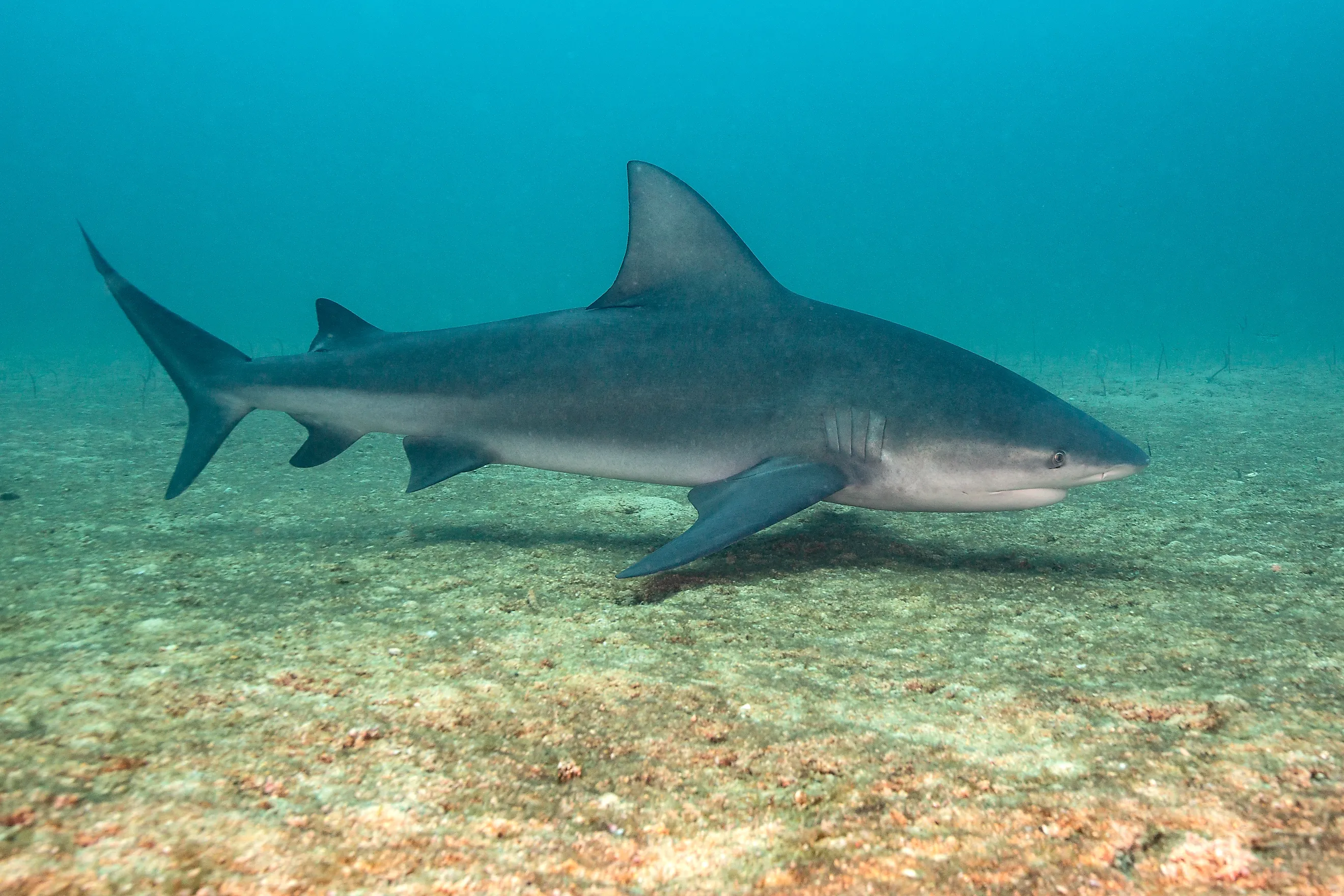
At the mouth of the bay, between Virginia Beach and Virginia's Eastern Shore, salinity averages 25 to 30 parts per thousand, the saltiest water in the Chesapeake. Bull sharks reach it on a seasonal migration, moving north along the Atlantic coast in summer. Even here they are uncommon. The Virginia Institute of Marine Science calls bull shark observations in the bay and its tributaries in summer only rare to occasional. The species grows to around 11 feet and feeds on whatever it can catch, including bony fishes, rays, other sharks, and sea turtles. According to the Chesapeake Bay Program, most sharks that come into the bay stay farther south, in its saltier parts.
The Lower Potomac Is a Bull Shark Hot Spot

The first Maryland water where bull sharks turn up with some regularity is the lower Potomac River, which meets the bay at Point Lookout in St. Mary's County. Two of them came up in August 2013 in pound nets off Cornfield Harbor, near Point Lookout State Park. John "Willy" Dean, his son Greg, and Rich Richie hauled them in with a Maryland DNR biologist aboard. One was 8 feet long and the other just over, and each weighed about 220 pounds.
Another 8-foot bull shark came out of a large net off Coltons Point, farther up the Potomac, on September 3, 2015. Paul Genovese of Maryland DNR called a bull shark in the river "actually pretty normal," and shark researcher Charles Bangley has said pound net fishermen around St. Marys still catch large ones on occasion. The same waters hold what may be the oldest bull shark story in the Chesapeake. In his 1640 annual report to Rome, Jesuit priest Thomas Copley described a laborer in the St. Marys River, a Potomac tributary, being seized by "a huge fish," and researchers who studied the account consider a bull shark the likeliest culprit.
Most Maryland Reports Come From the Mid-Bay River Mouths

Maryland DNR gets most of its bull shark reports from three river mouths, the Potomac's and two more in the middle of the bay, where the Patuxent comes in from the western shore and the Choptank from the Eastern Shore.
Waterman Larry "Boo" Powley has pulled bull sharks from both sides of that stretch. His July 2015 catch, off Hoopers Island in Dorchester County, measured roughly 8 to 8.5 feet, and he put its weight at 265 pounds. Three summers later he accidentally caught a 310-pound, 8.5-foot bull shark off Cedar Point, across the bay at the mouth of the Patuxent. Michael Roman of the University of Maryland Center for Environmental Science's Horn Point Laboratory has said the species can handle the bay's lower salinity.
Adult Bull Sharks Reached Galesville in the 1950s

Two adult bull sharks were caught on successive days in the same pound net near Galesville, a waterfront community on the West River about 14 miles south of Annapolis. Biologist Frank J. Schwartz described them in the journal Chesapeake Science in 1960, and he counted ten adult bull sharks recorded in Chesapeake Bay from 1956 to 1959, between 61 and 119 miles above the bay's mouth.
That put full-grown bull sharks in the middle of the bay more than 60 years ago. Schwartz connected their appearance to warming ocean waters at the time.
Gill Netters Have Caught Bull Sharks Up to the Bay Bridge

A park ranger at Sandy Point State Park, at the western end of the Chesapeake Bay Bridge near Annapolis, thought he saw a bull shark in the water one Monday in July 2014, and the beach was evacuated as a precaution. No shark was confirmed. Maryland DNR noted that cownose rays are often mistaken for sharks, and the Chesapeake Bay Program considers bull sharks no significant threat to human safety in the bay.
Bull sharks have been caught that far north. The Chesapeake Bay Foundation says gill netters have caught them as far up the bay as the bridge, which runs from Sandy Point to Kent Island, and a charter captain has recalled an 8.5-foot bull shark caught near the Bay Bridge in 1987.
Drought Years Bring Reports From the Head of the Bay

Long dry spells change how far salt water reaches in the Chesapeake. When the flow of fresh water from the rivers stays low, saltier ocean water moves farther up the bay, and heavy rain does the opposite, lowering the bay's salinity. In an ordinary year, the head of the bay and its tidal rivers are fresh, at less than 0.5 parts per thousand.
Maryland DNR says bull sharks have been reported as far north as Aberdeen Proving Ground, and that those reports usually come only in drought years. The Chesapeake Bay Program has said bull sharks, which can tolerate fresh water, have been observed north of the Bay Bridge all the way to the mouth of the Susquehanna River, most likely from July to September. Those upper-bay reports were published without dates or measurements. A 2020 newspaper story about a shark caught in the Susquehanna ran on April 1, under the byline Lirpa Loof.
Warm Water Sets Their Season, and the Bay Is Warming

In Maryland, bull sharks typically arrive in late May and can stay well into October, then head south along the coast when the water cools in fall. Alan Henningsen of the National Aquarium has said the Potomac's winter cold keeps them from living there year-round.
Young bull sharks grow up in brackish nursery estuaries well south of the Chesapeake, and the most likely one north of Florida's Indian River Lagoon is Pamlico Sound in North Carolina. A 2018 study led by Bangley found that warmer, saltier water had let bull sharks expand their nursery habitat in the sound. Juveniles in the study's gillnet survey rose from six caught from 2003 to 2011 to 53 from 2011 to 2016, and none were caught in water below about 72 degrees Fahrenheit. Scientists at the Smithsonian Environmental Research Center in Maryland have tagged bull sharks with acoustic transmitters whose signals are picked up by receivers along the East Coast. The Chesapeake Bay Program says the water in the bay and its rivers is warmer than in past decades.
How far up the Chesapeake a bull shark travels depends on the water it finds there. Maryland DNR's farthest reports, at Aberdeen Proving Ground near the mouth of the Susquehanna, usually come in drought years, when saltier water pushes farther up the bay. The documented catches sit farther south, from the pound nets of the lower Potomac to the gill-net records at the Bay Bridge and Schwartz's adults up to 119 miles above the bay's mouth. Those catches stretch from the 1950s to 2018. Over that time the bay has warmed, and the closest known bull shark nursery, in Pamlico Sound, has expanded with warmer, saltier water. In 1959, a year before his Galesville paper, Schwartz described two 8-foot bull sharks captured in Chesapeake Bay, Maryland, under an older name for the species, cub sharks.