How Ships Climb Around Niagara Falls
Niagara Falls drops about 167 feet, which is the number everybody knows and only half the problem. The real obstacle is the Niagara Escarpment, and the Lake Erie end of the Welland Canal sits 326 feet higher than the Lake Ontario end. Ships climb that in eight locks across 27 miles, taking roughly eleven hours, and the entire operation runs on gravity. There is not a single pump anywhere in the system.
The Falls Are Not The Whole Drop

Correcting the premise slightly makes the engineering easier to understand.
The falls account for roughly 167 feet of the descent from Lake Erie to Lake Ontario. The total elevation difference between the two lakes is 326 feet, so the waterfall is about half of what a ship has to overcome.
The rest is spread through the rapids and the gorge below. A canal has to deal with all of it, which is why there are eight locks rather than one very large one.
Eight Locks Do The Work

The modern arrangement is the product of a century of consolidation.
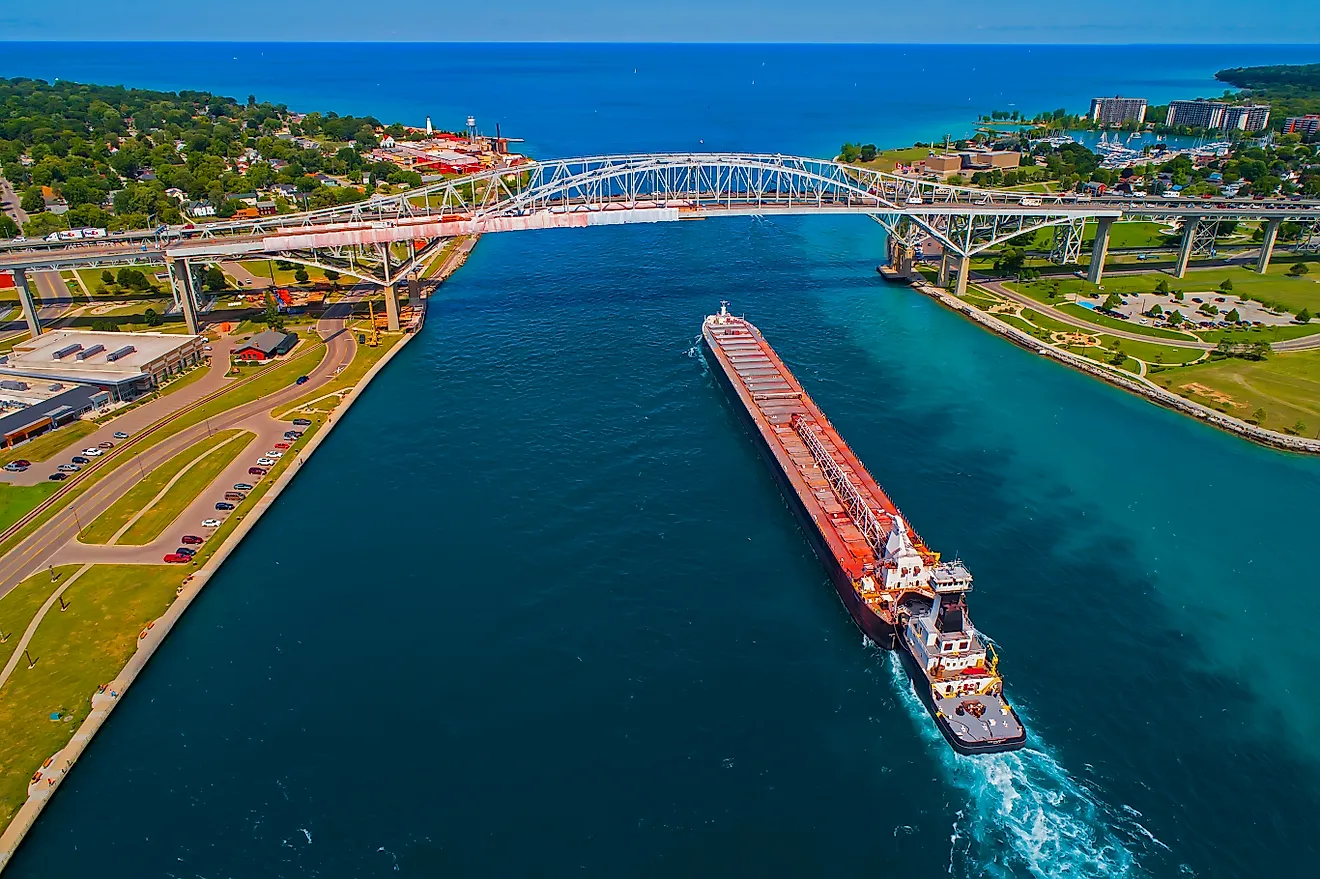
The fourth Welland Canal, completed in 1932, runs 43.4 kilometers from Port Weller on Lake Ontario to Port Colborne on Lake Erie using eight locks. Locks 1 through 7 lift a ship an average of 46.6 feet each.
The first canal, opened in 1829, needed 40 wooden locks to do the same job. Reducing that to eight cut transit from days to hours.
Three Of Them Are Twinned

The most striking section is a flight of three locks at Thorold, and they exist in duplicate.
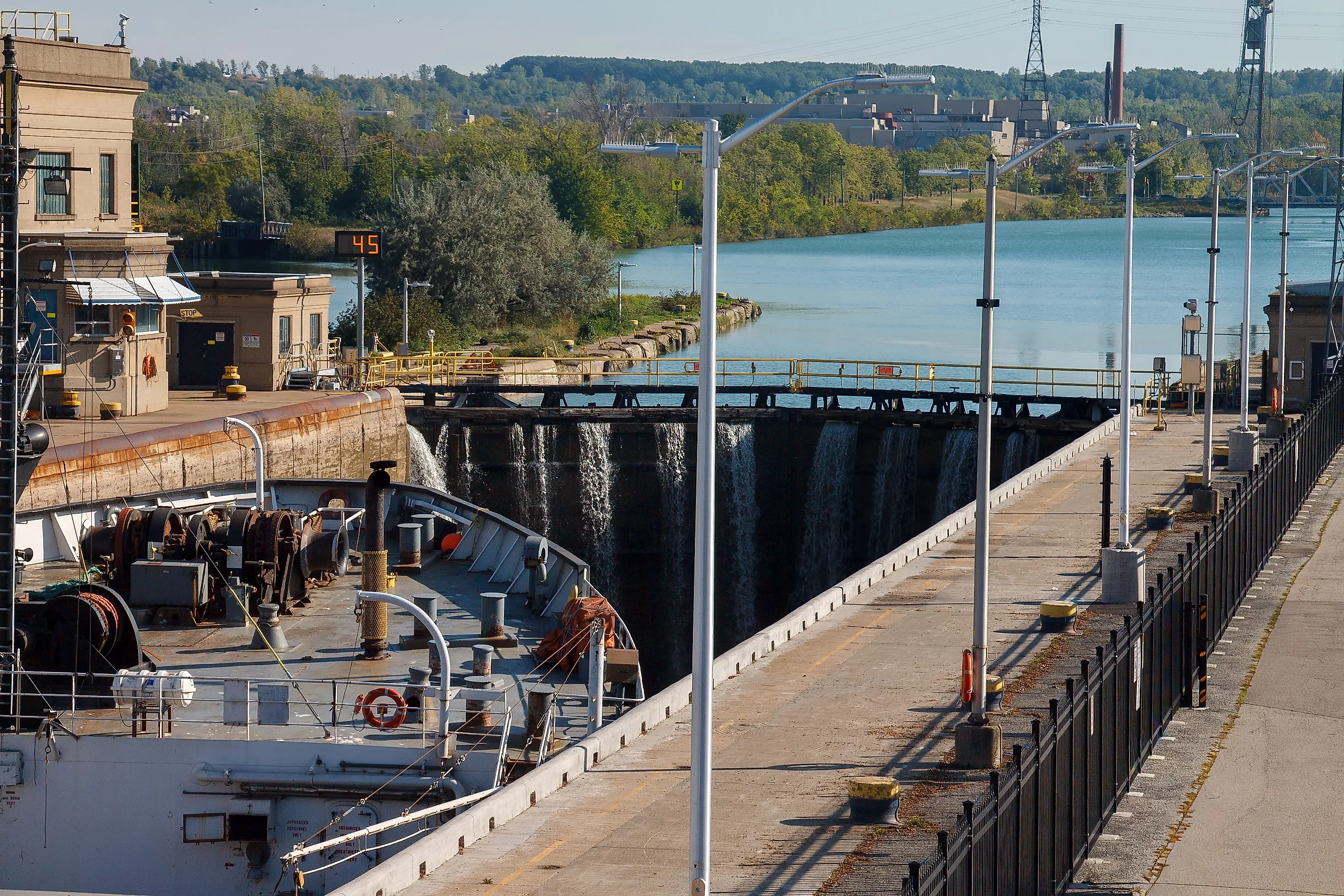
Locks 4, 5 and 6 are twin flight locks, built side by side and interconnected, lifting ships about 141 feet in three steps. Because each is doubled, vessels traveling in opposite directions can climb and descend simultaneously.
Six ships can be inside that flight at one time. It is the single busiest piece of the canal and the reason traffic does not have to alternate direction.
Lock 7 Controls The Canal

Immediately above the flight sits the lock that governs the rest of the system.
Lock 7 is the control lock for the entire canal, lifting ships the last step onto the summit level at the top of the escarpment. From its observation deck the skyline of Niagara Falls is visible in the distance.
Above it the canal runs level for about 16 miles, which is the majority of the route and none of the climbing.
The Last Lock Is For Wind

Lock 8 at Port Colborne does almost no lifting and exists for a reason specific to Lake Erie.
Wind causes considerable variation in the level of Lake Erie at Port Colborne, sometimes as much as 11 feet. Lock 8 is a guard or regulating lock that adjusts the canal's level to whatever the lake is doing on the day, with a lift usually between two and four feet.
To absorb that it is enormous. At roughly 1,380 feet it is one of the longest locks in the world, about the length of four football fields.
No Pumps Anywhere

The detail that surprises most visitors is what moves the water.
The locks are filled and emptied entirely by gravity. Lake Erie sits 326 feet above Lake Ontario, so water runs downhill through the system on its own, and every lift is powered by the weight of the water above it.
A ship going uphill is raised by water falling from a higher pound. Nothing is pumped, which is why the canal has operated through power failures and why its running costs are far lower than the engineering suggests.
Eleven Hours For Twenty-Seven Miles

The transit time looks slow until you count what is happening in it.
A typical passage takes about eleven hours, with reports ranging from seven to over fourteen depending on traffic and conditions. Most of that is spent maneuvering into and out of locks rather than sailing.
Twenty-seven miles in eleven hours is under three miles an hour. The ship is not traveling slowly so much as stopping eight times.
Suction Cups Replaced The Ropes

One recent change has altered the operation more than anything since 1932.
Hands-free mooring was introduced in 2014 and completed across the canal by 2018. Vacuum pads mounted in the lock walls grip the hull directly and hold the ship steady, with no lines handled by crew at all.
It removed the most dangerous job in a lock transit and cut time off every passage, multiplied across roughly 3,000 vessel movements a year.
Eighty Feet Is The Hard Limit

The canal's dimensions decide which ships exist on the Great Lakes at all.
Locks 1 to 7 are 766 feet long and 80 feet wide, with a maximum permitted vessel length of 740 feet. That is the Seawaymax standard, and any ship built within it can sail from the Atlantic to Lake Superior.
Thousand-footers, at 105 feet wide and over 1,000 long, cannot fit. Thirteen of the largest ships on the lakes are permanently excluded from this canal and therefore from the ocean.
The Escarpment Runs Much Further

The ridge the canal climbs is not a local feature, which puts the problem in context.
The Niagara Escarpment runs from New York State through Ontario, across the Bruce Peninsula and down through Michigan and Wisconsin. The falls sit where the Niagara River happens to cross it.
A canal had to climb the same caprock that produces waterfalls across four states and a province. Eight locks is the local answer to a regional obstacle.
The Short Answer

Ships bypass Niagara Falls through the Welland Canal, climbing 326 feet in eight locks over 27 miles in about eleven hours. Locks 4, 5 and 6 are twinned flights at Thorold handling 141 feet of that in three steps, with room for six ships at once. Lock 8 barely lifts at all and exists to match the canal to a lake whose level the wind can move by 11 feet.
None of it is pumped. Lake Erie sits 326 feet above Lake Ontario and the whole system runs on that difference, which means the falls themselves are supplying the energy that lets ships avoid them.