Which State Has More Venomous Snakes: Texas or Florida?
Rattlesnake warning signs dot Texas trailheads, while Florida boardwalks caution about snakes lurking beside the gators. Both states feel like prime ground for a dangerous encounter, yet the real story is in the numbers and the names.
Texas shelters 105 species and subspecies of snakes, 15 of them venomous, spread across copperheads, cottonmouths, rattlesnakes, and a cobra-relative coral snake. Florida hosts roughly half as many native snakes and only six venomous species, but far more people wading, golfing, and gardening right alongside them. Understanding which state truly has more venomous snakes, how their species differ, and what those fangs actually mean for human safety reveals a picture that is far more surprising, and reassuring, than folklore suggests.
Venomous Snakes of Texas

105 species and subspecies of snakes call The Lone Star State home. Of those, 15 are venomous. These potentially harmful serpents fall into four categories: copperheads, cottonmouths, rattlesnakes, and coral snakes. The first three belong to the pit viper subfamily, while the latter belongs to the Elapidae family, of which the cobras of Asia and Africa are also members. Let's look a little closer (but not too close!) at the various venomous snakes in Texas.
Copperheads

There are three species of copperheads in Texas, each carving out their own territory. The Southern copperhead (Agkistrodon contortrix) lurks in the eastern third of the state, the Broadbanded copperhead (A.c. laticinctus) covers the central and western chunks, and the Trans-Pecos copperhead (A.c. pictigaster) is isolated in the southern part of the Trans-Pecos (i.e. west of the Pecos River - an area dubbed "Far West Texas"). While the three subspecies vary slightly in appearance, they are generally 1.5 to 2.5 feet in length and have reddish-brown or chestnut-colored crossbands spanning their pale or very light-brown bodies.
The Cottonmouth

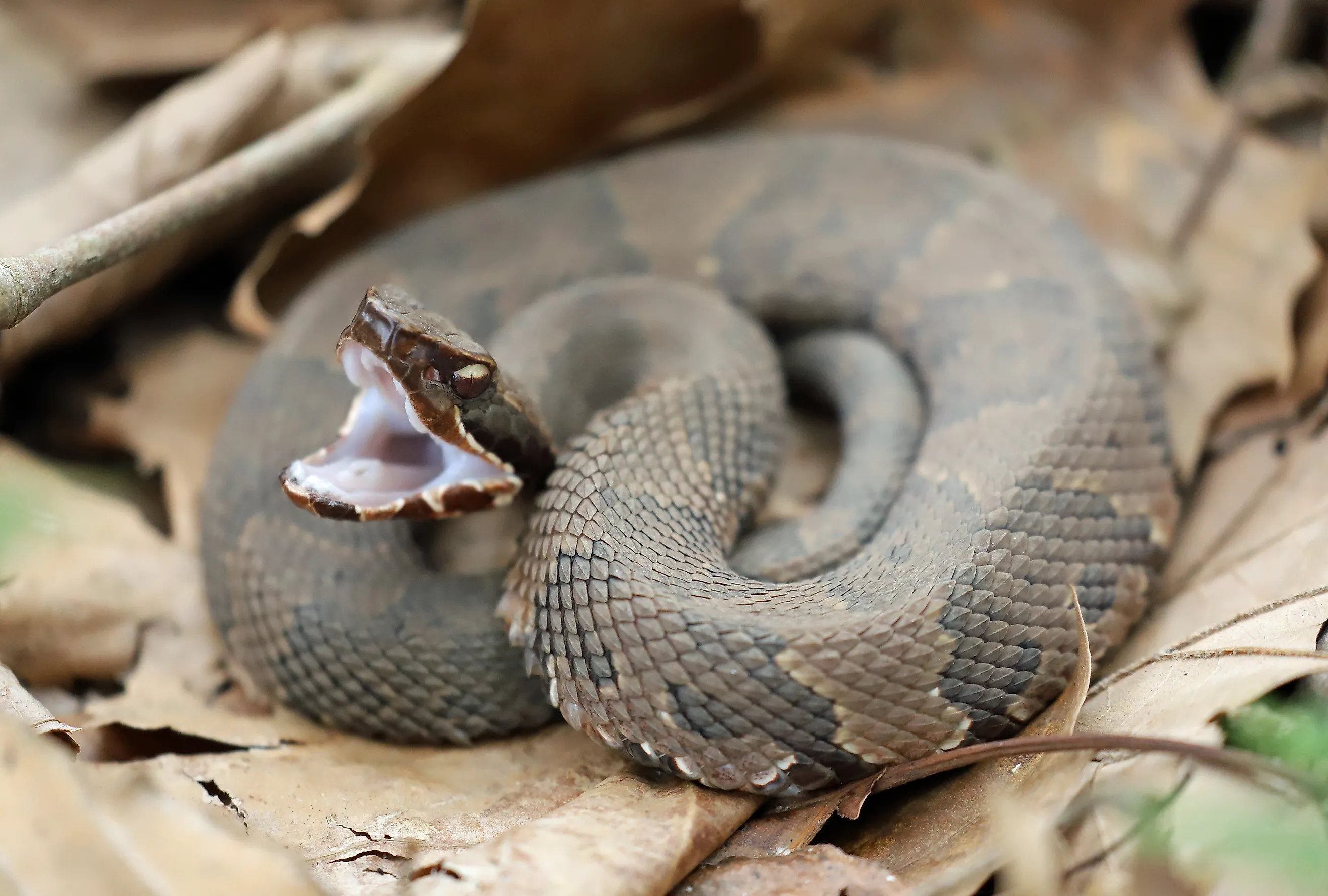
The sole subspecies of cottonmouth found in Texas is the Western cottonmouth (Agkistrodon piscivorous). This hefty snake averages about 3.5 feet in length and can range in color from olive green, olive brown, dark brown, and even approaches solid black. Individuals also exude varying degrees of wide and dark crossbands. But regardless of the external appearance, all cottonmouths have the characteristic white tissue inside their mouths (from which the species gets its name) - only shown when in a defensive posture or in the midst of a strike. Contrary to its name, the Western Cottonmouth is actually found in the eastern half of Texas. Given that it is a semi-aquatic snake (referred to as a water moccasin in some circles), this venomous species keeps close to slow-moving bodies of water, such as streams, ponds, swamps, and coastal marshes.
Rattlesnakes

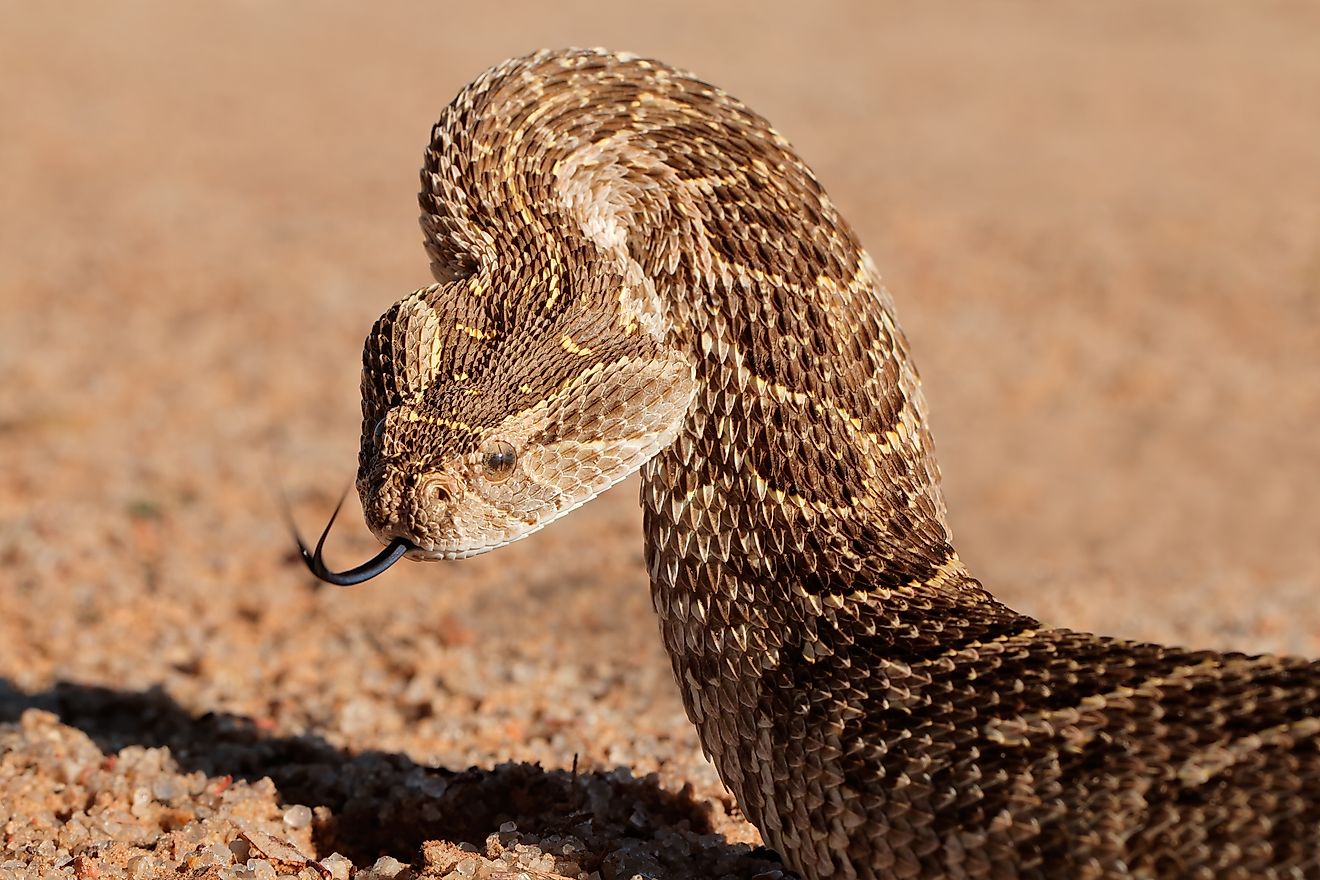
Texas lays claim to many types of rattlesnakes, but which can be categorized into two genera. Of the Sistrurus genus, there is the Western massasauga (S. catenatus) and the Desert massasauga (S.c. edwardsii). And of the Crotalus genus, there is the Western diamondback (C. atrox), Timber rattlesnake (C. horridus), Mottled Rock rattlensnake (C. lepidus), Banded Rock rattlesnake (C.k. klauberi), Blacktail rattlesnake (C. molossus), Mojave rattlesnake (C. scutulatus), and the Prairie rattlesnake (C. viridis viridis). Each variety looks a little different (or sometimes, a lot different), but they all possess the distinctive sound from which the species takes its name. When threatened, rattlesnakes vibrate their tails at a high rate of speed, causing the scales to strike each other and produce less of a rattle and more of a buzzing sound.
The Coral Snake

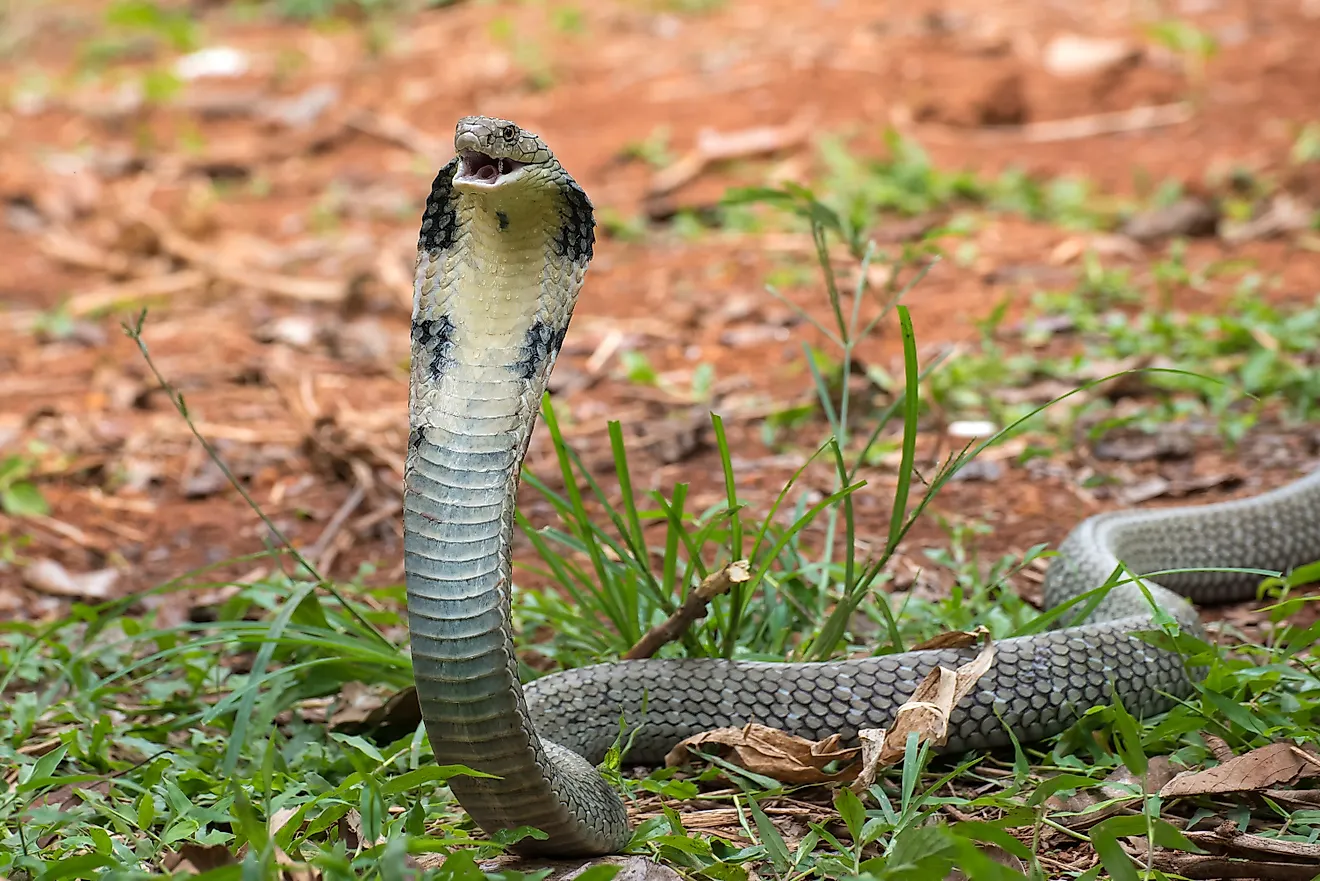
The Texas coral snake (Micrurus fulvius tener) is the only North American cobra (i.e., a member of the Elapidae family) to slither into the Lone Star State. Like other stateside coral snakes, it has bright red and black bands separated by thinner yellow bands. The Texas coral snake is a slim species, and grows upwards of 2.5 feet in length. If you are hiking in the woodlands, canyons, or coastal plains of southeastern Texas, then remember the rhyme: "Red on yellow, you're a dead fellow. Red on black, you're OK, Jack." This safety prompt is helpful for stateside coral snakes (though still imperfect), as other non-venomous snakes have evolved similar vibrant bands to fool would-be predators.
Venomous Snakes of Florida

Estimates on the number of snake species and subspecies native to Florida generally range between 44 to 46 (however, given the invasive python problem and the emergence of anacondas in the Everglades, the overall figure is closer to 50), but sources agree that there are six venomous types. Like Texas, The Sunshine State covers the categories of copperhead, cottonmouth, rattlesnake, and coral, but with some subspecies variations (and a bit of overlap too). Let's get into the weeds (and swamps, scrublands, forests, mangroves, etc.)!
The Southern/Eastern Copperhead

Florida has the same singular subspecies of copperhead that Texas does. Here, the Southern copperhead (Agkistrodon contortrix) is often referred to as the Eastern copperhead and sometimes as the Highland moccasin. The coloration is consistent with its Texan compatriot, though it tends to grow a few inches longer (i.e., up to 3 feet) in Florida. This heavy-bodied pit viper is found only in the deciduous forests, swamp edges, wetlands, and rocky hillsides of the Panhandle (i.e., Northwest), where it loves to feast on cicadas and other insects, as well as rats (great reasons to protect this non-confrontational and only mildly venomous snake), birds, amphibians, and other snakes.
Cottonmouths

There is one primary cottonmouth snake that is inhabiting Florida. The Florida cottonmouth (Agkistrodon conanti) exists in every single county, in nearly all freshwater environments. Cottonmouths do have a reputation for being aggressive, but most of the time, they prefer to flee dangerous situations and instead concentrate their venomous strikes on fish. The Latin name of the latter (piscivorous) means "fish eater" - a habit that pertains to both Floridian subspecies and cottonmouths as a whole. This species is often referred to as a water moccasin due to its semi-aquatic ways.
Rattlesnakes

Three species of venomous rattlesnakes are observable throughout The Sunshine State. The Eastern diamondback rattlesnake (Crotalus adamanteus), recognized as the heaviest pit viper on the continent, inhabits dry regions statewide, including pine woods and golf courses. The Timber rattlesnake (C. horridus), also known as the Canebrake rattlesnake, boasts one of the most extensive ranges of any snake in North America, although it is primarily found in small northern regions. Additionally, the Dusky Pygmy rattlesnake (Sistrurus miliarius barbouri) is distributed across the entire state, excluding the Florida Keys, as well as other parts of the southeastern United States. These small rattlesnakes, measuring approximately 15 to 21 inches, typically inhabit natural wooded areas where they may lie in ambush, but may occasionally be encountered in suburban neighborhoods.
Coral Snake

The species of coral snake that inhabits the entire region of Florida, as well as several states along the Eastern Seaboard and parts of the northeastern Gulf Coast, is identified as the Eastern coral snake (Micrurus fulvius). Due to its conspicuous coloration—comprising black, yellow, and red—this snake is also commonly referred to as the Harlequin coral snake. It is relatively easy to confuse this venomous species with the non-venomous scarlet snake, or in particular, the similarly banded, non-venomous scarlet kingsnake. However, by recalling the aforementioned mnemonic rhyme and observing the characteristic black, blunt head, one can accurately distinguish the venomous snake from its non-venomous counterparts, both of which do not possess neurotoxic venom. Despite its striking coloration, the Eastern coral snake tends to conceal itself within tall grass or beneath fallen leaves.
The Verdict
Texas has more than twice the number of venomous snakes as Florida (15 compared to 6) and also more native snake species/subspecies (105 versus around 45). Whether this makes Texas the "winner" depends on how one judges snakes personally. However, regardless of personal opinion, it's clear that snakes play a crucial role in the food chain and ecosystem health. They control rodent populations and serve as prey for many predators.
The potential risks from venomous snake bites are low, with about five deaths annually in the U.S. Usually, these snakes only bite when provoked or stepped on, and most Americans have access to effective antivenoms quickly. So, residents of Texas and Florida, as well as visitors, shouldn't worry much about venomous snakes.