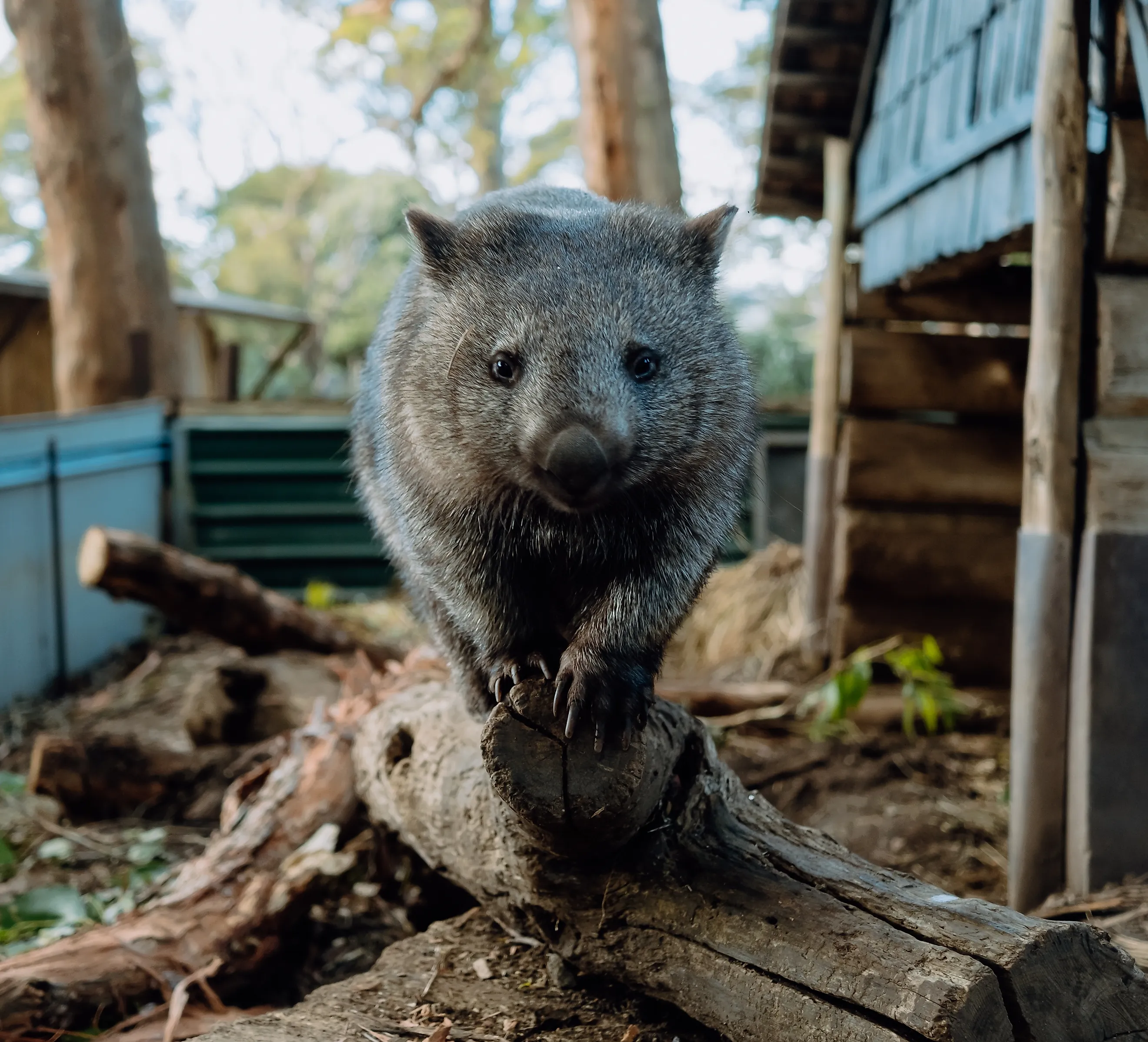
Wombat
Don't be fooled by the wombat's short legs and expressive face. These cuddly looking creatures can be feisty, and won't hesitate about standing up to threats, including humans. Their stout, compact bodies have some weight behind them, up to 40 kilograms (88 pounds) in large adults, along with powerful claws and very sharp teeth.
Found in parts of eastern and southern Australia, including Tasmania, wombats are nocturnal burrowing marsupials that spend their days sleeping and their nights searching for food. Due to human activity such as logging, farming, road development, and land clearing, they face habitat loss and other pressures. Depending on the species, they range from relatively common to critically endangered.
Taxonomic Classification

Wombats are marsupial mammals belonging to the family Vombatidae. They are closely related to koalas and belong to the order Diprotodontia, a group of marsupials that also includes kangaroos, wallabies, possums, and koalas. Wombats are characterized by their robust bodies, specialized digging abilities, continuously growing incisors, and unique backward-facing pouches.
There are three living species of wombat: the common wombat, also known as the bare-nosed wombat (Vombatus ursinus), the southern hairy-nosed wombat (Lasiorhinus latifrons), and the rare northern hairy-nosed wombat (Lasiorhinus krefftii). Wombats are native to Australia, including Tasmania, and their fossil history extends back millions of years.
Range and Habitat

All three living species of wombat are endemic to Australia and inhabit diverse environments ranging from coastal forests to arid grasslands, though each species has its own habitat preferences.
The common wombat’s range spans southeastern Australia, including New South Wales, Victoria, eastern South Australia, and Tasmania. It prefers wet, forested areas, mountain forests, coastal scrub, and temperate woodlands, often in places where slopes and suitable soils provide good conditions for digging burrows.
The southern hairy-nosed wombat has a patchy distribution across arid and semi-arid regions of southern Australia, especially South Australia and areas around the Nullarbor Plain. Slightly smaller than the common wombat, with soft, silky fur and a furry nose, this species prefers open woodlands, shrublands, and grasslands with sandy soils that allow for extensive warrens.
The critically endangered northern hairy-nosed wombat is now found only in a few protected locations in Queensland, including Epping Forest National Park, Richard Underwood Nature Refuge, and Powrunna State Forest, where the species has recently been reintroduced. The largest of the three wombat species, it has soft, silky fur similar to the southern hairy-nosed wombat, along with a broader muzzle. It is adapted to hot, dry conditions and often digs under native trees and shrubs for shelter and access to food.
Food

Wombats are herbivores that survive on a high-fiber, low-calorie diet consisting mostly of native grasses such as snow grass and wallaby grass, along with sedges, roots, tubers, and bark. Because their food is tough and fibrous, wombats have continuously growing, chisel-like incisors that they use to gnaw through vegetation. Digestion can take up to two weeks, allowing them to extract as much water and nutrition as possible from their food.
Native grasses make up much of a wombat’s diet, with roots, tubers, rushes, mosses, and occasional bark making up smaller portions. Wombats use their powerful, clawed front feet to dig into soil when feeding on underground plant material. Wombats generally emerge from their burrows after sunset and spend anywhere from three to eight hours grazing at night. In colder weather, they may also forage during the day. Their slow digestive process is one of the key adaptations that allows them to survive in dry environments where food may be tough, sparse, or low in moisture.
Physical Description

Despite their pudgy appearance, wombats are muscular marsupials characterized by barrel-shaped bodies, short powerful legs, and thick fur. On the common wombat, the fur is usually coarse, while the southern hairy-nosed and northern hairy-nosed wombats have softer, silkier fur. The northern hairy-nosed wombat is the largest of the three species, reaching slightly more than one metre in length and weighing up to about 40 kilograms (88 pounds). The common wombat is generally about one metre long and weighs roughly 22 to 39 kilograms (48 to 86 pounds), though island populations are often smaller. The southern hairy-nosed wombat is usually the smallest, with a body length just under one metre and an average weight of about 19 to 32 kilograms (40 to 70 pounds).
Their dense fur can range in color from sandy brown to greyish black. Wombats have very short, stubby tails and broad, flattened heads with small eyes. The common wombat has a leathery, hairless nose, while the two hairy-nosed wombats have a velvety covering of fur on their noses. Similar to rodents, wombats possess continuously growing incisors for cutting through tough vegetation.
They also have unusually tough hindquarters. Their rumps contain a sturdy, hardened plate-like structure made of cartilage, fat, and skin, which they use to block the entrances of their burrows when threatened. In some cases, a wombat can use its powerful hindquarters to crush or injure an attacker against the roof of a tunnel. Another distinctive physical characteristic of wombats is their backward-facing pouch, an adaptation that helps protect their young from dirt and debris while the mother digs.
Behavior

Despite their slow, lumbering waddle, wombats can move surprisingly quickly when threatened. A wombat can reach speeds of up to 40 kilometres per hour (25 mph) for short bursts, often long enough to reach the safety of its burrow. Once inside, it can defend itself using its powerful hindquarters. Wombats are generally placid animals, but they will defend themselves fiercely if threatened or approached too closely. Their routine behavior includes sleeping through much of the day in underground burrows and emerging at night to feed, sometimes covering several kilometres while foraging.
Because they are territorial and have relatively poor eyesight, wombats rely heavily on their sense of smell. They mark feeding areas and pathways with their distinctive cube-shaped scat, which helps signal their presence to other wombats and may reduce conflict. Adult wombats are generally solitary, though they may occasionally share burrows. Southern hairy-nosed wombats are the most social of the three species and may build warrens used by multiple individuals. Young wombats are often playful, engaging in running, jumping, rolling, and mock charges. These behaviors may help them build strength, coordination, and defensive skills as they grow.
Reproduction

Wombat courtship can be vigorous. Males may chase females, bite at their hindquarters, and engage in repeated pursuit before mating. In some cases, females resist or respond aggressively before mating occurs. Competition between males may also involve fighting, scratching, chasing, and displays of intense digging behavior. Wombats can breed at different times of year depending on species, location, and environmental conditions. After a short gestation period of about 20 to 30 days, the female usually gives birth to a single, tiny, underdeveloped joey. The joey immediately crawls into its mother’s backward-facing pouch, where it continues developing for several months.
Young wombats remain in the pouch for about six to 10 months, depending on the species, and are usually weaned after about 12 to 15 months. They reach sexual maturity at around 18 months to two years of age, although timing can vary by species, sex, and environmental conditions. Because females usually raise one young at a time and may not breed every year, wombat populations can be slow to recover from losses.
Importance

By digging extensive burrows, wombats aerate soil, improve water absorption, and promote nutrient cycling in their habitats. These tunnels also provide shelter for other animals during extreme heat, drought, or bushfire, offering refuge to vulnerable species. The 2019-2020 Australian bushfires alone were estimated to have resulted in the deaths of more than 1 billion animals. In other words, wombats both improve their environment, and provide shelter for other species, making them natural guardians.
Threats

Wombats face a daunting range of natural and human-caused threats. Sarcoptic mange is a debilitating and often fatal skin disease caused by mites introduced with European livestock. It causes severe itching, hair loss, skin thickening, infections, and weakness. The disease is especially serious for bare-nosed wombats and can cause local population declines if left unmanaged.
Introduced herbivores such as rabbits, sheep, and cattle compete with wombats for food, particularly during dry conditions. Land clearing for agriculture, urbanization, and timber harvesting can destroy burrows, fragment habitat, and reduce the availability of food. Vehicle collisions are another major threat, especially because wombats are low-set, nocturnal animals that often cross roads at night. Predators also affect wombat numbers, especially juveniles, which are especially at risk from foxes and dingoes. The low reproductive rates of wombats mean populations may struggle to recover quickly.
The northern hairy-nosed wombat remains critically endangered, although conservation efforts have helped increase the main Epping Forest population to about 400 animals and establish additional protected populations at Richard Underwood Nature Refuge and Powrunna State Forest. Southern hairy-nosed wombats remain more widespread but face regional pressures from drought, habitat degradation, and competition with introduced grazers. The common wombat is generally more secure and is listed as least concern, but some populations are increasingly fragmented and heavily affected by mange.
Conclusion
Wombats are an important part of Australia’s ecosystems. Their powerful digging helps shape the soil, recycle nutrients, improve water movement, and create burrows that may shelter other wildlife during droughts, heatwaves, and bushfires. Through their appetite for grasses, roots, sedges, and other plant material, they also help influence vegetation patterns in the landscapes where they live.
At the same time, conservation programs and citizen science efforts are helping researchers and communities better understand and protect wombats. Programs such as WomSAT, the Wombat Survey and Analysis Tool, allow “wombat warriors” to report sightings of wombats, burrows, roadkill, mange, and cube-shaped scat. These reports help scientists monitor wombat populations, identify threats, and support wider community education about one of Australia’s most distinctive marsupials.