10 Mammals With The Shortest Gestation Periods
The gestation period is the time taken for an embryo to develop inside a parent’s body. In mammals, it varies widely, from just a few days in some small rodents to more than a year in elephants. At the extreme short end is the stripe-faced dunnart, with an average gestation of about 11 days, the shortest known among mammals.
Several other small mammals, including opossums, mice, hamsters, and quolls, also have unusually brief pregnancies, often under a month. Short gestation periods are most common in rodents and marsupials, which tend to give birth at an earlier developmental stage and rely on rapid growth after birth.
This list ranks mammals by average gestation length and explains how body size, reproductive strategy, and development at birth shape these remarkably fast timelines.
Mammals With The Shortest Gestation Periods (Based On Average Number Of Days)
| Rank | Common Name | Scientific Name | Average Gestation Period |
|---|---|---|---|
| 1 | Stripe-Faced Dunnart | Sminthopsis macroura | 11 days |
| 2 | Opossum | Didelphis virginiana | 12-14 days |
| 3 | Hamsters | Cricetinae (subfamily) | 16-21 days |
| 4 | House Mouse | Mus musculus | 19-21 days |
| 5 | Eastern Quoll | Dasyurus viverrinus | 20-24 days |
| 6 | Rats | Rattus spp. | 21-24 days |
| 7 | Gerbils | Gerbillinae (subfamily) | 21-25 days |
| 8 | Wombat | Vombatidae (family) | 20-30 days |
| 9 | Muskrat | Ondatra zibethicus | 25-30 days |
| 10 | Domestic Rabbit | Oryctolagus cuniculus domesticus | 28-31 days |
1. Stripe-Faced Dunnart (11 days)

The stripe-faced dunnart (Sminthopsis macroura) is a small “marsupial mouse” found in Australia. It has the shortest gestation period of any mammal, at eleven days on average. Gestation typically lasts 10.5 to 11.5 days, making it significantly shorter than in other marsupials and placental mammals. The minimum gestation time is also the shortest among mammals, taking less than 11 days in rare cases. After birth, the underdeveloped young continue their growth in the mother’s pouch for several weeks, which is typical of marsupials. Breeding occurs from June to February, as evidenced by captive animals that have produced at least two litters.
Apart from its gestation period, this small animal lives primarily in Australia’s New South Wales region. It is also found in other parts of mainland Australia, especially arid and semi-arid areas. The average adult ranges from 155-198 mm (6.1-7.8) long, although their tail makes up more than half of this length. Stripe-faced dunnarts generally weigh between 15 and 25 grams. As with most marsupials, they have large ears up to 18 mm long, and are mostly pale gray or brown.
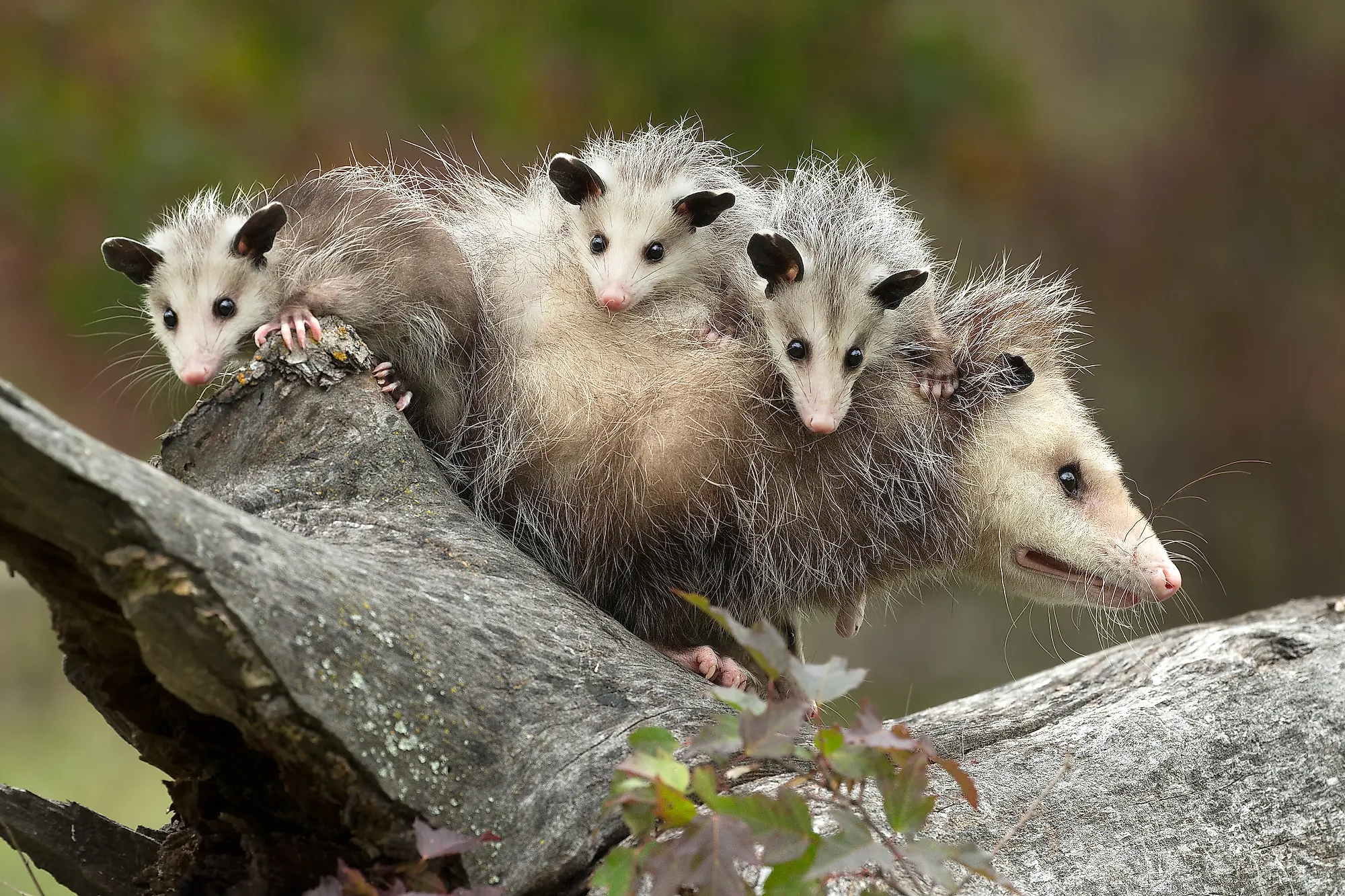
2. Opossum (12-14 days)

The opossum, another member of the marsupial order Didelphimorphia, is a mammal endemic to the Americas. Among the many subspecies, the Virginia opossum (Didelphis virginiana) is the only species in North America, and it is commonly known as a possum. It also has one of the shortest gestation periods in the world, ranging from 12 to 13 days. A typical litter can contain between 8 and 20 young, though many do not survive, as newborn opossums are extremely underdeveloped and must crawl to the pouch immediately after birth.
They also possess a placenta, though unlike those of other species, it is very simple and lacks complex functions. In terms of basic physical features, these animals range from 33 to 55 cm (13 to 22 inches) in length from snout to tail, and have a dull-gray or brown coat. They are also nocturnal and highly adaptable, feeding on insects, fruit, small animals, and carrion, which has helped them thrive in both wild and urban environments.
Along with the Virginia opossum, another subspecies is the water opossum (Chironectes minimus), which has a similar gestation period of 12-14 days. Found in Central and South America, this animal is locally known as the “yapok.” It is a semi-aquatic animal with several unique adaptations for living in water, including dense, water-repellent fur and broad hind feet.
3. Hamsters (16-21 days)

Hamsters belong to the rodent subfamily Cricetinae and are very popular house pets. There are about 19 species of hamsters, which are identifiable by their stout bodies, short tails, and thick fur. Depending on the species, hamsters range from 5 to 35 cm (2 to 13.8 inches) in length, with most reaching about 15 cm (5.9 inches) at maturity. Common examples include the Syrian hamster and several dwarf hamster species.
As prey animals in the wild, these small mammals have adapted to a fast-breeding cycle, reflected in their short gestation period of 16-21 days. A typical litter contains 6 to 12 pups, though larger litters can occur. Female hamsters can breed multiple times in a year and may become pregnant again shortly after giving birth. Their small size and high metabolic rate promote rapid development and frequent reproduction. However, the short gestation period leaves newborn hamsters underdeveloped and blind, and they require several weeks of care before becoming independent.
4. House Mice (19-21 days)

The house mouse (Mus musculus) is a small rodent belonging to the family Muridae. These small mammals are widespread across most of the world and have lived alongside human populations for centuries. They are commonly found near homes, farms, and storage areas, and have also been widely domesticated as pets and laboratory animals.
The average house mouse measures about 7.5-10 centimeters (3-4 inches) in body length, with a tail length of 5-10 centimeters (2-4 inches), and usually weighs under 30 grams. Like hamsters, their small size supports a short gestation period of just 19-21 days, allowing rapid reproduction vital for survival. This fast-breeding cycle helps mice maintain large populations even in unstable or resource-limited environments.
A typical litter contains 5 to 12 pups, and females can produce several litters each year. House mice reach sexual maturity quickly, usually within 5 to 6 weeks, and females are capable of mating again almost immediately after giving birth. This ability to reproduce continuously helps replace losses and sustain population growth in both wild and urban settings.
5. Eastern Quoll (20-24 days)

The eastern quoll (Dasyurus viverrinus) is a small carnivorous marsupial native to Australia. It belongs to the genus Dasyurus and was once widespread across southeastern Australia, though it is now mainly found in Tasmania after disappearing from the mainland. Eastern quolls are recognizable by their pointed snout, bushy tail, and spotted coat, which can be either fawn or black in color. The eastern quoll has a short gestation period of around 20 to 24 days. Like other marsupials, the young are born at a very early stage of development and continue growing in the mother’s pouch. A typical litter usually contains four to six joeys, which attach to the mother’s teats inside the pouch for several weeks after birth.
Adult eastern quolls typically measure about 45 to 55 cm (18 to 22 inches) in length, including the tail, and weigh between 0.9 and 1.7 kilograms (2 to 3.7 pounds). They are mostly nocturnal and feed on insects, small mammals, birds, and carrion. Their short gestation period supports a rapid reproductive cycle, helping maintain population numbers despite environmental pressures.
6. Rats (21-24 days)

Rats are a large group of animals in the rodent family, characterized by long tails and a medium-sized body. While similar in appearance to mice, they are much larger and less common as household pets. These animals are found worldwide, with various species, such as black and brown rats, dating back millions of years. The black rat is 28 to 40 cm long, including a tail about 18 cm long. While larger than mice, they are still quite small and have a short lifespan of about one year in the wild, prompting quick reproduction. To this end, female rats have a gestation period of 21-24 days. Females can also become pregnant again within 24 hours of birth, creating a rapid breeding cycle and exponential population booms.
Rats are highly intelligent and social animals that live in large groups called colonies. They have strong, continuously growing teeth that can chew through wood, plastic, and even soft metals. Historically, rat population booms have been recorded during periods of rapid urban growth, such as the Industrial Revolution, when dense housing and food waste allowed their numbers to increase quickly. These population explosions also contributed to the spread of diseases such as the bubonic plague.
7. Gerbils (21-25 days)

Gerbils are part of the subfamily Gerbillinae, a group of rodents with over 100 species. The most widespread is the Mongolian gerbil (Meriones unguiculatus), which is often kept as a house pet. This species, as well as many others in the subfamily, has a gestation period of 21-25 days, though this can vary depending on factors such as lactation and implantation. Female gerbils can also mate immediately after childbirth, increasing reproductive rates. The short gestation period allows multiple litters per year, helping ensure survival in harsh climates such as those in deserts where some species live. Gerbil pups are born hairless, blind, and very underdeveloped, relying entirely on the mother for warmth and milk during the early weeks of life.
These small mammals have slender bodies, long hind legs, and tails that are usually as long as their bodies. Most species measure 8-12 cm (3-5 inches) in body length and weigh 50-120 grams. They also have large eyes, soft fur, and strong claws adapted for digging deep burrow systems.
8. Wombat (20-30 days)

Wombats are large marsupials belonging to the family Vombatidae and are native to Australia. This muscular, short-legged mammal is one of the largest on this list, averaging around one meter in length and weighing over 20 kilograms across species. They have stout bodies with thick brown, gray, or black fur covering most of their body. Moreover, these animals have a relatively long lifespan of about 15 years in the wild and a slower metabolism than rodents like mice.
Surprisingly, despite these features, the wombat has one of the shortest gestation periods among mammals at just 20-30 days. While the exact length varies by species, this short pregnancy is possible due to the wombat’s well-developed pouch, where the newborn continues to grow for several months after birth. Like most marsupials, wombat young are born significantly underdeveloped and rely heavily on pouch life rather than long prenatal development. Wombats also typically give birth to only one offspring per pregnancy.
9. Muskrat (25-30 days)

The muskrat (Ondatra zibethicus) is a semi-aquatic rodent native to North America and belongs to the family Cricetidae. It is commonly found in wetlands such as marshes, ponds, lakes, and slow-moving rivers, where it builds dome-shaped lodges or burrows along the water’s edge. Muskrats are medium-sized rodents, typically measuring 40-60 cm (16-24 inches) in length, including their long, laterally flattened tail, and usually weigh between 0.6 and 2 kilograms (1.3-4.4 pounds). They have dense brown fur that helps keep them warm in cold water.
Muskrats have a relatively short gestation period of about 25 to 30 days. A typical litter contains 4 to 8 kits, though larger litters can occur under favorable conditions. Females can produce multiple litters per year, especially in warmer climates. Newborn muskrats are born blind, hairless, and completely dependent on the mother, growing rapidly during the first few weeks of life.
10. Domestic Rabbits (28-31 days)

The domestic rabbit (Oryctolagus cuniculus domesticus), as the name indicates, is a domesticated subspecies of the European rabbit. This small mammal is found everywhere except Antarctica in various breeds, historically kept as house pets and still used for food, fur, wool, and meat. Domestic rabbits have a very short gestation period of 28-31 days, which is vital considering that they were prey species in the wild. As with many other prey species, this rapid reproductive rate allows for multiple litters per year, improving the chances of group survival. However, newborn kits are born underdeveloped and grow rapidly outside the mother.
Beyond their reproductive features, these animals are admired for their thick fur and varying size. Different breeds differ immensely in size and shape, with tiny dwarfs like the Netherland Dwarf at around 0.9 kilograms (2 pounds), and giants like the Flemish Giant reaching over 7-9 kilograms (15-20 pounds). Rabbits also come in a range of colors, from solid to unique patterns like tricolored or spotted fur.
Mammals With The Shortest Gestation Periods
These ten mammals have the shortest gestation periods in the world. With factors like their small size, fast metabolic rate, and postnatal pouches affecting reproduction, most can give birth within a month. Moreover, some, like the opossum and dunnart, give birth just two weeks after impregnation. However, numbers vary, as gestation is affected by many factors, and some animal groups have species that may slightly fall outside the average range.