10 Animals That Live In Coniferous Forests
- The coniferous forest account for roughly 24-27% of global tree cover
- The largest area of wetlands in any ecosystem of the world is found in the Canadian boreal region with more lakes and rivers than anywhere else.
- Coniferous forests are home to 85 species of mammals, 130 species of fish, 32,000 species of insects, and 300 species of birds.
Coniferous forest ecosystems are the largest terrestrial biomes on earth and home to a wide variety of animals and plants. The forest includes a collection of evergreen and cone-bearing trees with temperate climate including plenty of precipitation, whether in the form of rain or snow. Trees found in the coniferous biome include hemlocks, pines, cedars, redwoods, fir, spruce, and cypress, and they tend to have long lifespans, some for thousands of years.
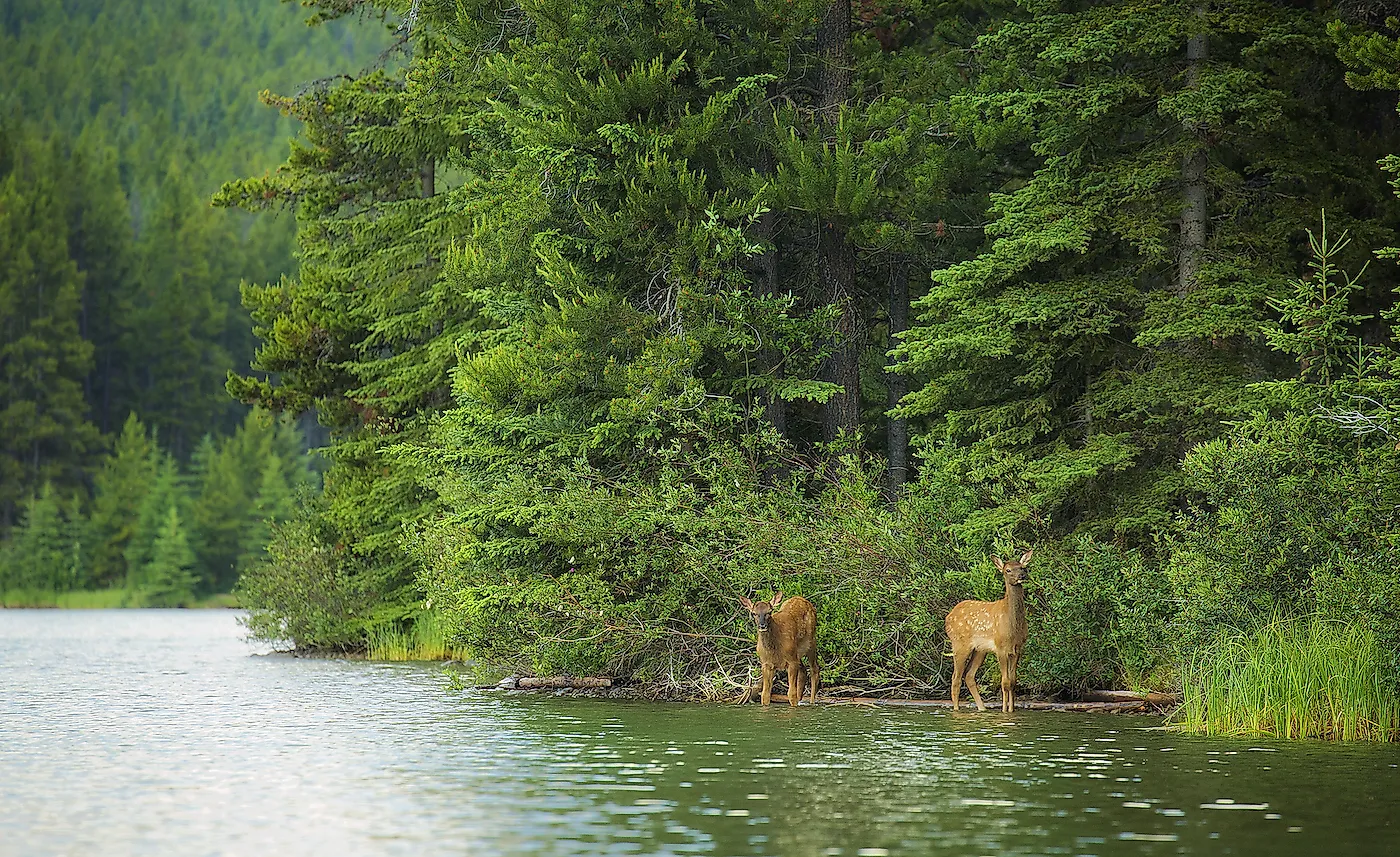
Many animals make their home in coniferous forests. Some have thick fur to insulate them against frigid winters, while others hibernate to endure the cold or migrate to warmer temperatures. A variety of mammals and invertebrates, from wolves and bears to large cats, moose, elk, porcupines, deer, squirrels, birds, insects, and snakes, are known to reside in coniferous forest zones.
These are a few of the most prominent animals found in coniferous forests around the world.
Owls

A variety of owl species nest in coniferous forests. The great grey owl is one of the largest species in the world and is found in the Northern Hemisphere. With its large round heard, grey face and feathers, and yellow eyes framed by dark circles, the great grey owl is distinct among its aviary counterparts.
Though it is only half as heavy as a snowy owl, the great gray owl earns its reputation for large stature from its 60-inch wingspan, long tail, and large facial disc. It has a fierce appetite for rodents and will hunt and eat up to one-third of its body weight each day.
The great grey owl is largely nocturnal, but may be seen at dusk and dawn, and will be found hunting during daylight hours in breeding season.
Coniferous forests are also inhabited by the long-eared owl, a common species in the Northern Hemisphere. Long-eared owls are found throughout Europe and North America, and some migrate to Asia to escape harsh winters. Its trademark "ears" are actually tufts of feathers located above its head, giving the owl its unique look and helping the medium-sized bird appear larger than it is.
The northern spotted owl can also be found in coniferous forest regions of western North America. These birds require a large amount of land for hunting and nesting.
After years of being disturbed by logging the population of the spotted owl dwindled and it was designated as an endangered species. They are now an indicator species, meaning their presence in a forest is a sign of a healthy ecosystem.
Grizzly Bear

Like the spotted owl, grizzly bears - one of the fiercest animals in North America - have been declared a threatened species in the lower 48 states in America and endangered in Canada.
Grizzly bears boast broad heads, extended jaws, large paws and powerful claws, making the bear capable of carrying large animals like full-grown cattle. They eat insects like ants or bees, seeds, roots, nuts, berries, and salmon - in fact, the grizzly is famous for its fishing capabilities.
Before western immigration and settlement, it was estimated that about 100,000 grizzly bears lived in North America. By the 1990s, that number had been reduced to fewer than 1,000, and most of those were living in preserves such as Yellowstone National Park. They are also found in Canada, in British Columbia, Alberta, the Yukon, and the Northwest Territories.
The main threat to the grizzly bear's status is destruction of its habitat. The animals, which can grow to between 500 to 1,000 pounds, require large spaces to roam and huge amounts of food.
Wolverine

Wolverines are reminiscent of a blend of a dog, skunk, and bear, with short legs, long hair, and an elongated snout. They wear a distinctive mask of dark fur around the eyes and forehead, with a stripe of blond or ivory fur down its back from shoulder to tail. As the largest member of the weasel family, wolverines grow to about four feet long and weigh up to 40 pounds and are capable of killing and eating an entire deer.
These weasels are omnivores and tend to hunt caribou, moose, deer, and mountain goats, as well as smaller animals such as squirrels and rodents, bird eggs, and berries. They prefer meat and will travel up to 15 miles in a 24-hour period to find prey or to feast on the remains of a dead animal.
Their keen sense of smell allows the solitary animals to hunt in all times of year, and wolverines can smell prey up to 20 feet under snow cover. They will dig unto burrows and kill hibernating animals during winter months.
Wolves

Several wolf species inhabit coniferous forests. The Eurasian wolf is a carnivorous subspecies found across Europe and Asia. Although its population has declined at various points in history, conservation efforts in its home countries have ensured the animals can thrive, and its numbers are believed to be stable. Eurasian wolves form large packs but are often solitary hunters.
Tundra wolves are among the largest subspecies, found in Eurasia from Finland to the Kamchatka Peninsula. The tundra wolf, which lives in packs of up to 20 animals, maintains a territory of more than 1,000 square miles because its prey is scarce. The wolf is threatened and hunted for its fur.
The gray wolf, also known as the timber wolf, inhabits various environments but is commonly found in coniferous forests. They stand about three feet tall and can reach lengths of three to five feet. Its long fur helps repel moisture, keeping the wolf warm and insulated during colder seasons.
At the top of the food chain, the timber wolf has no natural enemies and enjoys a stable population in Canada and Alaska, though they are considered an endangered species in most of North America.
Red Fox

The red fox is nocturnal, hunting at night for rodents, rabbits, birds, and other small game. The fox is not picky and will adjust its diet to its habitat, also eating fruit, vegetables, fish, frogs, worms, and, when living among humans, even garbage and pet food. This adaptability and resourcefulness have earned the red fox a reputation as a cunning and intelligent animal.
Red foxes are considered nuisances and are often shot because they kill farm animals or carry rabies, and they are sometimes hunted for sport, but their population remains stable.
Squirrels

Numerous squirrel species inhabit the trees of coniferous forests, including Abert's squirrels, which are usually found in the Rocky Mountains from Arizona to Mexico. These diurnal animals are active before sunrise and return to their nests at sunset, making brief forays during the day to forage. They favor ponderosa pines for nesting. Although not territorial, they tend to remain solitary throughout the summer months.
The Douglas squirrel is also a solitary animal found in coniferous forests, which prefers to take up abandoned nests left behind by woodpeckers or other birds. Like the Abert's squirrel they are diurnal; however, Douglas squirrels are territorial and will sound a loud, alarming call to ward off other animals.
Bobcat

As North America's most common wildcat, the bobcat is aptly named for its short, bobbed tail. The medium-sized cat is similar to, but smaller than, a lynx and sports a coat that ranges in shades of brown or beige, with spots or lines in black or dark brown. Bobcats live in the forest regions from British Columbia eastward to Nova Scotia in southern Canada, and southwards through most of the United States to central Mexico. They have been reported in every US state except Delaware.
A nocturnal animal, the bobcat is a nocturnal hunter, finding most of its prey during dawn and dusk. The cats mainly eat snowshoe hares in the north and cottontail rabbits in the south, as well as rodents, birds, and bats. Males are also known to hunt deer and other larger animals when smaller prey is scarce.
Bald Eagle

Known as the symbol of America, the blad eagle is one of the few omnivorous birds in the coniferous forest, living off of berries, buts, worms, and small rodents or fish. They typically nest in forested areas found next to large bodies of water and stay away from heavily-developed regions.
The bald eagle is tolerant of human activity and has adapted to take advantage of some development, congregating near fish-processing plants, dumps, and below dams where fish are found in high populations.
Their preferred perch is in tall, mature trees that offer a wide view and easy access to flight. The bald eagle is a powerful flier, capable of soaring over long distances.
Numbers of the bald eagle are considered a success of conservation efforts, increasing from 1966 to 2015. The bird was listed for protection as an endangered species in 1978 and since 1980, human behavior - including the banning of its highest pesticide threat, DDT - has allowed the bird's population to grow. By 2007, the recovery prompted the eagle's removal from the endangered species list.
Moose

An iconic animal of northwestern regions of North America, the moose is commonly found in confierous forest areas. Moose are the largest members of the deer family and one of the largest land mammals on the continent, standing as tall as 7.5 feet with an average weight of nearly 1,000 pounds.
The male Alaskan moose has the largest antlers in the deer family, measuring up to 6.5 feet across from tip to tip. These antlers are shed in late fall and early winter after the mating season, and in spring, males grow a new set, often larger than before. Moose use their antlers for protection and for fighting either to defend themselves or during the rut, when bulls compete for mating rights. Occasionally, the antlers of two males may become locked together, causing both to starve because they cannot forage or access water.
Most moose are herbivores, favoring twigs, bark, roots, and the shoots of woody plants, and they tend to prefer willows and aspens. During summer, moose will feed on aquatic plants like water lilies, pondweed, horsetails, and bladdworts.
Black Bear

The black bear, an omnivore, lives in the coniferous forest and is known as the smallest and most widely-distributed bear species in North America. Like the grizzly, the black bear feasts mainly on berries and salmon through the summer in order to sustain its hibernation, and though it lives in a forested area the bear will sometimes leave its habitat in search of food. Interactions with humans are common as the black bear will be attracted to immediate sources of food found in garbage cans or camping areas.
Black bears are considered a least-concern species due to their large, widespread population, which is estimated to be twice that of all other bear species combined. It is one of two species not considered threatened with extinction or endangered, along with the brown bear.
Depending on winter conditions, black bears generally hibernate for three to eight months. Sometimes the bears will hibernate for weeks at a time, waking to forage and then settling back into their dens, especially where winter is mild.