The Siege of Masada is one of the most powerful episodes of the First Jewish Revolt against Rome. It tells the story of a group of Jewish rebels who held out against Roman forces in a remote desert fortress, and, according to the primary historical account, chose death over capture. The story comes almost entirely from the writings of the Jewish historian Flavius Josephus. Because of this, historians continue to debate how much of the account is factual and which elements may have been shaped by literary or political motives.
One invariable truth is that it took the Romans a great deal of time and effort to defeat them. The rebels had taken over the great fortress of Masada, and because of where and how it was built, it was extremely hard for the Romans to conquer it conventionally. When Roman soldiers were deployed to capture them, the rebels were severely outnumbered, with historical estimates being roughly 15:1 (15,000 Romans to 1,000 Jews). Although they faced overwhelming odds, their resolve never wavered. On the final day of the siege, as per Josephus, approximately 960 Jewish rebels committed suicide defiantly in the face of defeat.
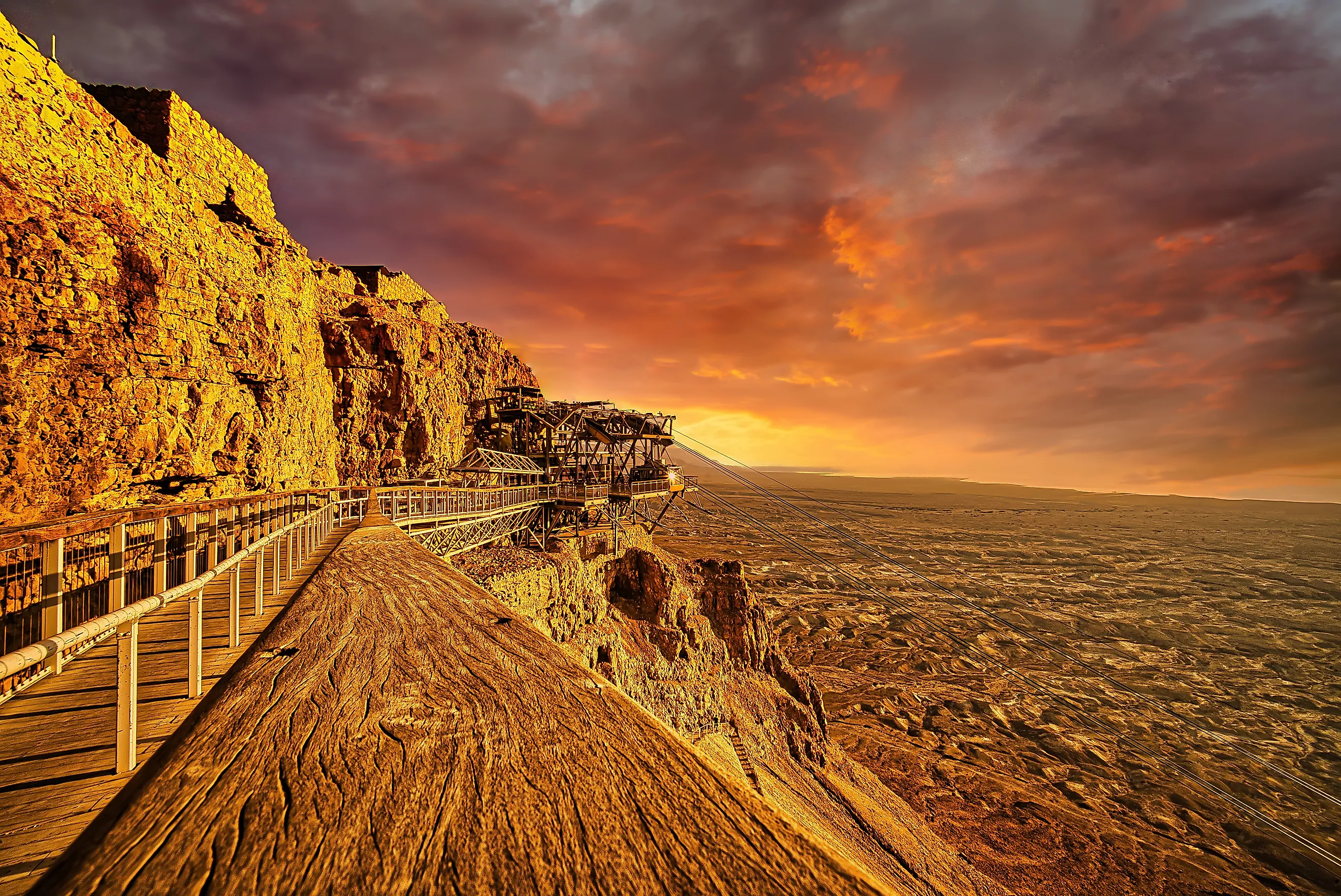
Sunrise view of the ancient ruins of the Masada Fortress (Credit: RnDmS via Shutterstock)
The siege of Masada was the last standoff that took place at the end of the First Jewish Revolt. The revolt began in 66 AD when the Jewish people decided to fight back against the heavy taxation and religious oppression the corrupt Roman government had been imposing for years. Before Jerusalem was taken over in 70 AD, there was already infighting among Jews, leading to factions of religious zealots disagreeing on how to respond to the Roman authorities. Some favored compromise over open resistance.
One of these factions was the Sicarii, a splinter group known for violent assassinations and radical resistance. They had taken over the fortress of Masada by tricking the Roman garrison with a sudden attack, made it a stronghold, and were prepared to fight for it to the death. By the time the Romans plotted their siege to take it back in 72 AD, the resistance had largely collapsed, though scattered groups, including those at Masada, remained. The Sicarii refused to give in and remained defiant until the very end.
How They Withstood The Romans
The men knew they had the odds stacked against them. There is no doubt that the leadership of Eleazar ben Ya’ir, who, unlike other rebel leaders, preached violence, not peace, inspired their choice not to surrender. Secure in the fortress, they had the following advantages:
Higher Ground
Masada, the ancient fortification in the Southern District of Israel. (Credit: photosounds via Shutterstock)
Anyone who understands the art of war knows that higher ground can be a massive advantage in battle. Masada's higher ground advantage was astounding. Built upon an isolated plateau within a cliff, roughly 1,400 feet above the surrounding desert, the fortress was seemingly impregnable. The cliff was next to impossible to scale. Higher ground gave them surveillance intelligence. It provided panoramic views of their enemy, preparing them for oncoming attacks. And of course, there is the advantage of gravity. While the Romans did employ projectiles, what goes up must come down, so this tactic proved largely ineffective.
Narrow Access Path
Masada (Credit: eskystudio via Shutterstock)
In the Battle of Thermopylae, the Spartan forces did so well against the Persians because they fought in a narrow pass that allowed only a limited number of people through. This tactic lessens the impact of being outnumbered. Similarly, the famous Snake Path that leads up to Masada on the other side of the cliff, a tourist attraction that hikers still attempt to climb today, would only allow for a thin string of soldiers to ascend at a time. It is also physically demanding. With complex zig-zags and without the ability to walk two abreast, this meant that if soldiers attempted the climb, it would be in a one-on-one fight at the top.
Structure
Ruins of Masada
Even if the soldiers were able to scale the cliffs or make it up the pass, they had to deal with a heavily fortified casemate double wall that surrounded the entire fortress. The wall was 1400 meters long and 4 meters thick, and although this would not have caused the Romans too much trouble if they had been able to attack Masada head-on, it added another problem, making the fortress even more imposing.
Storage Rooms
Masada (Credit: vvvita via Shutterstock)
With the fortress seemingly impenetrable, starving the Sicarii out would seem a viable option; however, Masada had many storehouses full of provisions and water cisterns that were extremely advanced for the time. The rebels had food and water to last for months. The Roman governor Lucius Flavius Silva, who commanded the legion of Roman soldiers, wanted the Sicarii captured to finally end the revolt. So what could be done?
The Siege Ramp
Roman siege engine at the base of the Roman ramp at Masada in Israel.
Despite these advantages, the Romans approached the siege systematically. They built a circumvallation wall around the base of the mountain to cut off escape and supply routes. They also established several camps, many of which are still visible today. To finally conquer the fortress, the Romans decided their best plan of attack was to build a ramp. Simply put, if there wasn’t a safe path for them to take, they were going to build one. Built using earth, stones, and likely forced labor, the ramp allowed them to bring siege equipment up to the walls.
Along with the ramp, they also built a siege tower equipped with a battering ram. According to Josephus, this eventually breached the fortress defenses. With fewer than a thousand rebels in the fortress, the chances of survival were slim for the Sicarii.
How Long Did The Siege Last?
Sunrise view of the ruins of the Masada Fortress and the Dead Sea, Judaean Desert, southern Israel (Credit: RnDmS via Shutterstock)
There is much debate as to how long the siege lasted. Josephus does not provide precise dates, and estimates vary. Many modern scholars believe the siege likely lasted several months, rather than years, based on archaeological evidence and Roman military practices. Roman soldiers had a reputation for brilliance in battle, and Emperor Vespasian, a former commander of the Roman forces, wanted the revolt put down. This could lend credit to the idea that the siege was much shorter than Josephus implied.
The fall of Masada is often remembered as the final act of the First Jewish Revolt. Whether the events unfolded exactly as Josephus described remains uncertain. What is clear is that Masada represents a moment of intense resistance at the edge of a collapsing revolt. Today, it stands as both an important archaeological site and a symbol, interpreted in different ways as defiance, tragedy, and the complexities of historical memory.