Why Modern Concrete Crumbles, But Ancient Roman Concrete Lasts Forever
The Roman Empire had a lasting influence on government, culture, and trade that continues to shape the modern world. One of its most enduring legacies is Roman concrete, which allowed builders to construct durable structures that have survived in part for nearly two thousand years. The strength of these buildings came from advanced engineering techniques and materials, while Roman emphasis on proportion and balance contributed to their visual appeal as well as their functional design.
Roman architectural influence is especially visible in Washington DC and in civic architecture throughout the United States. Many government buildings, museums, and financial institutions draw directly from ancient Roman design, using columns, domes, and arches inspired by classical models. These elements were adopted to convey permanence, order, and civic authority, qualities associated with Roman law, governance, and public life.
Banks in particular have long relied on classical architectural elements such as columns, symmetry, and high ceilings to project stability and institutional authority. A clear example can be found in San Francisco, where a five-story building on Grant Avenue, designed by Bliss & Faville and completed in 1910, once served as the Savings Union Bank. Its monumental scale and classical detailing reflect the influence of ancient Roman and Greek design filtered through early twentieth-century civic architecture.
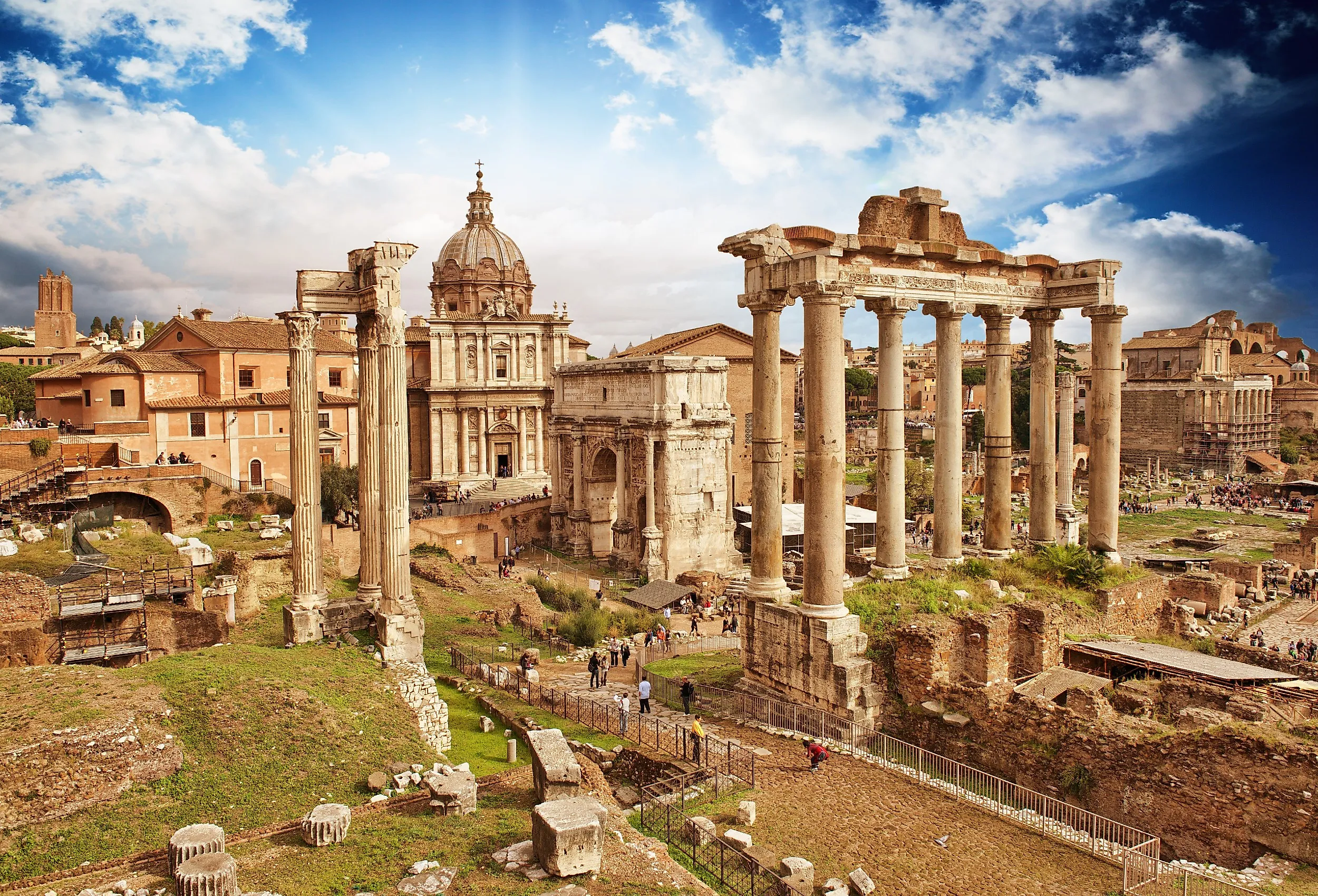
Although the Western Roman Empire fell in 476 CE, many of its most influential structures have endured. The Pantheon remains one of the best-preserved buildings of the ancient world, while the Colosseum survives as a powerful ruin. Together, they continue to shape architectural traditions centuries after their construction.
While modern concrete does not crumble because it is inferior. Roman concrete appears more durable because of its unique chemistry, massive construction methods, and the environments in which surviving examples remain.
Roman Buildings

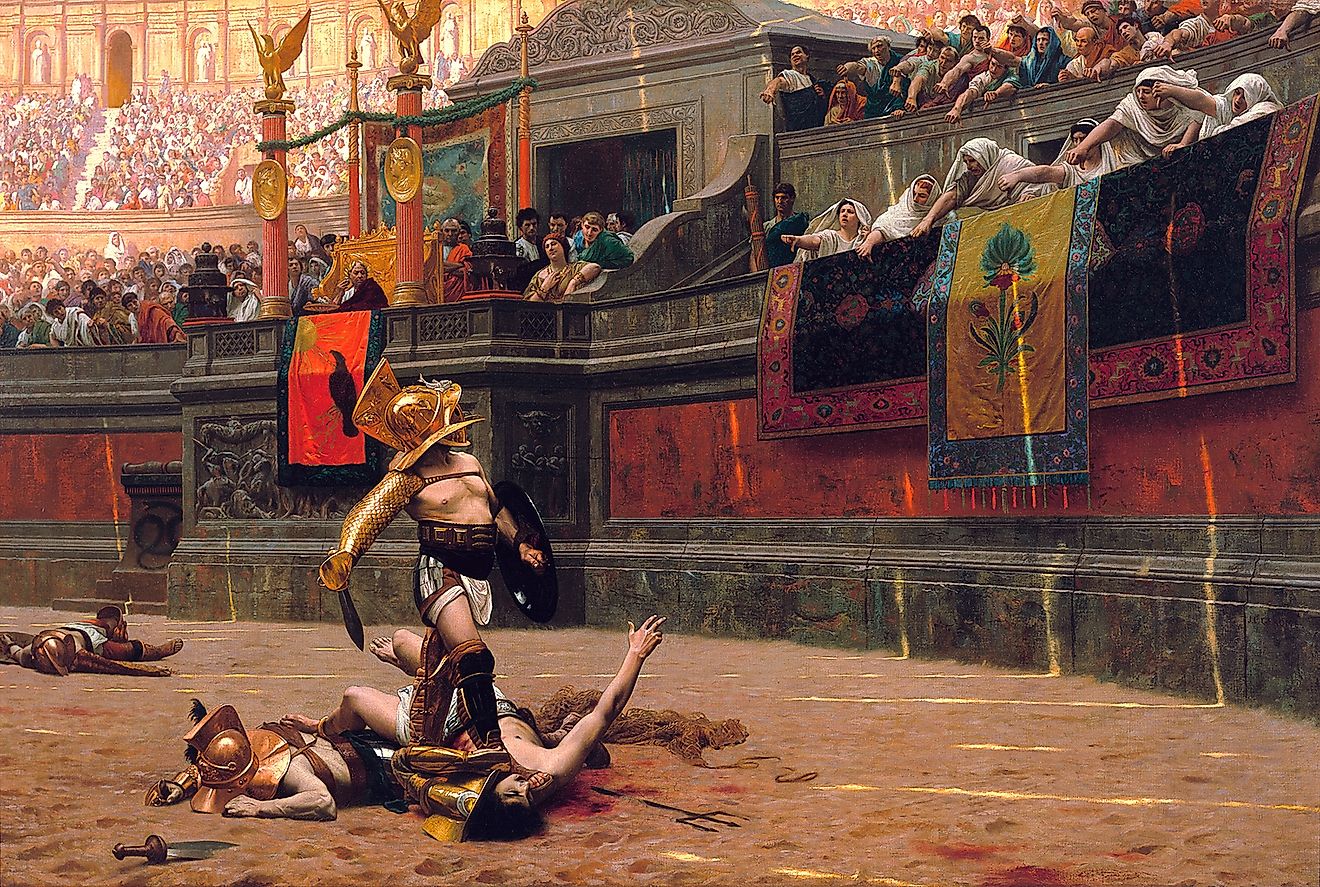
Throughout the Roman Empire, architects and engineers constructed monumental buildings that served public, political, and social functions. Amphitheaters were large, open-air structures, usually oval in shape, with tiered seating designed for public spectacles such as gladiatorial contests, animal hunts, and executions. In Rome itself, the Colosseum stood as the empire’s largest amphitheater and a central venue for state-sponsored entertainment.
As Roman control expanded across Europe, North Africa, and parts of Western Asia, infrastructure played a key role in maintaining urban life. Aqueducts were built to supply cities with fresh water for drinking, bathing, and sanitation. Many of these structures remain visible today in regions such as Spain, France, Italy, Turkey, Greece, and North Africa, demonstrating the empire’s advanced understanding of hydraulic engineering.
Most urban residents lived in multi-story apartment buildings known as insulae, which housed the lower and middle classes. Wealthier Romans lived separately in private residences called domus, often centered around courtyards and gardens. This division reflected the social hierarchy of Roman cities.
The Romans also erected triumphal arches to commemorate military victories and imperial achievements. Several survive today, including the Arch of Titus, the Arch of Septimius Severus, and the Arch of Constantine in Rome. These monuments continue to provide insight into Roman political messaging, architectural skill, and imperial identity.
Roman Architecture

Roman architecture developed through the adaptation of earlier Greek and Etruscan traditions, reshaped to serve the needs of an expanding empire. Several emperors played direct roles in shaping this architectural legacy. Emperor Hadrian oversaw an ambitious program of construction and restoration across the empire, favoring Greek-inspired styles while supporting innovative engineering. Emperor Vespasian began construction of the Colosseum, a project completed under his successor Titus, which became one of Rome’s most influential public structures.
The Roman architect Vitruvius outlined the principles of architecture in his first-century BCE treatise De Architectura, arguing that successful buildings should combine strength, utility, and beauty. Beyond function, architecture also served a political purpose. Monumental civic buildings, forums, temples, and baths reinforced Roman authority by presenting a consistent visual language of order, symmetry, and permanence across imperial territories.
Early Roman temples followed Greek models, incorporating Doric, Ionic, and Corinthian column orders. These temples were typically front-facing, with emphasis placed on the facade and a deep columned porch rather than full perimeter colonnades. Structures such as the Temple of Portunus in Rome and the Maison Carrée in Nîmes illustrate this early Roman adaptation of Greek temple design.
As Roman engineering advanced, builders expanded beyond Greek precedents. Materials were sourced from across the empire, including Egyptian granite and marble from Greece, Italy, and Asia Minor. The widespread use of arches, vaults, and domes allowed Romans to construct vast interior spaces while still incorporating classical columns, resulting in monumental buildings that combined decorative tradition with structural innovation.
Ancient Roman Concrete versus Modern Concrete

The Romans advanced the widespread use of concrete, particularly through their development of lime-based mixtures combined with volcanic ash known as pozzolana. This material, especially when used in marine environments, has shown remarkable durability over long periods. Pozzolanic reactions occur when silica- and alumina-rich volcanic ash reacts with lime in the presence of water, forming compounds that strengthen the concrete. The term pozzolana comes from volcanic deposits found near Pozzuoli in Italy, where the material was first identified and widely used by Roman builders.
Research into the longevity of Roman concrete has been led in part by University of Utah geologist Marie Jackson and her colleagues, who studied samples taken from ancient Roman harbor structures near Naples. Their analysis showed that seawater slowly interacted with the volcanic ash within the concrete, dissolving some components and triggering the growth of new minerals, including aluminous tobermorite. These interlocking crystals increased the material’s toughness and resistance to cracking, helping explain why Roman marine concrete has remained stable for nearly two thousand years in harsh coastal conditions.

Modern concrete differs from Roman concrete primarily in its binder chemistry and structural role. Today’s concrete is typically made using Portland cement, produced by heating limestone and clay to form clinker, which is then ground and mixed with water and aggregates such as sand and crushed stone. This material gains strength relatively quickly through hydration reactions, allowing structures to be built on tight construction schedules.
Unlike most Roman concrete, modern concrete is commonly reinforced with steel rebar to handle tensile stresses. While steel reinforcement greatly increases load-bearing capacity, it also introduces long-term durability challenges. Over time, carbon dioxide and moisture can penetrate concrete, lowering its alkalinity through carbonation and allowing steel to corrode. As the corroding steel expands, it creates internal stresses that lead to cracking and spalling of the surrounding concrete.
Research by scholars including MIT professor Admir Masic has highlighted that Roman concrete followed a different durability pathway. Roman marine concrete, in particular, continued to strengthen over time as chemical interactions between volcanic ash, lime, and seawater produced new mineral formations. Despite this long-term durability, Roman concrete is not widely used in modern construction because it lacks predictable early strength, standardized performance metrics, and compatibility with steel reinforcement systems required for contemporary engineering and building codes.
To Summarize

Concrete remains one of the most versatile construction materials ever developed. From ancient harbor works to modern buildings, bridges, dams, and sidewalks, it has shaped both past and present infrastructure. Roman builders used concrete in combination with arches, vaults, and massive forms to create durable structures, some of which still survive today. In certain environments, especially near volcanic regions and coastal waters, the chemical composition of Roman concrete contributed to its long-term stability.
Roman concrete, however, gained strength slowly and was suited to thick, unreinforced construction rather than the fast-paced demands of modern engineering. Modern concrete, by contrast, is designed for rapid curing, predictable performance, and compatibility with steel reinforcement. While this approach introduces long-term maintenance challenges, it allows structures to meet contemporary safety standards and construction timelines.
Roman concrete is unlikely to see widespread modern use, but its study continues to inform advances in materials science. Rather than a choice between ancient and modern methods, ongoing research aims to combine durability, efficiency, and sustainability in future concrete technologies.