Lost Civilizations We Still Know Little About
Historians tend to view history as a puzzle, and with each new discovery, they add another piece to an ever-evolving picture. Some historical pictures seem complete, such as the Roman Empire or Ancient Egypt. Over time, researchers have been able to establish clear timelines of events through artifacts and archaeological finds.
At the same time, large gaps remain in humanity's story. Empires and civilizations rose and fell throughout thousands of years, leaving ruins and clues behind that we still cannot fully decipher. Some of these lost civilizations built cities and developed complex trade networks. Others mastered advanced engineering, but none left a manual to explain their languages, rituals, and lifestyles. All researchers have to work with are soil and stones, and, in some instances, shards of pottery or ancient burial plots. And while they will continue to piece together the puzzle of these lost civilizations, it is abundantly clear that certain parts of human history are far more convoluted than they could have imagined. The following civilizations are some we still know little about.
Indus Valley Civilization

The mysterious Indus Valley Civilization is considered the earliest urban culture of the Indian subcontinent. Also known as the Harappan Civilization, this Bronze Age culture inhabited the northwestern regions of South Asia between 3300 BCE and 1300 BCE. It was the most widespread of the three earliest civilizations at the time, stretching across Pakistan, parts of Afghanistan, and specific regions of India. Historians believe that at its peak, this civilization housed around 5 million people, making it larger than contemporary Egypt or Mesopotamia.
Today, Indus sites still exist in Pakistan and northwest India, with around 1,500 settlements discovered. Mohenjo-daro and Harappa are the two most famous discoveries and are still being studied by researchers. Based on what has been found, historians deduce that people in the Indus Valley mastered urban planning. Harappa and Mohenjo-daro were built with exceptional precision and featured street grids. They also created the world's first known urban sanitation systems, with nearly every house equipped with a private bathroom and drainage. The drains were linked to a main street sewer, ensuring proper hygiene.

It is also clear that the Indus people built for the public and not for kings or leaders. There are few grand monuments at the sites discovered, and the Great Bath at Mohenjo-daro was essentially a large public pool. Beyond these discoveries and realizations, experts know little about the Indus civilization. Thousands of soapstone seals have been discovered over the course of decades of research, but the symbols and animals carved on them have yet to be decoded. To date, no one has been able to translate this language, which means we do not know who their leaders were, the laws they may have followed, or even what they called themselves.
The Indus culture started to decline around 1900 BCE. Some theories blamed an Indo-Aryan migration. Now, some researchers believe that climate change may have been to blame. Research suggests that the Sarasvati River dried up and that a shift in monsoon rains made it impossible to farm. The result may have been that people abandoned their great cities and headed towards the Ganges.
Norte Chico

Experts believe that a city called Huaricanga was established in the Fortaleza Valley on Peru’s north central coast nearly a thousand years before the first pyramids were built in Egypt. They also believe that Huaricanga was the first of its kind built by the Norte Chico civilization. The Norte Chico expanded into and inhabited the Pativilca and Supe Valleys. They grew cotton and built trading routes. They also managed extensive fishing processes. But they never used ceramic, did not have a written language, and never made war. Instead, they built storage warehouses to keep their cotton. They also built the city of Caral, which included homes, plazas, temples, and an amphitheater. They also built six stepped pyramids, the largest measuring 160 meters by 150 meters.
But despite the Norte Chico’s apparent good fortune, they could no longer sustain their economy by 1800 BCE. As new civilizations began to rise around them, the Norte Chico slowly faded away, possibly due to prolonged drought. All they left behind were their pyramids and other ruins.
Archaeologists also discovered a quipu at Caral, a set of knotted strings once used for record keeping. Other cultures that followed the Norte Chico used quipus for taxes and censuses. These cultures included the Inca. The fact that the Norte Chico was using this system in 3000 BCE is sufficient proof, for some, that they invented the first data storage system in the Americas.
While this is all that is known about the Norte Chico, it cannot be denied that their impact set the foundation for Andean culture. Their architecture influenced the Chavin, the Moche, and the Inca. They also established structures that influenced society for the next 4 millennia.
The Kingdom of Aksum

The Kingdom of Aksum has its own fascinating history, a history we are still trying to understand today. What researchers do know is that the kingdom was the first major African empire to adopt Christianity. But long before that, it was a global trade force, even if its origins are largely unclear. Aksum was located where the Roman Empire, India, and Southern Arabia met. Today, this area is known as northern Ethiopia. There are records of the kingdom's later history, but the period before 500 AD is still rather murky.
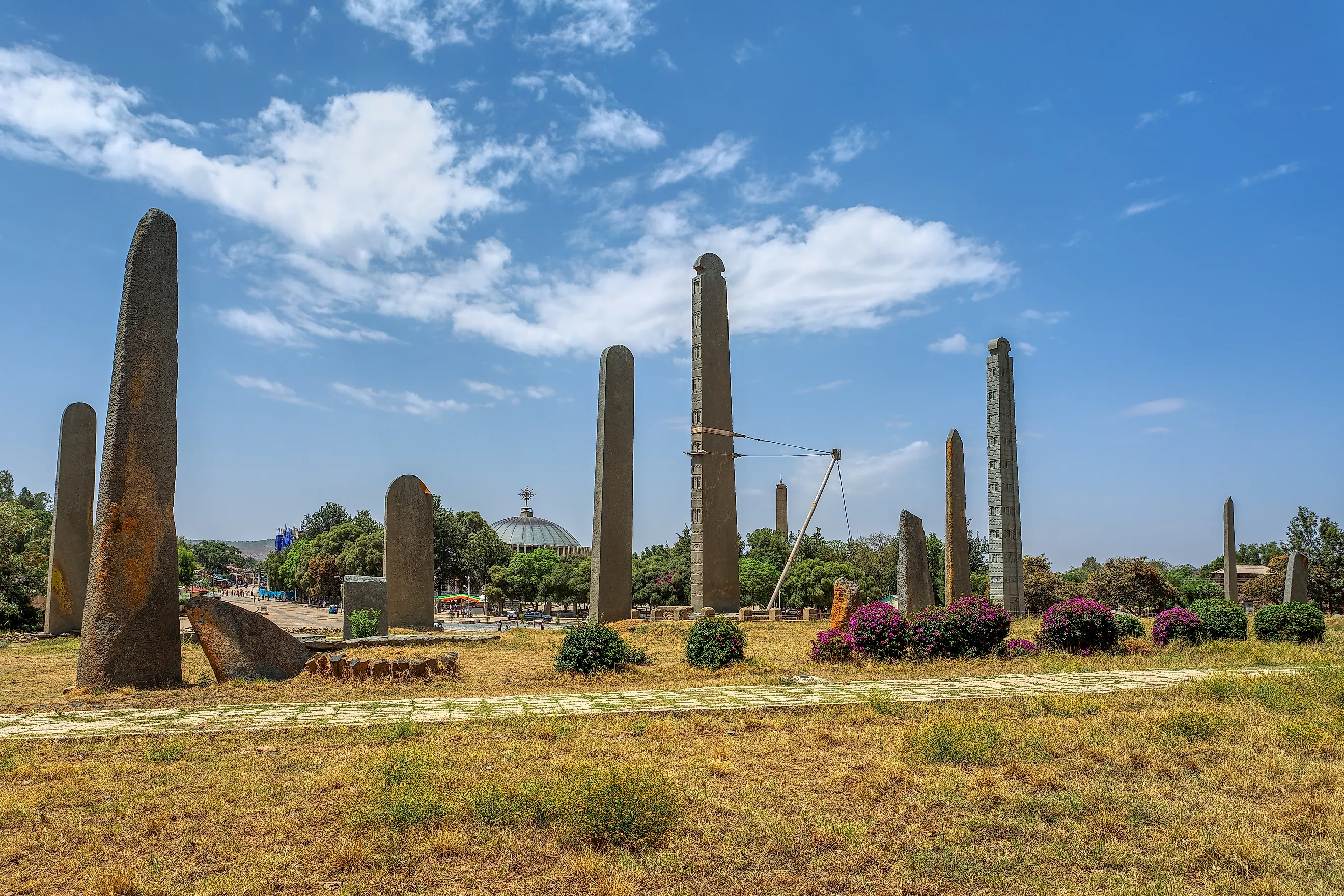
What remains of the Aksum era is fascinating, especially the Stelae of Aksum. These monolithic towers, carved from massive granite blocks to resemble multi-story buildings, were actually grave markers. They came complete with 'false doors' and windows. The largest of these, the Great Stele, was once over 108 feet tall and weighed around 520 tons. That is just about the same weight as 80 African elephants. It is unknown how the Aksumites transported these stones from quarries miles away. Researchers also do not know how they erected them with such incredible precision.
Furthermore, Aksum, aside from Meroe and Egypt, was the only African state at the time to create written records. The famous Ezana Stone features several inscriptions in several languages that recount the Aksumite ruler's military skills. Aksumite coins also featured several languages, with gold coins bearing Greek mottos and brass coins bearing Ge'ez inscriptions.
At the same time, even though the Aksumites appeared incredibly advanced, minting their own coins and building giant towers, we know little about their early social life. Most of what they built for living, including houses and markets, rotted away over the centuries since it was constructed of wood and mud. The stone 'skyscrapers' and some coins remain, but this is not enough to depict how the Aksumites lived day to day.
The Tartessos Civilization

The history of Tartessos, for many historians, sits on the cusp of myth and reality. For one, historians believed for many centuries that Tartessos was nothing more than a legend. Some thought that Tartessos was Tarshish, mentioned in the Bible as a land of infinite silver. Others were convinced that Tartessos was the real inspiration behind Plato's Atlantis. But then, archeological discoveries in southern Spain proved that between the 9th and 6th centuries BCE, a very real civilization controlled the area around the mouth of the Guadalquivir River.
These discoveries proved that the Tartessians were master metallurgists. This is not surprising, since they lived on top of the Iberian Pyrite Belt. They mined gold and silver and worked to perfect cupellation, a process that separates pure silver from lead ore. This incredible technology made Tartessos an attractive trade partner for the Phoenicians and Greeks. They traded exotic luxury goods for Tartessian metals. The resulting wealth created a local culture where Iberian traditions mixed with Middle Eastern art. This, in turn, resulted in stunning artifacts like the Treasure of El Carambolo.
This part of the Tartessian story is not the most mysterious. What continues to baffle historians today is the reason behind the decline of Tartessos. Sites including Cancho Roano and Casas del Turunuelo have provided evidence that the Tartessians participated in a chilling ritual. It appears that there may have been a massive event around 500 BCE, culminating in the sacrifice of dozens of livestock and horses. After the sacrifice, it is believed that the Tartessians removed valuables from their buildings and then set them on fire. When the fire burned itself out, they covered what remained in dirt and clay. What is incredibly strange about this is that the Tartessians did not flee conflict or invaders. They destroyed their own spaces and simply walked away. Their Paleo-Hispanic writing is still only partially deciphered, so at the moment, more questions than answers remain.
The Nok Culture

The Nok Culture suddenly appeared on the Jos Plateau in Nigeria around 1500 BCE. They also left behind an enduring archaeological mystery. The Nok people are famous for their terracotta sculptures, featuring clay heads and perforated eyes. These statues are the oldest known figurative art in sub-Saharan Africa, but historians still do not know who the people were or why they made them. The hairstyles and jewelry of these sculptures suggested that the Nok lived in a society that valued status and fashion. Many of these statues have been discovered buried, either moved by floods or people. It is unknown whether their purpose was to depict ancestor spirits or to serve as grave markers. Some experts believe they may have been 'lucky charms' to help protect crops. But none of these theories has panned out as yet.
It is also believed that the Nok were technological pioneers who skipped the Bronze Age, moving directly from the Stone Age to the Iron Age. One of the remaining Nok archaeological sites, Taruga, demonstrated that the Nok were smelting iron as early as 500 BCE. They used advanced furnaces that allowed them to create tools to overhaul their agricultural processes. As such, they could clear entire landscapes, a feat that their neighbors could not replicate.
Despite these achievements, the Nok are known as 'ghosts' today because no Nok skeletons have ever been found. The soil on the Jos Plateau is extremely acidic, which means it breaks down organic matter. So, nothing but stones, iron slag, and clay remains in the area. There is no way to perform DNA tests to definitively establish which of the modern ethnic groups in the area may be the descendants of the Nok. There is also no way to study Nok teeth to determine what they ate or the diseases they died of. And, when the Nok stopped making their sculptures around 500 AD, it does not necessarily mean the civilization died out. They may have adopted a new way of life. But, since there is no way to know this for sure, historians remain in the dark.
Some Chapters of Ancient History Remain a Mystery
History is not always told by those who prevailed or those who left behind incredible writings and books. These lost civilizations prove you can be brilliant and still be forgotten. The Indus people knew more about plumbing than anyone else at the time. The artists of the Nok knew something we probably never will. Yet, these empires have faded away because we do not understand their languages, or their homes have completely rotted away. Experts are left staring at a frustrating puzzle with some of the most important pieces still missing. Whether the puzzle will eventually be completed remains to be seen.