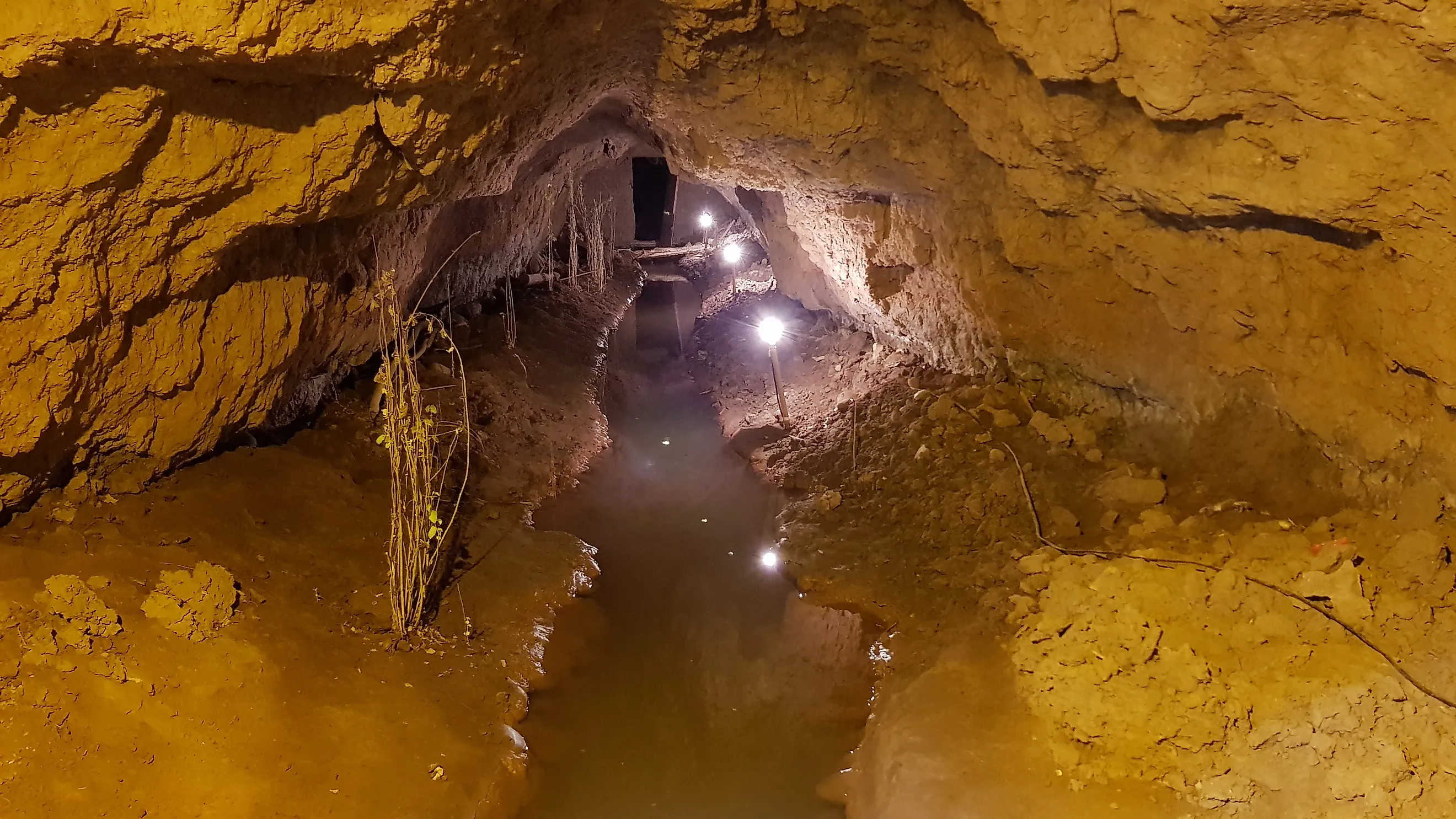
Ancient Tunnels Still Functioning
Gravity was the only engine the ancient world needed to move water. Engineers cut channels at a shallow slope so the water would run downhill on its own for miles. A qanat in the Iranian desert has watered crops this way for more than two thousand years. The design outlives the empires that built it, as long as someone keeps the channel clear. That is why a handful of these tunnels still deliver water today, across three continents.
Hezekiah's Tunnel, Jerusalem

King Hezekiah of Judah faced an Assyrian army marching on Jerusalem around 701 BC. His answer was to hide the city's water. Workers cut a tunnel through solid limestone to carry the Gihon Spring inside the walls, where Sennacherib's besieging troops could not reach it. The winding passage runs about 1,750 feet and empties into the Pool of Siloam.
Two crews dug from opposite ends and met in the middle, a feat recorded in an ancient Hebrew inscription found on the tunnel wall in 1880 and now held in the Istanbul Archaeology Museums. More than 2,700 years later, spring water still runs through the passage, waist-deep in places, and visitors can wade its full length beneath the City of David. It belongs to a long record of engineered water supply in the city, which includes a Roman-era aqueduct that archaeologists uncovered in Jerusalem in recent years.
Cloaca Maxima, Rome

The Roman Forum was a swamp before it was a forum. Around 600 BC, under the king Tarquinius Priscus, Etruscan laborers and Roman citizens dug a great drain to pull standing water off the valley floor and send it to the Tiber. The Latin name means Greatest Sewer. Once the marsh was gone, the drained ground became the civic center of the Roman world.
The channel was later roofed over and tied into the growing city's baths and latrines. It still does part of its original job. Rainwater and runoff from beneath the Forum, the Velabrum, and the Forum Boarium drain through surviving sections into the modern sewer network, roughly 2,600 years after the first stones were set. That endurance places it among the oldest sewers still in use anywhere, and it reflects the drainage and durability that defined Roman engineering.
Qanat of Gonabad, Iran

In the dry plains of northeastern Iran, the only reliable water lies deep underground. More than 2,500 years ago, during the Achaemenid period, Persian workers reached it by building the Qasabeh Qanat at Gonabad. A qanat is a gently sloping tunnel that taps an aquifer at the foot of high ground and moves the water to fields and towns by gravity alone. The main shaft here descends about 300 meters (roughly 1,000 feet), among the deepest of any qanat ever built.
The system still works. Water travels along about 33 kilometers (21 miles) of hand-cut channel fed by hundreds of wells, and roughly 150 liters a second still surface near Gonabad. UNESCO added the Persian qanats, Gonabad among them, to its World Heritage list in 2016. The technique spread west into the Arab world and east along the Silk Road, yet the original channels here still carry water today.
Aqua Virgo, Rome

Agrippa, the general and son-in-law of the emperor Augustus, completed the Aqua Virgo in 19 BC to supply his new public baths in the Campus Martius. The aqueduct draws on springs about 13 miles east of the city and delivers the water through a line that runs mostly underground into central Rome. Of the eleven aqueducts that served the ancient city, this is the only one that has stayed in continuous use.
Most tourists see its endpoint without knowing it. The same water that Agrippa's engineers captured now pours from the Trevi Fountain, and it also feeds fountains at Piazza Navona and the Spanish Steps. Popes and engineers repaired and rerouted the line over the centuries, and the modern conduit carries the name Acqua Vergine. After more than 2,000 years, the spring still reaches the heart of Rome along Agrippa's route.
Aflaj of Oman

Farming in Oman's interior depends on a network of channels called aflaj. Each falaj carries water by gravity from an underground source or a mountain spring to the date gardens and villages below. The tradition reaches back more than two thousand years, and about three thousand of these systems still run across the country. Communities divide the flow by carefully timed shares, a schedule once set by the sun and the stars.
Five of the aflaj were placed on the UNESCO World Heritage list in 2006. Among them is Falaj Daris near Nizwa, the largest in its region, which still moves a strong and steady flow to its farms. The channels remain central to rural life even as modern wells and a falling water table put pressure on the old sources. They are one of the ways people have made a living in the world's great deserts.
Karez of Turpan, China

The Turpan Basin in western China is one of the hottest and driest places on the continent, with only about 16 millimeters (0.6 inches) of rain a year. Farmers there grow grapes and melons anyway, thanks to the karez. These underground channels tap groundwater fed by snowmelt from the nearby mountains and carry it for miles below the surface, where the desert heat cannot draw it off through evaporation. The network at Turpan is often dated to more than two thousand years ago.
At its height the system held well over a thousand channels and stretched thousands of miles underground, which earned it the nickname the Underground Great Wall. Modern wells and pipes have taken over much of the work, and only a few hundred karez still carry water. Those that remain supply a meaningful share of the basin's irrigation, and local families still clear and maintain the channels their ancestors dug.
Built to Move Water, Not to Impress
The tunnels that survived share a plain design. Each uses the slope of the land so that gravity, and nothing else, moves the water, with no pumps, no power, and no moving parts that wear out. What kept them running was not only the original digging but centuries of patient cleaning and repair by the people who relied on them. A Roman aqueduct or a Persian qanat fails the moment maintenance stops, and the ones still working are the ones a community never let go dry. The water keeps moving as long as someone keeps clearing the channel.