9 Wonders In Irrigation Engineering Across History
The first cities couldn't exist without irrigation. Rome ran on eleven aqueducts totaling about 500 kilometers of channel that delivered roughly a billion liters a day at peak. Iran's qanats predated them by at least half a millennium and are still flowing. Libya pumps 6.5 million cubic meters of fossil water across the Sahara every day through pipes wide enough to drive a car through. The nine projects ahead, ancient and modern, rank among the most consequential water-engineering achievements in human history.
Irrigation Wonders Of The World
| Name | Location | Year Built |
|---|---|---|
| Roman Aqueducts | Rome, Italy | 312 BC |
| Qanat System | Iran | 1000 BC |
| Great Man-Made River | Libya | 1991 AD |
| Incan Aqueducts | Peru | 1400 AD |
| Dujiangyan Irrigation System | China | 256 BC |
| Hohokam Canals | United States (Arizona) | 600 AD |
| Aswan High Dam | Egypt | 1970 AD |
| California State Water Project | United States | 1973 AD |
| Murrumbidgee Irrigation Area | Australia | 1912 AD |
Roman Aqueducts - Rome, Italy

Rome's first aqueduct, the Aqua Appia, ran underground for about 16 kilometers from 312 BC. Ten more followed over the next 500 years until the network totaled roughly 500 kilometers and supplied the city with about a billion liters of water a day at peak. The Aqua Claudia, started by Caligula in 38 AD and finished by Claudius in 52 AD, took 14 years to build and reached the city through a 68-kilometer route that included a 15-kilometer raised arcade across the Roman countryside. The Pont du Gard in southern France, part of the 50-kilometer aqueduct that supplied the Roman city of Nemausus (modern Nîmes), rises 48.8 meters above the Gardon River and was inscribed as a UNESCO World Heritage Site in 1985.
Qanat System - Iran

Iran's qanats predate Rome's aqueducts by at least 500 years. The system uses a network of vertical access shafts connected by gently sloping underground tunnels that draw groundwater from the foot of mountain ranges and carry it by gravity to settlements in the arid lowlands. The longest single qanat, the Zarch qanat in Yazd Province, runs about 71 kilometers and is roughly 3,000 years old. UNESCO inscribed "The Persian Qanat" as a World Heritage Site in 2016 with eleven exemplary qanats across the country. Many of these systems continue to operate, supplying water to villages that have depended on them for millennia.
Great Man-Made River - Libya

Libya pumps about 6.5 million cubic meters of fossil water across the Sahara every day through the Great Man-Made River. The project taps the Nubian Sandstone Aquifer System through more than 1,300 wells, some reaching depths beyond 500 meters, and carries the water to Tripoli, Benghazi, and other coastal cities through four-meter-diameter concrete pipes wide enough to drive a car through. Phase I construction ran 1984 to 1991, when the first water reached Benghazi. The full network of pipes now stretches approximately 4,000 kilometers, and Muammar Gaddafi called it the "Eighth Wonder of the World" while the project was still under construction.
Incan Aqueducts - Peru

The Inca built earthquake-resistant aqueducts in the 1400s that still water agricultural terraces at Tipón, about 25 kilometers southeast of Cusco. Some channels were cut directly into bedrock; others rest on dressed-stone walls fitted together without mortar so tightly that a blade cannot slide between them. The system used earlier Wari foundations from the preceding centuries in some places. The aqueducts supported maize, potatoes, and quinoa across the empire's terraced agricultural zones at altitudes above 3,000 meters. Spanish smallpox killed the emperor Huayna Capac in 1527; Francisco Pizarro executed Atahualpa in 1533, and the empire fell within a generation.
Dujiangyan Irrigation System - China

A Qin Dynasty engineer in 256 BC built the only major surviving irrigation system in the world that runs without a dam. Li Bing and his son designed the Dujiangyan to split the Min River using a long artificial island called the Yuzui, or "Fish Mouth Levee," that separates flood waters from irrigation flows automatically. The system has prevented annual flooding of the Chengdu Plain for more than 2,200 years and currently irrigates over 6,000 square kilometers of farmland that produce a substantial share of Sichuan Province's rice and vegetables. UNESCO inscribed the system as a World Heritage Site in 2000.
Hohokam Canals - United States (Arizona)

Hohokam farmers moved enough Salt and Gila river water to irrigate hundreds of square kilometers of what is now the Phoenix basin, all without metal tools. Construction began around 450 AD; the canal network reached its largest extent between 1100 and 1450 AD with several hundred kilometers of main canals and laterals. Some main canals reached five meters in depth and up to fifteen meters in width, dug with stone tools and shaped baskets for soil removal. The system was abandoned in the mid-15th century, but the modern Arizona Canal that supplies Phoenix follows the original Hohokam main canal route.
Aswan High Dam - Egypt

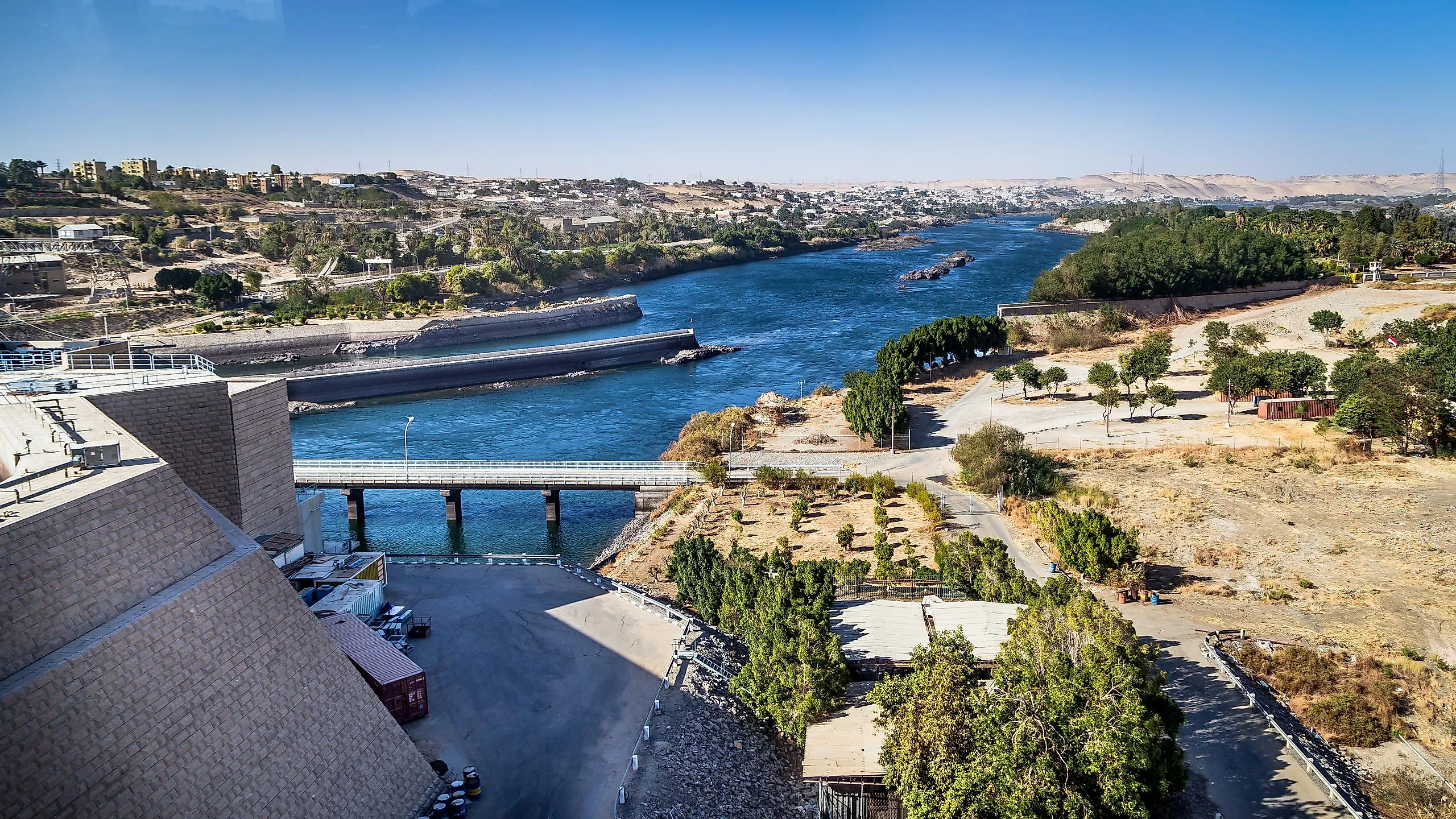
The Aswan High Dam ended thousands of years of annual Nile floods when it was completed in July 1970 and inaugurated in January 1971. The structure rises 111 meters above bedrock and stretches 3,830 meters across the Nile, holding back Lake Nasser, one of the largest artificial lakes on Earth. The dam's construction required the relocation of the temples at Abu Simbel, which UNESCO and a coalition of 50 countries cut into blocks and reassembled on higher ground between 1964 and 1968. The dam's twelve turbines generate about 2.1 gigawatts of installed capacity, supplying roughly 10 billion kilowatt-hours per year. Its construction also nearly doubled the area of arable land in Egypt by enabling year-round irrigation.
California State Water Project - United States

The California State Water Project moves water from the Sierra Nevada more than 700 miles south through 34 reservoirs, 20 pumping plants, and 5 hydroelectric plants. The California Aqueduct, completed in 1973, runs 444 miles down the western edge of the Central Valley to Pyramid Lake in the Tehachapi Mountains. The Edmonston Pumping Plant lifts that water roughly 600 meters over the Tehachapis, the highest single-lift pump system in the world. Oroville Dam at the project's northern anchor stands 770 feet (235 meters), the tallest dam in the United States. The system supplies drinking water to about 27 million people and irrigates 750,000 acres of farmland, primarily in the southern California valleys.
Murrumbidgee Irrigation Area - Australia

Australia's Murrumbidgee Irrigation Area began delivering water in 1912 after Burrinjuck Dam was completed on the upper Murrumbidgee River in New South Wales. The scheme transformed semi-arid country in the Riverina region into about 660,000 hectares of farmland that now produces the majority of Australia's rice and a substantial share of its wine grapes and citrus. Griffith and Leeton, the two main service towns, were laid out by Walter Burley Griffin, the American architect who also designed Canberra. The system has shifted in recent decades toward automated channel gates and water-trading markets to handle increasing climate-driven scarcity in the Murray-Darling Basin.
What Holds These Nine Together
Three of the nine date to before 250 BC and still operate in some form. Two more, the Hohokam canals and the Incan aqueducts, fell out of use with the civilizations that built them but left infrastructure that modern systems traced over. The four modern projects, Aswan, the Great Man-Made River, the California State Water Project, and the expanded Murrumbidgee system, each move quantities of water that would have been inconceivable to the ancient engineers. What unites the nine is the same problem the first cities faced: people, food, and dry ground in the wrong relative positions. The solutions are some of the most ambitious construction projects humans have undertaken.