The Most Adventurous White-Water Rafting Destinations In The US
- Rafting was introduced to the Olympic Games in 1972 in Munich.
- White water rafting is one of the fastest growing outdoor activities in the world.
- Whirlpool Rapids Gorge, Niagara River, New York is one of the most dangerous white-water rafting destinations in the world.
White-water rafting is the sport of climbing into an inflatable boat and letting a river try to throw you out of it. People have been doing this for fun since the 1950s, and they keep coming back for the same two reasons: the adrenaline, and the strange bond that forms between people paddling for their lives together. The United States has no shortage of rivers for the job, so here are ten of the best.
We have declined to rank them. Sorting rivers by "adventure" is a fool's errand, since one paddler's terror is another's warm-up, and any list that crowns a dam-scheduled family float over a canyon full of class V rapids has quietly given up on the exercise. Consider this a collection, not a leaderboard. Bring a helmet and a sense of humor.
Colorado River, Arizona

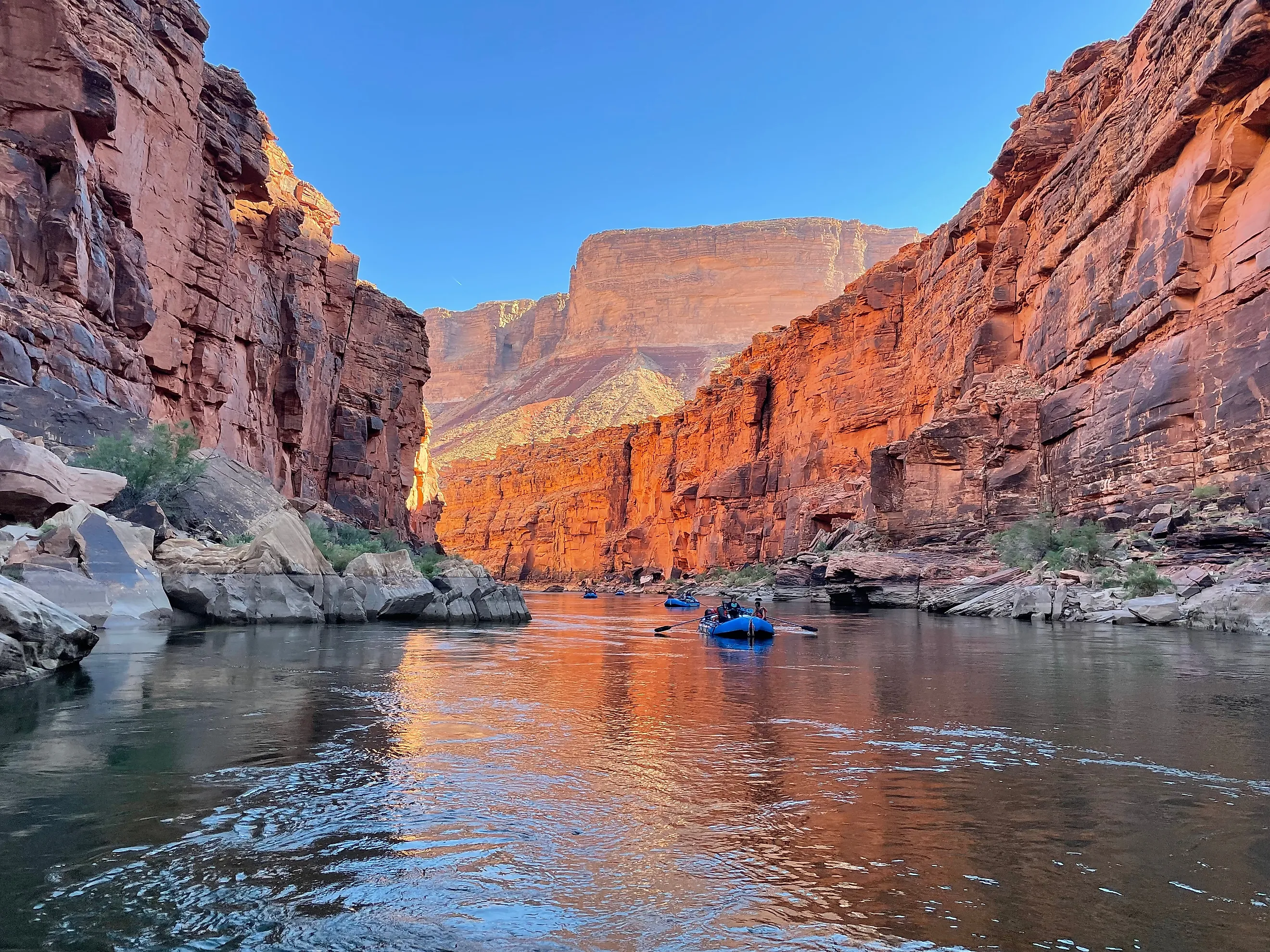
The Colorado River is the one everyone pictures: it begins high in the Rocky Mountains and saws straight through the Grand Canyon, throwing up some of the biggest runnable rapids in North America along the way. Lava Falls alone has a reputation that arrives several miles ahead of it. Trips range from a few hours to expeditions of more than two weeks. One catch: this is not a drop-in-whenever river. Flows are regulated by Glen Canyon Dam, private launches need a permit and a famously long wait, and the season runs spring through fall, not, as the legend sometimes claims, every single day of the year.
Tuolumne River, California

Known to its regulars as "the T," the Tuolumne pours out of Yosemite National Park into eighteen miles of nearly nonstop class IV whitewater in the Sierra Nevada. The centerpiece is Clavey Falls, a legendary class IV-plus drop that has flipped a lot of boats and humbled a lot of egos, so being a confident swimmer is not optional here. Permits are capped at a couple of commercial launches a day, which keeps the canyon feeling like it belongs to you. Add a hike in the park on either end and you have a very full weekend.
Rogue River, Oregon

The Rogue starts in Oregon's Cascade Mountains and runs west to the Pacific through a corridor of forest so undeveloped it looks staged. It is a friendly river with a wild streak: long calm stretches for beginners to find their paddling rhythm, broken up by class III and IV rapids, plus the notorious Rainie Falls, which most rafters scout and many simply walk around. Multi-day trips let you sleep in historic riverside lodges, some dating to the early twentieth century, which is a rare luxury on a whitewater trip.
Deerfield River, Massachusetts

The Deerfield rises in southern Vermont, cuts through Massachusetts, and empties into the Connecticut River, and the Massachusetts stretch is where the rafting happens. It is the most democratic river on this list, with rapids that run class II through IV, so an outfitter can match a trip to a carful of nervous first-timers or a crew of adrenaline junkies. You wind through narrow canyons and thick forest on clear water, which is about as pleasant as a workout gets.
Youghiogheny River, Pennsylvania

The Youghiogheny, mercifully shortened to "the Yough" (say it "yock") by everyone who lives nearby, touches West Virginia and Maryland but saves its best water for Pennsylvania. It comes in three flavors. The Upper Yough is the expert's playground, roughly twenty back-to-back class IV and V rapids that give you almost no time to think between them. The Middle Yough is the family stretch, gentle class I and II water where the biggest hazard is sunburn. The Lower Yough splits the difference and is one of the busiest whitewater runs in the eastern US.
Arkansas River, Colorado

A tributary of the Mississippi, the Arkansas River rises in Colorado and eventually crosses Kansas, Oklahoma, and Arkansas, but the whitewater lives up in its Colorado headwaters, where more than a hundred miles of rapids make it one of the most rafted rivers in the country. Browns Canyon is the crowd-pleaser, all bouncy class III and IV. The Numbers, Pine Creek, and the Royal Gorge sections climb past class IV into genuinely serious territory, framed the whole way by snowmelt-fed peaks.
Nenana River, Alaska

The Nenana runs along the eastern edge of Denali National Park, fed by glaciers pouring off the Alaska Range. It is emphatically not in the White Mountains, whatever the internet may tell you. The water is icy and silt-gray, ringed by some of the biggest mountains on the continent. The upper river is a mellow class II and III float, good for families and for spotting Dall sheep, moose, and golden eagles. The Nenana Gorge is the main event, ten miles of steep-walled class III and IV water with rapids named Coffee Grinder and Ice Worm. Camp in the park afterward.
Salmon River, Idaho

The Salmon River earns its nickname, the "River of No Return," honestly. It runs about 425 miles entirely inside Idaho, the longest free-flowing river held within a single state in the lower 48, with no dams to tame it. That wildness is the whole appeal. One multi-day trip serves up class II to IV rapids, calm floats, sandy beaches to camp on, and swimming holes, all threaded through the enormous Frank Church-River of No Return Wilderness. It suits nervous beginners and hardened experts on the very same water.
Gauley River, West Virginia

The Gauley is a bucket-list river that barely exists as a rafting destination most of the year. For six weekends each fall, the Summersville Dam lets loose a torrent that turns it into what locals proudly call the "Beast of the East." The Upper Gauley is the expert's prize: twelve miles and five legendary class V rapids with names like Pillow Rock and Sweet's Falls, a run that assumes you already know what you are doing. Beginners get firmly steered to the milder Lower Gauley, class III and IV, where the river still snakes past waterfalls and cliffs toward the town of Gauley Bridge. And note that this is the Gauley, not the neighboring New River; mixing up the two is how people end up in the wrong boat.
Kennebec River, Maine
The Kennebec River begins at Moosehead Lake, Maine's largest, and runs about 170 miles south past Augusta to the sea. Its rafting run is a triumph of scheduling: the Harris Station Dam, the state's biggest hydro station, releases water on a set timetable from May through October, so the whitewater turns up on cue every single day, rain or shine. Through the Kennebec Gorge you hit class III and IV rapids with names like Big Mama, the Alleyway, and Magic Falls, hemmed in by canyon walls hundreds of feet deep. The wildlife runs to moose and bald eagles; reports of crocodiles are, this being Maine, greatly exaggerated.
So Which One Wins?
The honest answer is none of them, and all of them. That is the trouble with any "most adventurous" ranking: the Gauley terrifies seasoned experts while the Middle Yough delights eight-year-olds, and both boats are having the time of their lives. The right river is the one that matches the size of the adventure you actually want, and the size of the swim you are willing to take if it goes wrong. Pick a class, book a guide, and let the water sort out the rest.