Exploring the Waterfalls and Wineries of Ontario’s Niagara Region
As I walked up the Canadian side of the Niagara River, the roar of Horseshoe Falls rose in tandem with its mountain of mist. I hadn't been to Niagara Falls since I was a kid, and my girlfriend had never seen this natural wonder of North America, so it was with wide eyes and elated spirits that we joined the thousands upon thousands of international tourists. Niagara Falls, Ontario, like Niagara Falls, New York, stands atop the Niagara Gorge, within view of three major waterfalls that are collectively known as Niagara Falls. Further up the namesake river, one of Ontario's premier cultural (or should I say, viticultural) attractions grabs the spotlight. Niagara-on-the-Lake, or NOTL, harbors a Historic Old Town full of classical British architecture, military forts, and touristic indulgences. But it also acts as the epicenter for Ontario's world-famous wine region.
These two destinations are mere minutes apart, but offer entirely different, albeit equally-memorable, experiences. Let's first get wet and wild in Niagara Falls, and then wined and dined in Niagara-on-the-Lake.
Unveiling the Falls

The American half of Niagara Falls has more cascades (i.e. all of American Falls & Bridal Veil Falls, plus a portion of Horseshoe Falls), but the views from the Canadian side are the most compelling. Given the advantageous vantage point for the 2,200-foot (670-meter) crest of Horseshoe Falls, and the sweeping, rainbow-streaked views of the two international falls, first-time visitors are best served by Niagara Falls, Ontario.
At about 167 feet (51 meters) tall, Horseshoe Falls is not the tallest waterfall in the world, but with a peak flow rate of 6-million cubic feet (168,000 cubic meters) per minute, it is certainly one of the most powerful and voluminous. In fact, cold as those Canadian winters can get, this sustained cascade resists freezing. The only time in recorded history that the falls stopped was a 30-hour span in 1848 when a large ice flow from Lake Erie jammed the pivotal waterway.

Though Ontario boasts the better views and bolder boat tour (more on this in a moment), Niagara Falls, New York, thanks to Niagara Falls State Park, factors in more shoreline greenery and hiking trails. This can be a nice antidote to the casinos, hotels, and gaudy restaurants that surround the falls on both sides. If you're craving the full Niagara Falls experience, valid passport holders can simply walk across the Rainbow International Bridge or the Whirlpool Rapids Railroad Bridge, or, as avid walkers are wont to do, make a full loop of it.
If you have kids, then you might want to stick around for the arcades and fun-houses, but if you're like Irina and I, then your M.O. is to revel in the falls for a while, and then get out of dodge. The true chronology of our two-day tour went: morning/early afternoon in NOTL, mid-afternoon winery, evening walk along the falls, sleep in the nearby town of Welland (as in the Welland Canal), and then return to the falls for our morning cruise. But in the spirit of compartmentalizing attractions, it is to Niagara City Cruises that we now turn our attention.
Into the Mist

Even us Canadians refer to the soaking wet, whoop!-inducing boat tour as the Maid of the Mist. Technically, that is the blue-ponchoed tour boat that operates out of New York. In Ontario, the equivalent company is called Niagara City Cruises, and is marked by a boat full of red ponchos. Even though the latter has the better branding (I'll give them that), our Canadian captains edge just a little bit closer to the violent wall of water that is Horseshoe Falls.
This 20-minute voyage runs all day, every day (during the summer), and as of the writing of this article, sets each ticket holder back $47.95 CAD plus tax. As commanding as the falls are from the top of the gorge, you'd be re-mist (haha, get it?) to skip this turbulent, base-level experience. The cruise begins by floating past the American Falls and Bridal Veil Falls (take pictures now because you'll want to stow your phone in a second!) and then forges straight into the daunting watery realm like a scene from the Odyssey. The tour is perfectly safe, but man, you can feel the pantheistic power of this 12,000-year-old glacial formation!
Niagara-on-the-Lake

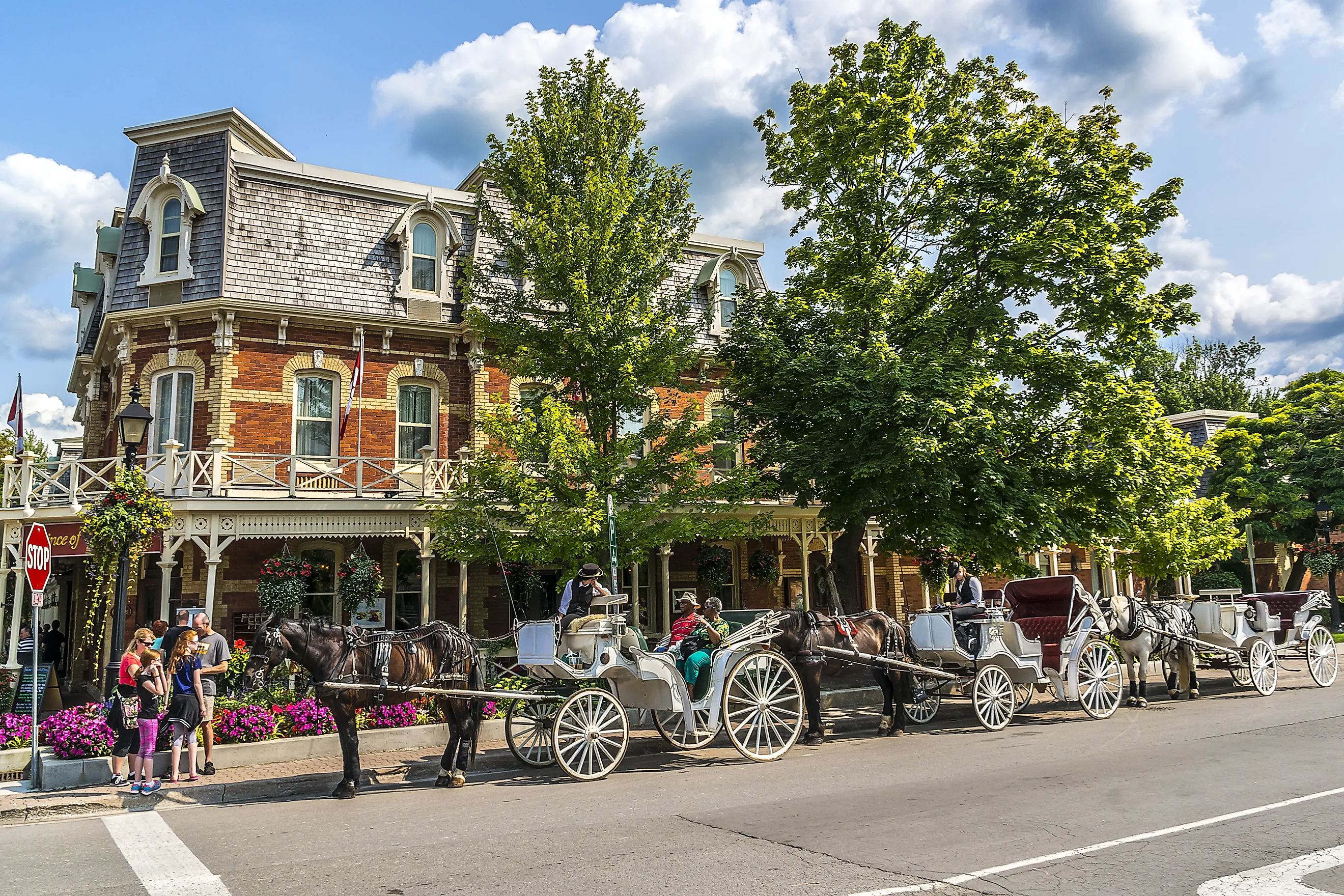
Having been established by British Loyalists in 1779, served as the first capital of Upper Canada between 1792 and 1796, rebuilt in British Classical architecture following the destruction of the War of 1812, and thoughtfully restored beginning in the 1950s, Niagara-on-the-Lake is one of the most historic and overtly-beautiful communities in all of Canada. Iconic Queen Street cuts through the heart of NOTL's Historic Old Town, with the rest of the 25-block, 90-unit National Historic Site of Canada fanning out around the shores of the Niagara River and Lake Ontario. The Prince of Wales Hotel, with its Victorian opulence and queue of horse-drawn carriages, is the preferred photo-op, but be sure to wander the adjacent residential streets for recurring examples of quaint, uncommercialized architecture.
For all its elegance, Queen Street's commercial core can also come across as kitschy. For example, the boutique clothing shops are copy-and-paste, and tailored solely toward wealthy retirees. With that said, there are ample outlets for homemade fudge, old-fashioned hats, local lavender products, and classic souvenirs mixed in.

If you drop right into Queen Street, you might feel overwhelmed by the crowds and underwhelmed by the superficial commercialization. On the other hand, if you begin at Fort Mississauga, as we did, walk along some of the sculpted Great Lake shoreline, through the Niagara-on-the-Lake Golf Club, between the historic homes, onwards through town and into Fort George, you will have a well-rounded view of the military legacy, colonial elegance, and positive energy of this place. Add in a performance at one of NOTL's Shaw Festival theatres and you'll be itching to come back time and again. And we haven't even gotten to the wine yet.
Niagara Wine Region

Historical spectacle aside, Niagara-on-the-Lake is orbited by dozens of wineries. The Niagara Peninsula, aka Niagara Wine Region, is Canada's largest, densest, and most diverse viticultural area, specializing in cool-climate wines such as Chardonnays, Rieslings, Pinot Noirs, and especially Icewine. In terms of recognizable brands, you've probably come across Jackson-Triggs during your Great Lakes travels, but Niagara-on-the-Lake has all sorts of small-scale, generation vineyards to visit. Take a shuttle tour if you want to really go crazy, rent a bike if you'd like to go at your own pace, or simply pop into a random vineyard on your way into or out of town. Irina and I settled on Reif Estate Winery, and were treated to a tasting in the mid-afternoon sun, as well as the musical stylings and traditional attires of a Ukrainian fundraiser that just so happened to be there that afternoon (though unique entertainment is certainly not a novel concept in this part of the Golden Horseshoe).

While the full-blown wineries have all sprouted around NOTL's periphery, there are plenty of opportunities to sample the goods while downtown. For instance, Shaw Cafe & Wine Bar (named after the famous playwright, George Bernard Shaw), with its two-tiered, flower-filled patio, was the lunch-spot of choice on this sunny Saturday. The ambience was lovely and the menu satiating, but from one broke backpacker to prospective others, be forewarned: Niagara-on-the-Lake breaks the bank. In fact, with a summer accommodation rate of roughly $400 to $500 (USD), there was no chance of us staying the night. Hence the aforementioned, no-frills, Welland AirBnB.
Bonus Destination

Another viable base-town for you budget-conscious Niagara visitors is Port Colborne, Ontario. Serving as the entrance to the Welland Canal, this Lake Erie enclave welcomes massive lake freighters under its vertical lift bridge. The regular flow of nautical traffic can be enjoyed from the colorful shops and patios of West Street. After some pub-grub at the Canalside Restaurant (and Inn, for you overnighters), it was here that we uncovered the artisans initially sought in NOTL. The Picket Fence, Grant's Gifts, Pickadilly Books & Coffee, Tea On West, The Painted Pot, and more, all contributed a slice of small-town personality to this waterfront strip. Definitely give Port Colborne a whirl if you're looking to round out an enriching weekend in the Niagara Region.
Churning Water Into Wine

Bouncing back and forth between Niagara Falls, Ontario and Niagara-on-the-Lake induces dramatic tonal shifts. On the one part of the Niagara River, you've got the most accessible major waterfalls on the planet. Because of this double-edged sword, you'll be thrust into the magnificence of nature moments after parking your car. You'll also be sharing it with a slew of the city's 12-million annual visitors, and with the unapologetic commercialization that caters to them. At the mouth of that same river, Niagara-on-the-Lake stands as a shrine to pre-Canadian settlement, anachronistic British architecture, lasting thespian culture, and nation-leading viticulture (as well as some egregious commercialization of its own, but that all comes out in the wash). So if you're on the hunt for waterfalls and wineries, plus several surprises along the way, Ontario's Niagara Region is ripe for the picking.