Walking In Jefferson’s Footsteps At The University of Virginia
If you're planning on visiting Charlottesville (and you should), be sure to include the University of Virginia (UVA) on your list of must-sees. There's so much to see and do on the beautiful grounds of this UNESCO World Heritage Site that I recently spent a full day exploring UVA alone and could easily have spent longer.
My first stop in Charlottesville was to check into the wonderful Oakhurst Inn. This classy 4-star boutique hotel is situated just a few minutes' walk from the university grounds and makes for an ideal location from which to experience both the campus and downtown Charlottesville. From here, you're just a half-mile (10-minute) walk from the Academical Village, the historic heart of UVA.
After grabbing a delicious breakfast at the Oakhurst Café, the inn's first-rate coffee shop and eatery, I headed toward the heart of campus with no more than a general idea of what lay ahead.
Park the Car and Wander

It's one thing to read about the architectural achievements of Thomas Jefferson, the university's founder and architect, but seeing them up close is a whole other experience. Immensely walkable, wandering the UVA grounds required little more than a comfortable pair of shoes, a fully charged iPhone, and the kind of curiosity that comes with exploring new travel destinations.
UVA's historic landmarks are close to one another, making it easy to see everything in a few hours. Or if you prefer to dawdle as I do, it can take most of the day. Best of all, you can park the car and forget about it, another plus for staying at the Oakhurst Inn.
Whether you're here on business or pleasure, are visiting friends or family at the university, or maybe even checking it out as a place to study, take it from me: time spent exploring Virginia's top college town is time well spent.
The UVA Academical Village

The Academical Village perfectly encapsulates Jefferson's original vision of a communal learning environment where living and learning happen in close proximity. The concept, created in 1819 and centuries old, still felt surprisingly relevant as I started my adventure at the historic center of this UNESCO site.
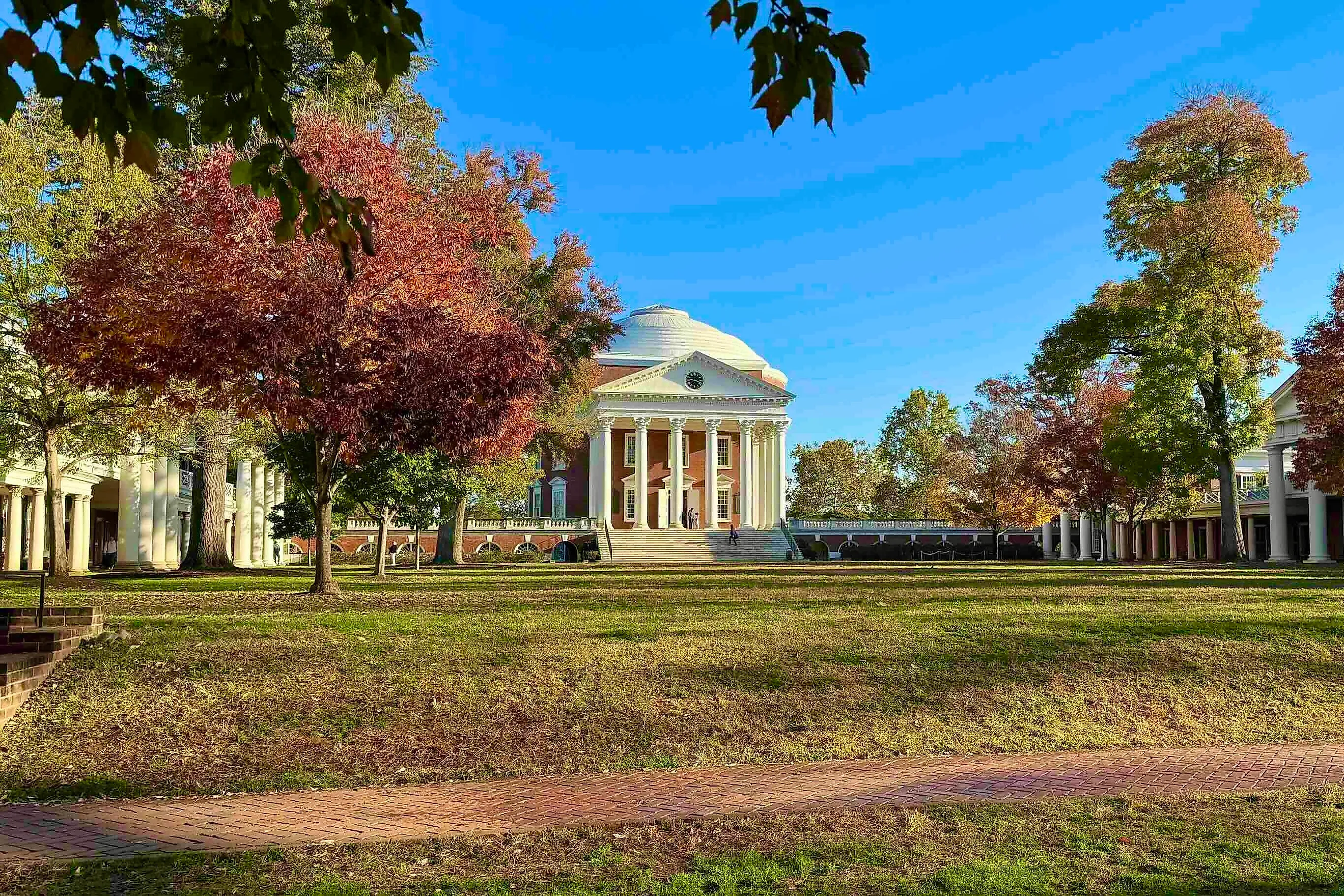
Bordered by inward-facing pavilions and academic structures, the first glimpse of The Lawn, the heart and soul of the Academical Village, is from its south end. Standing with my back to Old Cabell Hall, built in 1898 and UVA's main lecture and concert hall, I cozied up to the Uni's statue of Homer and caught my first glimpse of the Rotunda at the far end of The Lawn. Having arrived not long after sun-up, there wasn't a person in sight, a rare treat at one of Virginia's most famous views.
What also struck me was just how open and inviting the Academical Village is. You're free to wander The Lawn's red brick pathways and the buildings around its perimeter at your leisure. So, take your time crisscrossing this beautiful green space to find great spots for a photo.
The Lawn at UVA

The Lawn is, without a doubt, the most iconic landmark at the University of Virginia. And while UVA has grown and evolved over the decades since it was founded centuries ago, The Lawn remains unchanged. The symbolic and physical center of the UVA campus, it covers 35 acres and is framed by 10 pavilion-style buildings that form a horseshoe shape with the Rotunda at the top.
Each of these buildings, including the 54 accommodation units located here, opens directly onto The Lawn. Still used by students, the lucky few who get allocated digs here face stiff competition due to the high demand.

But it's easy to understand why they'd want to claim one. In front of each room, a classic rocking chair sits on the covered walkway facing The Lawn, a small noticeboard on each door informing passersby what knowledge the resident can share, or what they're interested in learning more about.
Dating back to Jefferson's time, this simple means of communication between academics not only encourages the sharing of ideas but has also helped foster a strong sense of community and kinship. Among those known to have lived in the Academical Village are Edgar Allan Poe, whose room on the West Range has been preserved as it would have appeared in his day, and Woodrow Wilson, America's 28th President, who roomed on the West Range as a law student.
The Rotunda

Located at the top end of The Lawn, The Rotunda was the last building to be finished in the Academical Village. Completed in 1826, its interior was gutted by a devastating fire in 1895 and has been renovated many times since. Despite having spied it from a distance, the scale of this colonnaded red brick building really doesn't register until you stand directly in front of it. And there's a very palpable "wow" factor.
Inside, the space is both grand and intimate all at the same time. While UVA still uses The Rotunda for lectures and events, the friendly folks at its entrance were quick to encourage me to explore, which I did… top to bottom. Climbing the elegant curving stairs upwards, the dome is no less impressive from the inside. Known as the Dome Room, its large skylight lights the whole space to great effect.

The ground floor museum was also a highlight. In addition to fascinating displays relating to the building and the university, as well as exhibits about the founders, an old fireplace catches the eye. Only discovered during recent renovations, it's part of a forgotten 19th-century chemistry laboratory and contains a sophisticated ventilation system that had been completely forgotten about.
After exploring the interior of The Rotunda, circle around to the rear of the building. Not only does this provide an even better sense of its size, but it'll lead you to another superb spot for a photo, this time with a statue of Thomas Jefferson himself.
Tips to Help You Explore the UVA Grounds

UVA offers great tours of The Rotunda and other parts of the Academical Village, each bookable online. Find out more about this great way to explore the University of Virginia campus at https://rotunda.virginia.edu.
For further details about these and other things to do in Charlottesville, check out the town's official tourism website at www.visitcharlottesville.org. The Virginia Tourism website is another great resource.
And if you do plan on making a getaway of it, be sure to include Jefferson's Monticello estate in your itinerary. Just a short drive away, Jefferson lived there from 1770 until 1826, designing the estate and its buildings himself.