Istanbul in the Off Season
Equal parts intriguing and intimidating, Istanbul long hovered on my travel radar. Finally, in February of this year, I booked an entire month in Turkey's biggest city. But my ignorance of this transcontinental World Heritage Site set me up for two mistakes. First, one month is nowhere near enough to uncover its major landmarks and dense Byzantine streets. That would take a lifetime. And second, being one of the most visited cities on the planet (around 18 million foreign visitors in 2025), Istanbul doesn't have an off season. Even in winter, the bridges and monument-centric shopping streets are packed with pedestrians, major roadways are ceaselessly jammed, the Taksim Tramway has people hanging off its sides, and accommodations run at a premium.
With all of that said, the puffy-jacket temperatures and relatively lessened crowds did make it easier to cope with Istanbul's chaos. Not to mention, the payoff experienced at places like the Basilica Cistern, Galata Tower, and the colorful streets of Balat was always worth the queues and real-life games of Frogger. So follow me as we bridge the Golden Horn between Old City and modern promenade, and as we cross the Bosphorus between Istanbul's Balkan Peninsula and Anatolia. I promise not a comprehensive city guide, but rather a vicarious wander full of sights, sounds, and recalibrated expectations from Istanbul in the "off season."
A Quick Lay of the Land

Established as Byzantium by the ancient Greeks and rechristened Constantinople by the titular Roman emperor in the fourth century C.E., the city did not officially take the name Istanbul until 1930, a few years after the young republic moved its capital to Ankara. In the interim, countless occupations by oscillating empires and ideologies shaped Istanbul into the cultural and architectural hodgepodge that it is today.
Istanbul's split geography is a big part of the appeal, too. The Golden Horn splits the city's European side in two, while the Bosphorus ferries daily visitors across to its Asian shore. This makes Istanbul one of the few cities in the world to span two continents, and easily the most famous. Let's start our tour in the heart of Europe, where old and new collide.
Kicking Off in Galata

After a spirited (and costly) airport taxi ride, I was dropped off in the northern half of Istanbul's European hemisphere: a neighborhood called Galata. Starved after my flight in from Malaysia, I climbed the dark and steep steps up to a studio apartment, dropped my bag, and re-emerged on these unknown streets, reveling in those honeymoon moments that come with a brand new country.
I noticed that my rental sat above a lamp store. Nothing particularly unusual about that. But then I noticed another lamp store next to it. And then another. Then I noticed that the majority of the street, and the next one, and the one after that were dominated by lamp stores! On that dark February night I appreciated the luminous ambience, "but where the heck are all of the people and restaurants?" I thought.
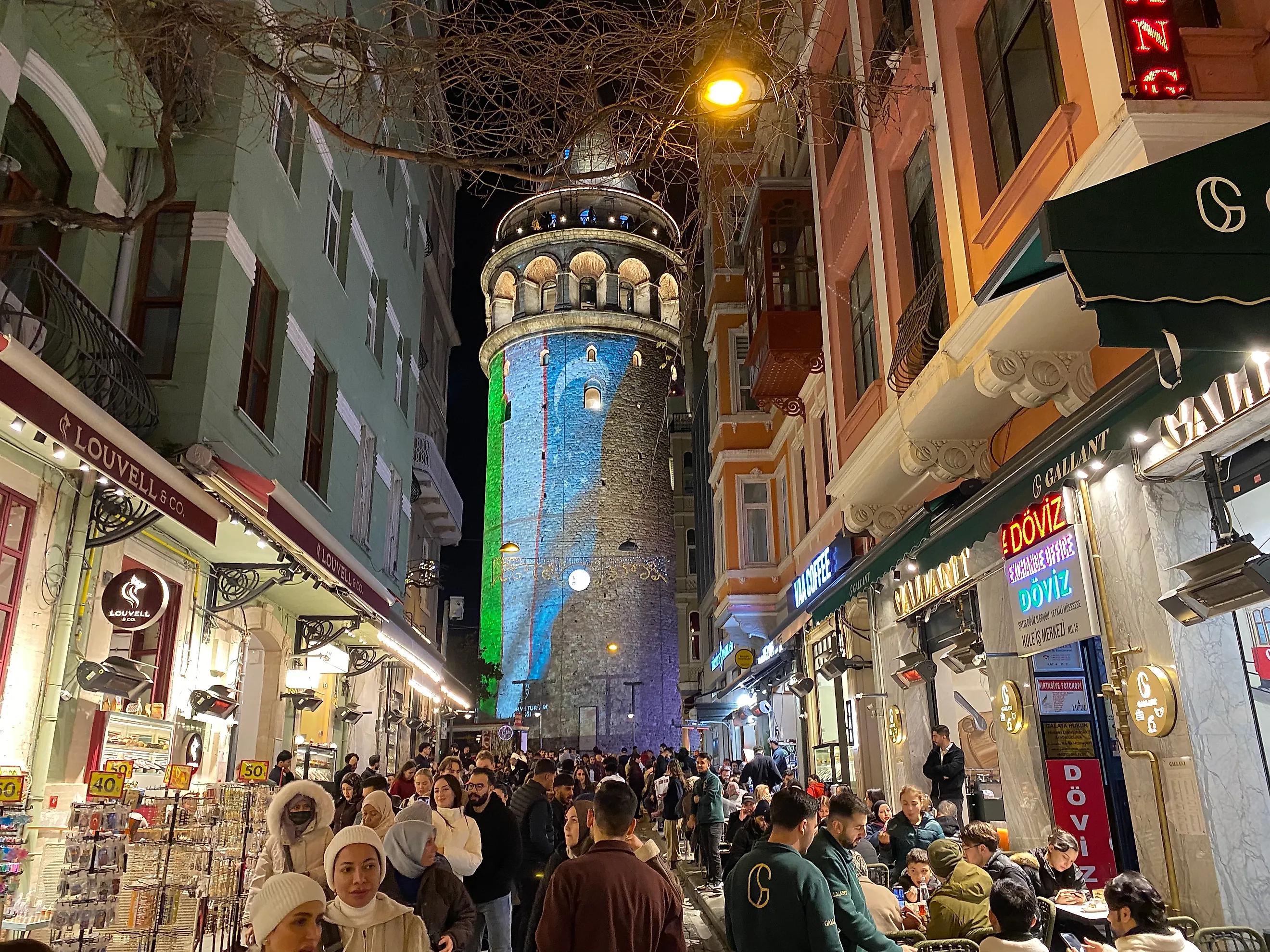
Then it happened. I turned the corner of a street I still can't pronounce (Büyük Hendek Caddesi) and was stunned by the circa-1348 Galata Tower, the parallel rows of buzzing eateries, and the sea of tourists in the space between. Suppressing my hunger, I let myself absorb the midnight fervor for a moment, and then slipped into an inconspicuous durum restaurant with not particularly good reviews. Why? Well, as the great mountaineer George Mallory once said about his impetus toward Everest: Because it is there! There's no need to overthink that first meal in a new place after a long travel day. And sure enough, this meat-based flatbread hit the spot, just as it would pretty much every day for the next month, from every vendor I happened to try. And unlike classic sit-down restaurant prices, durum always proved to be an affordable option.

I discovered another low-key culinary staple the next morning when I walked across Galata Bridge. Here, hundreds of fishermen line up shoulder to shoulder, hooking mackerel straight out of the Golden Horn. The resulting filets are grilled, slipped into a bun, and served all along the waterfront in established restaurants, barbeque huts, and sometimes from the fishermen themselves who stand next to a pop-up grill until the day's supply runs out. The creation is called Balik ekmek ("fish bread"), and goes for as little as 150 Turkish Lira ($3 USD).
They say there's a bias given to the first thing a person experiences. This was certainly the case with Galata, as it ended up being my favorite of Istanbul's neighborhoods. I appreciated the magic of the tower, but also the solitude so easily obtained in the surrounding streets. Getting lost is all part of the fun in this city, and it's particularly easy to do from Galata. Bridges and boats fan out across the water, steep streets wind through world-weary microcosms, and for every overpriced tourist restaurant, there's an overpriced traditional taverna waiting one block over.
Taksim Square Is Taxing

In anticipation of my girlfriend's arrival, I surrendered my lamp store bachelor pad in Galata and followed the tram line all the way up to Taksim Square to check into a long term accommodation. I of course did not ride the tram, as every time it went by, the only available real estate was on the outside, mostly claimed by parkour tweens. But lugging my trekking bag up the pedestrian shopping street (which, again, I can't pronounce, and neither will you) allowed me to absorb more of Istanbul's commercial atmosphere. Here, fancy fashion brands rub shoulders with baklava and Turkish delight shops. It can be difficult to navigate the blobs of people, as there is no discernible flow of traffic. And even if you find a path forward, you're likely to be intercepted by some dude peddling knock-off cologne who won't take no for an answer.
Branching off from Istiklal Caddesi are numerous side streets worth exploring. Many great bars are to be found between the major boulevard and the tramline, and lesser known cafes reward those who stray further still. Basically, if you see a steep hill, descend it, because all kinds of thematic shops congregate around those slick, crowd-depleting cobblestones.
This whole neighborhood culminates at Taksim Mosque (Taksim Camii), which opens into a spacious public square (hence the name). The call to prayer isn't as strictly adhered to in this part of the city, but the regular chants emanating from the minarets does emphasize that behind all of the shopping and nightlife, Taksim, like the rest of this long-time Ottoman capital, has deep religious roots. In fact, over 90% of its population identifies with the Sunni Muslim sect.
Beautiful Balat

Along with the overpopulated and overtly-commercialized aspects of Taksim Square, its ubiquitous greyscale wore on me after a couple of weeks. So it was with immense delight that I discovered the neighborhood of Balat during an exploratory run. This Old Town enclave smears a painter's palette onto the western shore of the Golden Horn. Each boutique and residence adopts a different solid color facade, and multiple rainbow stairs make for particularly potent photo-ops. Menu wielding proprietors will certainly try to beckon you in for lunch or a Turkish coffee, but other than one pushy Turkish delight dealer, I found Balat to have a more relaxed demeanor. Irina and I were fortunate to be able to shift over here from Taksim for the last few days of our Istanbul tour. Sleep followed suit. No late night drunkards in the street beneath our window. And no police chases…
Major Monuments of the Old City
Istanbul operates on multiple scales. There are the tightly-packed, disorienting streets, and then there are the unmistakable monuments spanning empires and millennia. Let's take a quick tour of three standouts.
Basilica Cistern

The largest of Istanbul's subterranean cisterns was built in the sixth century by Emperor Justinian I. 336 marble columns support a rectangular chamber that was once capable of holding 80,000 tons of water. Today, a small amount of water is kept for effect, and moody lights add mystique, especially when it comes to the Medusa statues hiding in the back corner. When Irina first pitched me the 2,250 TL ($48 USD) tour of a glorified water tank, I was skeptical. But it ended up being one of Istanbul's best features, and the cornerstone of a full afternoon of exploration.
The Blue Mosque

Climbing out of the cistern and back into the full light of day (which really takes a second to readjust to), we saw that Hagia Sophia, mere meters away, was under construction. Thankfully, the equally celebrated Blue Mosque was as welcoming as ever. Remember how I mentioned Istanbul's Islamic backbone? Well, it is presented in its finest form in this ornate place of worship. The Blue Mosque is separated from Hagia Sophia by large gardens, but is still just a short stride from Basilica Cistern. There are two entrances to make note of. One is for practicing muslims looking to pay homage, and the other is for everyday tourists eager to glimpse the mosque's tiled interior. Like many holy sites around the world, shoes must be removed. But unlike many holy sites, pictures are allowed inside and out. This is much appreciated as the tens of thousands of blue tiles after which the mosque takes its name (formally, Sultanahmet Camii if you're searching on the map) are inspiring in the truest sense of the word.
Grand Bazaar

Given the recurrent badgering and scams experienced elsewhere, I expected the famous Grand Bazaar to be a real showdown. But though I went in with elbows up, I left with a gentle smile on my face. Perhaps it was because we went early on a weekday. Perhaps it was because the relative "off season" was still underway. Or perhaps my presuppositions were simply unfounded. But either way, the vendors were overwhelmingly amenable, even gracious. There was no arm grabbing. No "free samples" that devolved into a shouting match. Just a few Where are you froms and inoffensive jokes aimed at getting prospective customers to break stride.

With 22 entrance gates, 20 domes, more than 60 streets, and something like 4,000 shops (spices, rugs, gold jewelry, etc.), the Grand Bazaar (Kapalı Çarşı), like the rest of Istanbul, requires patience, curiosity, and flexibility to navigate the maze. It is already one of the largest (and oldest) covered markets in the world, not including the block after block of satellite markets. Given that these outside vendors tend to offer lower prices, avid shoppers might want to set aside a separate day for what is essentially Grand Bazaar part deux.
Slow Boat To Asia

As deep as we've gone into Istanbul's glamorous and underbelly sides, we've yet to explore its Asian hemisphere. After all, Turkey's largest city has one foot in Europe and one in Asia. Since there are no border crossings, journeying to the east requires nothing more than a short crossing of the Bosphorus for about the price of a fish sandwich. Just take stock of which terminal you push off from, as we had a little mix up on the way back, having boarded a ferry bound for further up the riverbank, rather than back to Europe.
In some ways, Istanbul's eastern half overlaps with the west. Touristic streets empty onto fast-paced thoroughfares or spill into nondescript residential zones. But at the same time, the wide and minimally-commercialized waterfront is a breath of fresh air, as is the easygoing neighborhood of Kuzguncuk. With copious streetside cafes, a community garden, and a multi-ethnic lineage that was isolated from the rest of Istanbul until the early 20th century, Kuzguncuk struck a new chord almost a month into our Istanbul epoch. When I return, I'll flip the script by seeking accommodation in Asia, and simply visiting Europe. But as things stood, it was pretty cool to be able to just bop over the Bosphorus for a day trip. If you're looking to check off a new continent (or two), this is an efficient way to do it.
Off Season?

Istanbul has fast-paced cabbies, but also pensive fishermen. It parties all night (and morning) in Taksim Square, but shows up en masse for the sunrise call to prayer. It is half European, half Asian. It has built monuments to Medusa and Muhammad. It is sweet (think Turkish delights) and savory (like menemen or manti). Simply put, Istanbul is a lot to take in. As I push past the 2,000 word mark, I feel as if I've barely scratched the surface. But that's what a 2,700-year-old, transcontinental city will do to you. Even during its so-called "off season."