Inside the Florida Town With the Largest Concentration of Natural Springs on Earth
I was more than surprised to learn that the largest concentration of natural springs on Earth wasn't in some far-off, remote land, but almost on my doorstep. Ocala, Florida, is home to an estimated 1,000 artesian springs fed by the Floridan Aquifer. And six of the best are clustered around Ocala National Forest: Silver Springs, Rainbow Springs, Juniper Springs, Alexander Springs, Silver Glen Springs, and Salt Springs. All push crystal-clear, warm water to the surface year-round. Here’s what I found out that makes them worth a visit.
Silver Springs

Silver Springs State Park is one of the largest artesian spring formations ever discovered. Located just a short drive east of Ocala, I discovered that its main spring and five feeder springs discharge a remarkable 550 million gallons of water daily and form the headwaters of the Silver River. This five-mile waterway flows into the Ocklawaha River, and is fun to explore.
Tourism here dates to the 1820s when steamboats made their way upriver, carrying passengers to see this natural wonder. In 1878, a local entrepreneur invented the glass-bottom boat to give visitors a window into the world below the water’s surface. Today, glass-bottom boats remain the park’s signature experience to this day and are one of the best freshwater boat cruises I've ever done (and I've done a few!).

I opted for the 90-minute Extended River Boat Tour; it’s well worth the extra few dollars over the standard 30-minute ride. A knowledgeable captain narrates the history of the springs while pointing out wildlife along the banks, from great blue herons and alligators to the colony of rhesus macaques that has lived in the surrounding forest since escaping into the wild in the late 1930s.
Through the glass panels in the hull, I was surprised at just how clearly I could see everything beneath me. From the sandy bottom to the fish darting among limestone formations, and even a dugout canoe dating to the 1500s, it was a little like watching a well-filmed nature show. I also saw abandoned props from old film shoots, as Silver Springs was once one of Florida’s most popular film locations.

The park covers 5,000 acres and offers kayak and canoe rentals for paddling the Silver River, 14 miles of hiking and biking trails, and the Silver River Museum and Environmental Education Center. The museum also includes a reconstructed 1800s pioneer settlement, exhibits on the area’s natural and cultural history, and one of the original glass-bottom boats salvaged from the river. There's also a licensed cafe for those, like me, who want to linger a little longer to enjoy the water views.
Rainbow Springs

Though a little further to drive (it's located about 20 miles southwest of Ocala near the town of Dunnellon), Rainbow Springs State Park is a must-do. It protects Florida’s fourth-largest spring, archaeological evidence suggests it has been used by humans for some 10,000 years. And it’s easy to see why. The headwaters pool has four main boils, with hundreds of smaller springs downstream contributing 400 to 500 million gallons of water daily to the Rainbow River. The result is water so clear that visibility often exceeds 100 feet.
The park’s 1,472 acres include a designated swimming area at the headsprings, a network of nature trails, and a man-made waterfall that dates from the site’s former life as a privately owned tourist attraction.

I teamed up with Get Up and Go Kayaking for a fun guided river tour. With my experienced guide leading the way, my excursion launched from KP Hole Park and headed upstream along the Rainbow River in transparent kayaks. With an unobstructed view through the kayak's clear hull, my guide pointed out turtles and fish, as well as wading birds along the riverbanks. We also stopped at a hidden side canal where we stepped out of the kayak and waded through the warm, crystal-clear spring water. The return trip downstream was an equally relaxed float.
The headspring’s swimming area is another reason to visit. The water stays at 72 degrees year-round, making it comfortable for swimming, regardless of the season. During the summer months, tubing down the Rainbow River is a popular option, with shuttle services returning visitors to the starting point. Park trails wind through gardens and past waterfalls, and the campground offers sites just down the road from the headsprings.
Juniper Springs

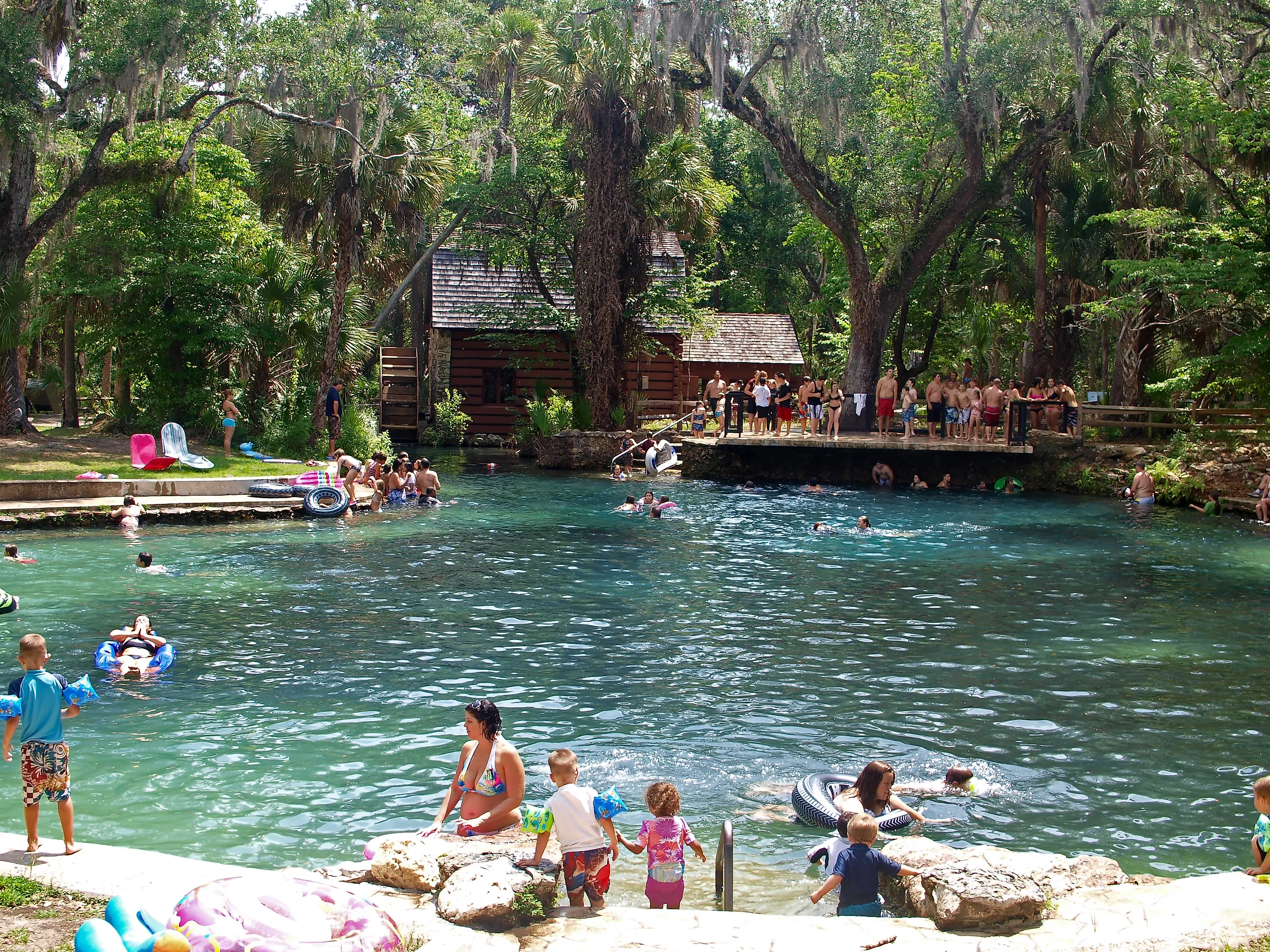
Located 30 miles east of Ocala, Juniper Springs Recreation Area is one of the oldest developed recreation sites in the Eastern United States. Constructed in the 1930s by the Civilian Conservation Corps, the site consists of a swimming area, campground, and trails, and features a stone millhouse that generated electricity for the site. It now houses interpretive displays about the history of both the site and the surrounding area.
The setting here is subtropical rather than river-based, with hundreds of small springs and larger vents bubbling up through crevices beneath a dense canopy of palms and live oaks, making it feel more like a tropical oasis than typical north-central Florida. The spring feeds Juniper Run, a seven-mile canoe and kayak trail that winds through the Juniper Prairie Wilderness under a dense canopy of old-growth forest.
Rated one of the top canoe runs in the country, the narrow, winding creek does require some paddling skill due to its tight turns and low-hanging branches. Canoe and kayak rentals are available on-site, and a shuttle service returns paddlers to the starting point.
The campground at Juniper Springs is one of the most popular in the Ocala National Forest, and for good reason. Shaded by a thick canopy of oaks, sites are well-maintained and within walking distance of the swimming area. A short interpretive nature trail leads from the spring pool through the surrounding scrub and palm hammock to Fern Hammock Springs, a smaller, more delicate spring surrounded by ferns and palmettos. While swimming isn’t allowed at Fern Hammock, standing on the bridge and gazing down at its bubbling vents is a pleasant way to pass the time.
Alexander Springs

Located in the southern section of the Ocala National Forest and about an hour from Orlando, Alexander Springs is one of 27 first-magnitude springs in Florida, a designation that means it discharges at least 100 cubic feet of water per second. It’s also the only spring in Ocala National Forest where scuba diving is permitted.
Large and gently sloped, the spring pool has a sandy bottom that gradually deepens from the shore to about 25 feet at the main vent. Unlike many Florida springs, which have narrow access points and steep drop-offs, Alexander Springs’ wide, beach-like entry is ideal for families.
The snorkeling here is excellent, with water clarity often exceeding 90 feet. The pool’s edges are thick with water lilies and aquatic plants, creating what look like small underwater forests. Spotted bass, bluegill, mullet, and freshwater turtles are common sights, and the limestone formations around the vent are worth exploring.
For paddlers, the Alexander Springs Creek flows approximately 10 river miles before reaching the St. Johns River. It’s a wide, slow-moving waterway, fringed with palms, that gives it a jungle-like feel. Alligators, great blue herons, turtles, and otters are regular sights along the run, and kayak and canoe rentals are available on-site. There’s also a campground with tent and RV sites.
Silver Glen Springs

Silver Glen Springs is another first-magnitude spring within the Ocala National Forest. Its semicircular pool measures 200 feet across, and the two main vents push 73-degree water up with enough force to create a visible boil on the surface. The spring run flows less than a mile before emptying into Lake George, the second-largest lake in Florida and part of the St. Johns River chain.
Silver Glen is considered one of the best snorkeling springs in the forest. The water is remarkably clear, and when sunlight hits at certain angles, refracted rainbows play across the sandy bottom. Schools of striped bass congregate around the deeper sections of the pool, unfazed by swimmers and snorkelers. Kayaks and canoes can be rented for paddling excursions down Silver Glen Run toward Lake George.
Near the entrance to the swim area, a palm tree that appears to grow straight out of the water is one of the most photographed features in the entire Ocala National Forest. The site is also an important archaeological area, with large shell middens (ancient refuse heaps left by indigenous peoples) visible near the spring, and evidence of Native American habitation goes back some 5,000 to 7,000 years.
For hikers, the Lake George Trail is a three-mile round-trip through oak and palmetto forest to scenic overlooks of the lake’s shoreline. A shorter option, the Spring Boils Trail, leads to nearby Jody’s Spring.
Salt Springs

Salt Springs Recreation Area, the northernmost of the six springs I've included on this list, is located between the St. Johns and Ocklawaha Rivers, east of Ocala. What makes Salt Springs unusual is its water chemistry. As groundwater passes through deep limestone layers rich in sodium, potassium, and magnesium, it picks up enough mineral salts to give the water a slight salinity. It’s also just enough salt to support several species not normally found in freshwater springs, like blue crabs and mullet, which thrive alongside their freshwater cousins.
The spring discharges 52 million gallons of water daily at a constant 74 degrees Fahrenheit, slightly warmer than the other springs on this list. The swimming area is bordered by a concrete retaining wall with steps leading into the water, and the underwater landscape is an intriguing jumble of limestone fissures and rock formations through which water bubbles to the surface, making snorkeling a great way to appreciate the scene fully.
Salt Springs is also home to the largest campground in the Ocala National Forest, with more than 150 sites, including the only full RV hookups in the forest. The nearby Salt Springs Marina offers boat access to Salt Springs Run and, from there, to Lake George.
Florida’s Natural Spring Capital
Ocala’s natural springs offer something unique. Whether like me you’re peering through the glass hull of a boat at Silver Springs, paddling a see-through kayak around Rainbow Springs, or floating in the mineral-rich waters of Salt Springs, these six destinations are a reminder of the region’s tremendous diversity.