The State Parks With Old-Growth Forest
While vast swathes of North America were cleared by the logging booms of the 19th and 20th centuries, isolated pockets of ancient woodland survived. Shielded by steep ravines, remote geography, or the foresight of early conservationists, these stands escaped the axe. Some of these stands are entirely protected by state parks. Here, trees have reached the biological limits of their species, growing into complex, multi-layered canopies that cast deep shadows over forest floors thick with centuries of decay. Across the foggy coasts of California and the humid swamps of Florida, six state parks preserve these rare remnants of ancient forests. These parks offer public access to complex, old-growth forest ecosystems that are 300 to over 1,500 years old.
Prairie Creek Redwoods State Park, California

In the coastal ravines of Prairie Creek Redwoods State Park, ancient redwoods tower over a subcanopy of Douglas fir and oak where sunlight rarely touches the forest floor. These redwood stands have individuals over 360 feet tall with trunk diameters surpassing 20 feet.
In addition to the living giants, the park's 14,000-acre old-growth sanctuary hosts standing snags and massive fallen logs that support specialized fungal networks and provides habitat for birds such as the marbled murrelet and northern spotted owl.
A walk along the Karl Knapp and Cathedral Trees Trail reveals the scale of these massive trees, and the paths can be combined into a three to four mile loop. For a deeper exploration of the forest, the James Irvine Trail offers a 4.5-mile one way route departing from the visitor center that traverses the heart of the old-growth zone. This path crosses steep ravines covered in huge ferns and moss clinging to rock faces beneath the redwood canopy.
Humboldt Redwoods State Park, California

The 53,000-acre Humboldt Redwoods State Park preserves the largest contiguous block of old-growth coastal redwood forest in the world, covering over 17,000 acres of ancient trees along the South Fork Eel River. The Founder's Grove within the park is home to the "Dyerville Giant", a fallen redwood that measured 362 feet tall and is estimated to have stood for over 1,600 years. Standing trees in this tract often exceed 300 feet in height, with diameters surpassing 20 feet.
The 0.5-mile loop Founder's Grove Nature Trail winds through the massive trees and a forest floor covered in a dense carpet of oxalis and redwood sorrel beneath the massive canopies of the redwoods. Just downstream, for a view of the riverine old-growth, the Rockefeller Loop follows a 0.7-mile circuit crossing the South Fork Eel River. A large portion of the 32-mile Avenue of the Giants road also passes through the park, allowing visitors to view ancient trees from the road.
Hydrology plays a significant role in this forest's ecosystem. Seasonal flooding of the South Fork Eel River deposits sediments rich with nutrients that fuel the growth of the massive redwoods. Additionally, the thick blankets of summer fog that roll in from the coast are crucial for the health of this ancient forest. The moisture from the fog can contribute 30 percent or more of the coastal redwoods' annual water intake.
Porcupine Mountains Wilderness State Park, Michigan

In Michigan's Upper Peninsula in Porcupine Mountains Wilderness State Park, old-growth characteristics are defined not by towering redwoods, but by dynamic "pit-and-mound" topography. When 300-year-old hemlocks and sugar maples eventually topple, their upturned root systems leave water-filled soil pits for breeding amphibians while creating dry mounds for forest wildflowers. Rotting logs also act as natural nurse trees, fueling seedling growth alongside fungi and insects.
The 60,000-acre park protects about 35,000 acres of old-growth northern hardwood forest. It represents one of the largest remaining tracts of this type of ecosystem in the Midwest. The canopy is dominated by sugar maple, basswood, and yellow birch, with individuals reaching heights of 100 to 150 feet and diameters exceeding five feet. Some hemlock and white pine specimens date back over 300 years. They have survived in protected ravines where fire frequency was historically low.
A number of trails pass within the old-growth stands. The Little Carp River Trail routes through ancient hemlocks and pines, and includes views of Overlooked and Greenstone Falls. The Escarpment Trail takes visitors near the Lake Superior shoreline, winding through dense hardwood stands where the canopy closure limits understory growth to shade-tolerant plants like ferns and wild ginger. Winter access is possible via cross-country ski trails.
Itasca State Park, Minnesota

At the Headwaters of the Mississippi River, Itasca State Park contains a significant tract of old-growth red and white pine. Fire history studies indicate that this tract has experienced multiple low-intensity fires over the past three hundred years, which removed competing vegetation without killing the mature, thick-barked pines.
The 1.9-mile Dr. Roberts Trail loops directly through these open, sunlit pine barrens along the shore of Lake Itasca. The oldest trees can reach over 140 feet tall and have large trunks with the bark scarred by fire. The floor is covered in a thick layer of pine needles, which acidifies the soil and inhibits the growth of competing hardwoods. The Mississippi Headwaters boardwalk gives a shorter, more accessible view of the transition zone between the pine forest and the hardwood wetlands.
Fakahatchee Strand Preserve State Park, Florida

Fakahatchee Strand Preserve State Park contains the largest strand swamp in the world with extensive stands of old-growth bald cypress and pond cypress. These trees, some exceeding 100 feet in height and six feet in diameter, grow in a linear pattern along a freshwater slough, with roots adapted to prolonged submersion.
This old-growth swamp is dotted with cypress knees projecting vertically from the water, providing structural stability and gas exchange for the submerged root systems. Epiphytic orchids, including the rare ghost orchid, grow on the trunks of these massive cypress trees. These delicate plants thrive in the high humidity and filtered light of the swamp canopy. The 2,500-foot Big Cypress Bend Boardwalk, located off US-41, elevates visitors above the water to protect the fragile root systems with a clear view of the giant trees and cypress knees.
Some of the oldest trees are estimated to be between 200 and 500 years old and are concentrated in the deeper portion of the forest, where water depth prevents the establishment of other competing species unable to survive prolonged root submersion. Today, the stand serves as a critical reference site for restoration efforts in the broader Everglades ecosystem.
Cook Forest State Park, Pennsylvania

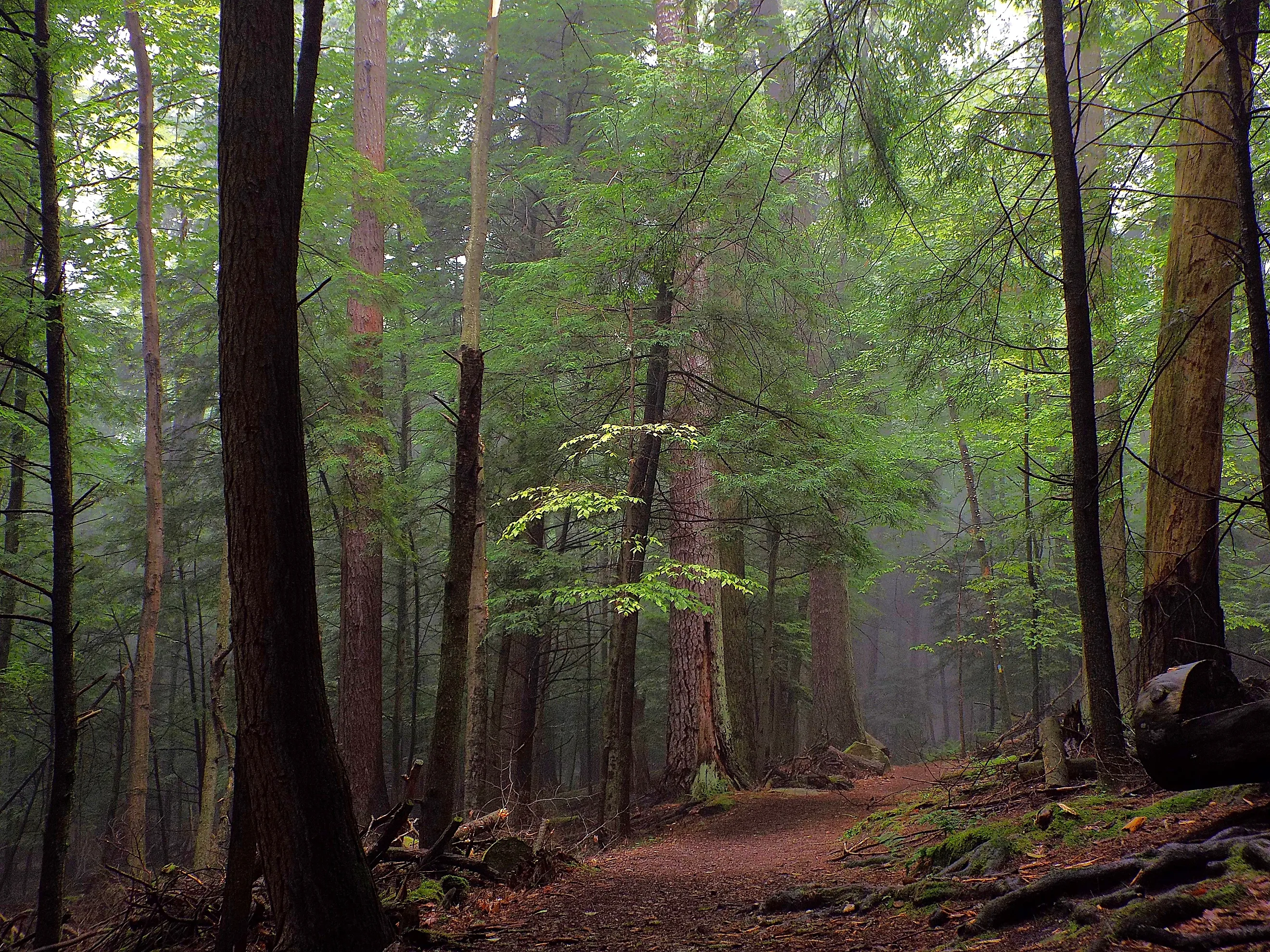
While almost the entire state of Pennsylvania was clear-cut by the early 1900s, a remote 2,300-acre enclave of trees survived inside Cook Forest. Today, Cook Forest State Park preserves some of the largest and most significant tracts of old-growth white pine and eastern hemlock remaining in the eastern United States.
The most popular route to view the oldest trees is through the 1.9-mile Longfellow Trail. This loop leads through the heart of the preserve where the forest floor is covered in clubmoss, partridgeberry, and delicate ferns that thrive in the low-light conditions. The path includes signage identifying ancient trees. The Henry Run Falls Trail is a more challenging hike, descending into the ravine where some of the largest hemlocks cluster along the stream banks.
The park's Forest Cathedral Natural Area features the oldest white pines measuring over 170 feet in height and five feet in diameter. Some individuals are estimated to be over 400 years old. The hemlocks, equally ancient, form a dense, shady subcanopy that maintains a cool, moist microclimate on the forest floor. Fallen trees, some measuring over four feet in diameter, lie in various stages of decay and provide nutrients for the next generation of seedlings.
The Old-Growth Forests of US State Parks
These six state parks preserve increasingly rare old-growth forests that exist outside of the national park system, protected through state-level legislation and management policies. Preserving these ancient ecosystems requires careful stewardship from visitors. When exploring these state parks, stick strictly to designated trails and boardwalks to avoid compacting delicate soil, destroying fungal networks, or damaging fragile root systems.