The State Parks Donated By Wealthy Families
Philanthropy at the ecological level of land donations that become public parks in the US is not just a tale of divvying up estates, checking the box of public conscientiousness, or giving a chunk of real estate in hopes that the future will smile kindly on the largesse of a benefactor's will and name. In many instances, especially at the state park level, land donations made by wealthy families over the course of American history have often involved distinctly high minded objectives or phenomenally creative landscaping projects that otherwise would not have been possible for posterity to realize without the explicit intervention of an aristocratic mind, or that of his or her surviving spouse or descendants with the means to achieve a good "deed," by literally deeding forth a portion of private land to the public domain. These state parks contain a mix of creative and heroic stories of the well-to-do who were willing to wade in and refine the space around a natural wonder in an attractive way or contest a variety of other potentially obnoxious developments, so that a beautiful natural landscape they had come to call "theirs" could be shared, protected, and transformed into a place called "ours."
Harriman / Bear Mountain State Parks, New York

Thoughts of prison bugged railroad magnate Edward Harriman as the construction of his prized Gilded Age mansion, Arden House, was reaching completion in 1909 on the Highlands near the Hudson River. The state of New York had decided to build a prison on a 740 acre piece of property it had recently purchased on Bear Mountain, which just so happened to border Harriman's 30,000 acre estate. This particular project was to be a replacement of the Sing Sing Prison, a place already besmirched by a legacy of notorious inmates and harsh punishments since its construction in 1826. Sing Sing had such a bad reputation that the town of Sing Sing, New York, the prison's namesake, actually voted to change the town name to Ossining in 1901 to distance itself from being confused with the prison. The state transferred a group of prisoners to assist in construction, living in barracks on the site. Harriman developed a plan to counter the effort and wrote a letter to then Governor Charles Hughes offering to donate 19 sq miles to the state of New York on the condition that they end the prison project, and instead create a public park. Unfortunately, Harriman would die of cancer in the Fall of 1909, leaving the business unfinished. His wife, Mary Averell Harriman rose to the occasion and completed the deal by donating 10,000 acres which would become Harriman and Bear Mountain State Parks. In time, these parks would incubate the beginnings of the Appalachian Trail.
Matthiessen State Park, Illinois

Sometimes an ingenious creative mind behind a large estate uses the leisure time that wealth provides in order to build a private wonderland which one day gets donated. These are the real hidden treasures often unfolding around a central geographic characteristic that specifically attracted the owner to acquire the land in the first place. Matthiessen State Park in Oglesby, Illinois came into being as the result of a 176 acre gift made from the estate of Frederick William Matthiessen after he passed away in 1918. During his life, Matthiessen employed 50 landscapers to mold and refine this particular plot into what he called the "Deer Park," a canyon with special features such as a portion of a tributary of the Vermilion River with 7 waterfalls, a 45 ft drop between sandstone areas called the upper and lower "dells," and plentiful wildlife, especially deer. His work force built trails, dams, stairways, and bridges that facilitate human recreation to the present day, bring out the area's natural accents, and preserve the ecological integrity without defacing the land. Matthiessen was originally from Denmark and immigrated to the United States in 1856 right before the American Civil War. He made his fortune by building a zinc smelting business to extract zinc from ore for a variety of applications during a prosperous period of American industrialization in the late 1800s and early 1900s. He was also elected mayor of Lasalle, Illinois for 5 straight terms between 1887-1897. Matthiessen Park has expanded to 1,938 acres.
Rhododendron State Park, New Hampshire

Just outside of the town of Fitzwilliam, New Hampshire, lies a natural "stand" of rhododendron flowers that is 16 acres large. The area has been a specially recognized locale since the late 1700s when American Revolution veteran, Captain Samuel Patch and his son Sam Jr, built a house on land surrounding the massive plot of wild rhododendrons. Though the property changed hands several times over the next century, the land remained undisturbed by development and the "Old Patch Place" continued intact until 1902 when Levi Fuller bought it and made it known that he was going to "lumber off" the property, meaning that he was going to clear cut the entire acreage. Mary Lee Ware, a botanist who loved rhododendrons, heard about what was going on from her residence in Boston. She was not afraid to get in the middle of stopping Fuller by simply buying the land for a price he could not refuse. Then she proceeded to give the whole thing to the Appalachian Mountain Club (AMC) in 1903, with the expressed stipulations that the land "...be held as a reservation property protected and open to the public....forever." In 1946, the AMC formally handed the property over to the state of New Hampshire. The state park has expanded to 2,723 acres but the primary feature is the 16 acres of rhododendrons that Mary Lee Ware saved over a hundred years ago, which made the park New Hampshire's only official botanical state park.
Rockefeller State Park Preserve, New York

From 1983-2019 descendants of the John D. Rockefeller family donated 1771 acres from its Pocantico Hills and Rockwood Hall country estates to the state of New York in order to create a public reserve. This particular land was the focal point of a 45 mile series of crushed stone roads lined with hand laid fine granite coping stones, originally intended for carriages, that wrapped around the 24 acre Swan Lake and through forests, designed and implemented by John D. Rockefeller, Sr. and Jr., beginning in 1910. The Rockefellers built these roads to enhance the natural terrain for aesthetic, recreational, and functional purposes as linking paths connecting various parts of the two estates. The preserve features 202 species of birds and carries the Important Bird Area designation by the National Audubon Society. The land has long been an adored property that John D. Rockefeller, Sr. first began acquiring in 1886. Rockefeller maintained and preserved tulip trees already on the property, many of which are now over 150 ft tall forming an exquisite backdrop to the Big Tree Loop path, a favorite part of the carriage road network for forestry enthusiasts. This example demonstrates the ways in which ecologically minded private ownership has handed off a polished baton for the continued enjoyment of future generations in the public domain.
Cumberland Falls State Resort Park, Kentucky

As the second largest waterfall east of the Mississippi River, Cumberland Falls is the "Niagara of the South" with a 65 ft tall, 125-300 ft wide sheet of water breaking the flow of the Cumberland River in Kentucky. The spraying water at Cumberland Falls is the only place in the western hemisphere that produces a "moonbow," which is a white light halo effect visible through water spray during full moons. The first recorded sighting of the waterfall was in 1750 by Dr. Thomas Walker. Cumberland Falls Hotel was constructed in 1875 by Socrates Owens. In 1902 Henry Brunson bought it and continued to operate a scenic resort there. In the 1920s he sold it to the Cumberland River Power Company for $190,000. They wanted to build a hydroelectric dam just above the falls and divert the river which would have destroyed the waterfall. The editor at the Louisville Times, Tom Wallace, got personally involved, undertaking a campaign to save the falls. In 1927, T. Coleman Dupont, a U.S. senator at the time, as well as a famous Dupont scion who had made a fortune through heading family gunpowder explosives businesses, stepped in and began negotiating to save the falls. He died in 1930 before closing the deal but his widow, Alice Elice du Pont purchased the property for $400,000 to preserve the natural wonder. The following year she made a gift of it to the state of Kentucky and it was dedicated as a state park on August 21, 1931.
Bentsen-Rio Grande Valley State Park, Texas

Hopes of citrus grove paradise brought Peter Bentsen and his growing family to south Texas in the borderlands surrounding Mission, along the Rio Grande, in 1918, after a 17 day, 1,765 mile trek, forever leaving behind a bare scrabble homestead life in South Dakota. When they arrived, Peter purchased a 14 acre plot of "Sharyland," an audacious new development project run by John Shary. Shary was beginning to irrigate 36,000 acres of land in the river region towards the sale of private plots and the cultivation of citrus groves. Peter, nearly penniless, also took work as a land agent for Shary and became instrumental in the success of the project. After World War I, Peter Bentsen's sons, Lloyd and Elmer, both of whom served in the war effort, came home and assisted their father, buying up undeveloped land, recultivating it as citrus grove farm plots, and then selling parcels to the public, forming the Bentsen Land Development Company. In 1937, Lloyd Bentsen, Sr. purchased 3,162 acres which would become the "Pride O Texas" citrus operation. They cleared over 2000 acres for the citrus grove but after discovering a plot of ebony trees covering almost 600 acres, the brothers decided to preserve it. In 1944, they donated the 586.9 acre section of ebony trees to the state of Texas, soon to become the Bentsen-Rio Grande Valley State Park. The park also serves as the headquarters of the World Birding Center, while the National Butterfly Center lies nearby.
Washington Oaks Gardens State Park, Florida

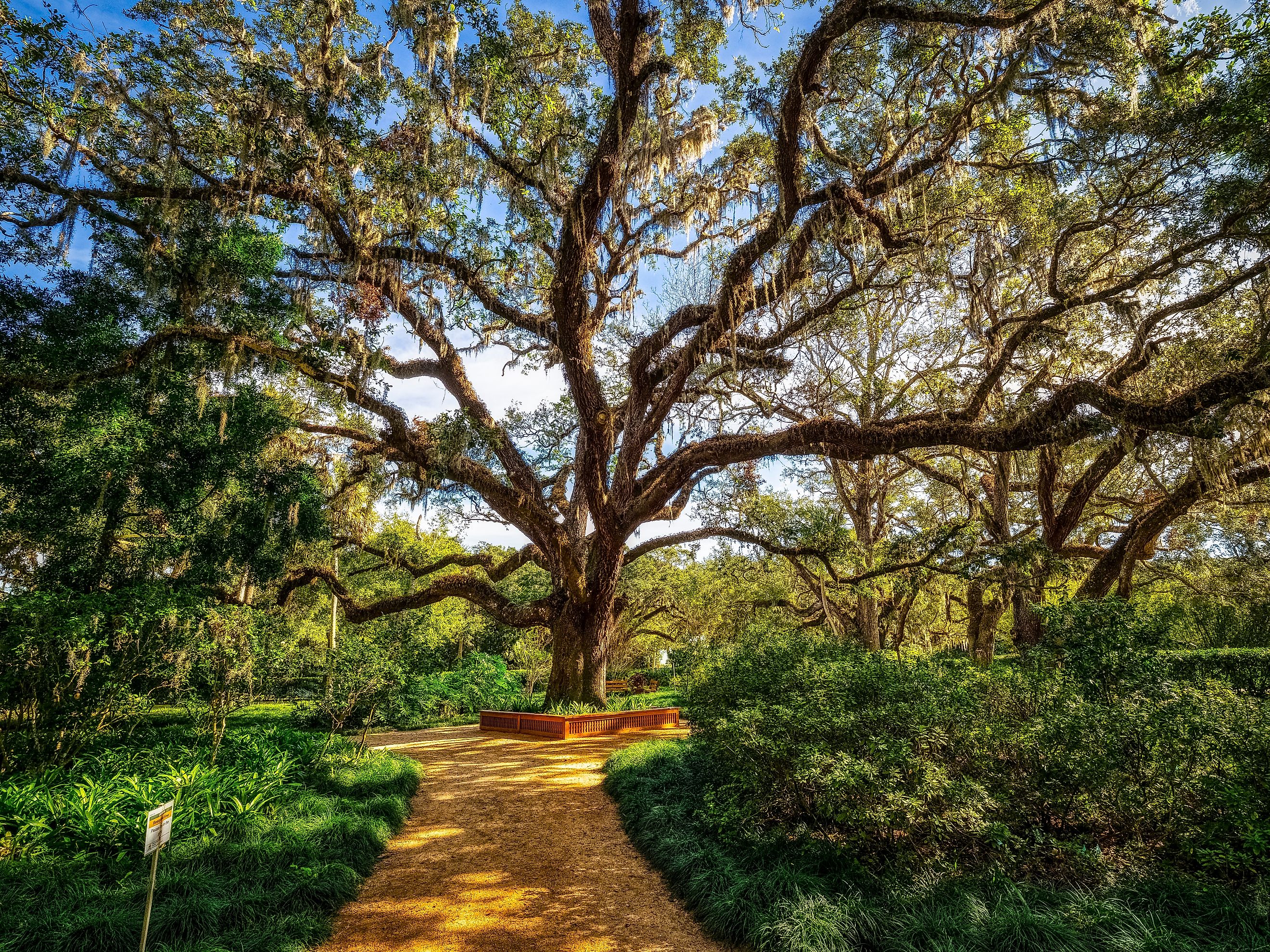
In 1936, designer Louise Clark and the super wealthy Owen Young, a chairman of General Electric (GE) and founder of the Radio Corporation of America (RCA), discovered Washington Oaks while on a date, looking for a place to picnic near the beach. Soon they would be married and Owen gave Louise Washington Oaks as a wedding present. For the next 25 years, Louise cultivated elaborate gardens on the property and used her design skills to accentuate its best features, turning it into a tropical retreat. After Owen died in 1962, she donated the land to be maintained as a state park, with 20 acres of botanical gardens and 400 acres of maritime hammock with 200-300 year old Live Oak trees and coastline featuring coquina shell formations. The land that became Washington Oaks Gardens State Park in 1964, appears first in the historical record as the cotton plantation Bella Vista ("Good View"), an adjunct part of a bordering sugar cane estate called Mala Compra ("Bad Bargain"), both situated 5-7 miles along the Matanzas River, where it flows into the Atlantic ocean. Joseph Marion Hernandez purchased both in the early 1800s, and eventually made a gift of Bella Vista to his daughter Louisa on the occasion of her marriage to George L. Washington in 1845, who was a relative of the first US president, George Washington. Thereafter, the property became known as Washington Oaks, since the most remarkable natural feature were the large Live Oak trees, creating an extended canopy of shade.
Mount Philo State Park, Vermont

"Not a stick of it...There is something in the world besides money," Frances Humphreys reportedly retorted to an inquirer who had asked about whether she planned to cut timber for profit from her land on Mt. Philo in Charlotte, Vermont in 1918. The public's enjoyment of a beautiful natural landscape was what mattered to her. The historic property is located 16 miles south of Burlington and features views overlooking Lake Champlain from a 968 ft peak. Humphreys would donate 160 acres in 1924 that would become Mt. Philo State Park, the first state park in Vermont, marking a general shift towards recreational preservation in state history. James and Frances Humphreys were a wealthy couple from Massachusetts who had become enamored with Mount Philo after staying at the Mount Philo Inn on vacation during the Summer of 1900. The Inn was owned and operated by James and Clara Lewis who had started a farm on the land years before but realized by 1896 there was more of an opportunity to develop the area into a tourist attraction by providing lodging and various amenities to visitors. And so, Lewis had torn down the original farmhouse, built an inn, and developed carriage roads up the mountain, with attractions like scenic lookout stations, gazebos, an observation tower, and a tent colony for guests who wanted to "rough it." The Humphreys continued to visit year after year and then started buying up land around the inn and further up the mountain, including the peak.
Pattison State Park, Wisconsin

There are never too many waterfall rescue stories. Sometimes even a lumberman or a miner, both of whose occupations are identified with negative deforestation impact industries, can affect positive ecological objectives when geography involves personal attachment to something like a waterfall. Martin Pattison worked in both the timber and iron industries, having gotten his start in lumber and then building his real fortune in owning and mining iron ore from lands he purchased in Minnesota, becoming one of the most successful iron magnates of that state. Decades earlier he and his brother William had bought land for a lumber clearing operation along the Black River, near Big Manitou Falls, Wisconsin's highest waterfall at 165 ft tall. The falls had become a favorite scenic retreat of his for years though they sold their land in 1888, and Martin moved on to the iron phase of his career. In 1917, word spread that there was a plan afoot to build a hydroelectric dam on Black River that would destroy Big Manitou Falls. Pattison entered the game and before the project had advanced to a starting phase, he secretly bought up 660 key acres surrounding the falls from an array of smaller landowners in the area, before the dam application was filed. Thus, he was able to secure the property necessary to save the falls. He then donated it to the state of Wisconsin in 1918, which he famously dubbed "a Christmas present for the people."
Forest of Nisene Marks State Park, California

What was left after the redwoods had been cleared and there was no oil to be found? In the end it was the memory of a mother who loved nature that caused siblings Herman, Andrew, and Agnes to donate 9,700 acres in her name to the State of California to create the Forest of Nisene Marks State Park, 9 miles east of Santa Cruz. The land they accumulated between 1951-53 had been clear cut generations before by the Loma Prieta Lumber Company, whose interest had been the highly prized redwoods. Loma Prieta worked out a deal with the Southern Pacific Railroad to sponsor the effort by building a rail line through the canyon specifically to facilitate the transport of redwood timber. From 1883-1923, approximately 140 million board ft of wood had been cut from this particular forest, enough to fill railroad box cars for 39 miles. The Marks siblings succeeded in buying the land from the lumber companies and other private owners but their original intent was to hunt for oil, as there had been oil speculation in Santa Cruz for some time. However, despite years of drilling, they came up dry. And so mother nature breathed a sigh of relief when the siblings connected with the Save-the-Redwood League who helped to begin to recover the forest, turning towards ecological preservation. The park was donated in 1963 and currently contains 10,036 acres, now restricted as a "natural reserve" to be used for "camping, hiking, and nature study."
The Lens of Ecological Philanthropy
That wraps up our journey through 10 state parks donated by wealthy families. In microcosm, studying these examples provides a solid look at 2 key dynamics in American history: the success that produces wealth enough to buy land to achieve personal dreams, and the integrity to see a higher value through giving lands to the public for their enjoyment. This kind of fusion suggests that prosperity is not necessarily gained at the expense of ecological mindfulness or community goodwill. These stories provide insight into many aspects of history, regional business development, and the personal anecdotes that give more robust depth than just a family name from a long time ago, adopted as the title of a park.