The State Parks Built By The Civilian Conservation Corps
Known as the largest and most successful federal conservation program in the US, the Civilian Conservation Corps was a workforce initiative that emerged during the New Deal era following the Great Depression. From 1933 to 1942, the program employed more than three million men to improve public lands, forests, and parks across the country. Prior to the inception of the corps, many states lacked a formal park system. During its operation, the Civilian Conservation Corps helped develop over 800 state parks throughout the US, building the foundation for the state park system we know today. These six state parks rank among the most prominent the corps developed, and the Depression-era labor behind them remains visible at each one today.
Bottomless Lakes State Park, New Mexico

Bottomless Lakes State Park was the first state park in New Mexico, established in 1933. It was one of the first sites the Civilian Conservation Corps took on, with crews building roads, picnic shelters, and the stone bathhouse at Lea Lake through the mid-1930s. Red bluffs border the park, and its namesake is a chain of eight small lakes along the eastern edge of the Pecos River valley. These lakes are technically sinkholes ranging from 17 to 90 feet deep, formed by dissolving limestone over time. Each lake has its own appeal, with Lea Lake serving as the largest and only lake open to swimming and non-motorized boating in the park. Pedal-boat and paddleboat rentals are available from Memorial Day to Labor Day. Scuba diving enthusiasts can explore the depths of Lea Lake's cerulean oasis from below, offering a unique freshwater dive in the otherwise arid New Mexico landscape. Divers must provide their own gear. Rentals and air refills are not available onsite. Outside of watersports, there are 5 miles of trails in total for hiking and birding, three of which double for mountain biking, along with 42 campsites across two campgrounds.
Coolidge State Park, Vermont

Named for Vermont native and 30th president of the US, Calvin Coolidge, construction on Coolidge State Park began in 1933. The park was the third of 21 Vermont state parks established by the CCC and one of the most extensive. Enveloped by 21,500 acres of state forest, the Civilian Conservation Corps built the park from the ground up, including many forest service roads and other reforestation projects in the surrounding area. Little has been done to the park since, leaving a time capsule of rustic, early 20th century corps infrastructure. Activities at the park change with the season; hiking and mountain biking reign supreme in the warmer months while cross-country skiing and snowshoeing are most popular in the winter. There are 30 miles of multi-use trails within the park, several of which connect to longer routes outside of the park, in the surrounding Coolidge State Forest. Traditional camping and horse camping are available within the park as well, including a loop composed entirely of lean-to campsites, the only such loop in any Vermont state park.
Florida Caverns State Park, Florida

Nine state parks across Florida emerged from the creation of the Civilian Conservation Corps, including Florida Caverns State Park. Work began on the park in 1935 and finished in 1942, creating the seventh state park in Florida. The 1,300-acre park in the northwest Florida panhandle holds over 30 named limestone caves that cover 10 acres. During construction, the corps focused heavily on these caves, forging a 3,000 foot trail system underground. Known as the "Gopher Gang," Civilian Conservation Corps men worked 55 feet below the surface in constant 65 degree weather to build the framework that stands today. The only park of its kind in the state and one of few across the country, tours of the largest cavern are open to the public most days out of the year. On the tour, visitors pass through Florida Cavern along the same tunnels that Civilian Conservation Corps workers carved from the limestone all those years ago. Each tour is roughly 45 minutes long, three quarters of a mile long, and is considered to be moderately difficult.
Guernsey State Park, Wyoming

Guernsey State Park covers 6,000 acres around the Guernsey Reservoir in southeastern Wyoming, one of 12 state parks across the state. From 1934 to 1937, the Civilian Conservation Corps took the rugged Rocky Mountain landscape surrounding the reservoir and cut miles of trails and campsites for hiking, biking, and rock climbing across the mountainous terrain. While the recreation opportunities inside the park are extensive, the real draw is the historic Civilian Conservation Corps architecture, untouched by modernization. The most notable structure in the park is an elaborate stone and log picnic shelter known as The Castle. Set on the dividing line between the recreation and conservation sides of the park, the Castle looks more like a medieval fortress than a picnic shelter. The two-story structure has a handcrafted stone fireplace, spiraling staircases, an observation tower, and stone arches that frame views of the western landscape. It remains one of the most remarkable Civilian Conservation Corps built picnic shelters in the country.
Mendocino Woodlands State Park, California

Unlike most state parks which center on individual recreation, Mendocino Woodlands State Park in northern California was planned with community education in mind. The only state park designated as a recreational demonstration area in California, Mendocino Woodlands State Park was one of 46 Civilian Conservation Corps constructed recreational demonstration areas across the country. Essentially, these areas were conceived to address recreation needs near urban communities where resources were limited. Deep in the Redwood Forest, the 720 acre park has three private group campgrounds, each equipped with cabins, a kitchen, dining hall, and bath house. These campgrounds can house groups of 30 to 200 guests. The first campground opened in 1938 and by 1943, all campgrounds were accessible. Alongside the campgrounds, staff run educational workshops and programs throughout the year. Aimed specifically at youth, the park's outdoor environmental education program lets students learn about the wildlife and foliage of the redwood forest firsthand. Workshops and courses are available to schools, extracurricular groups, and homeschooled kids.
Palo Duro Canyon State Park, Texas

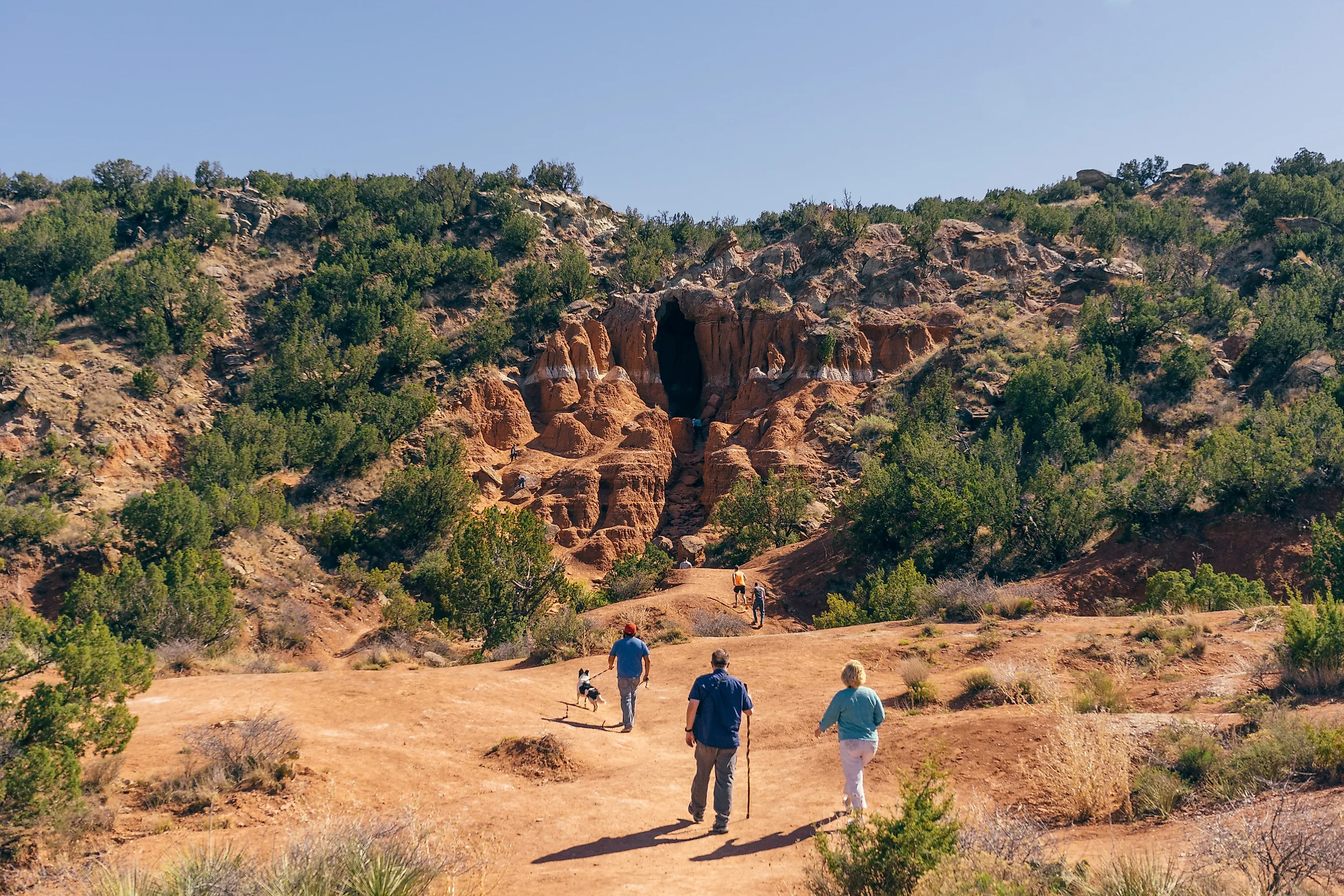
Palo Duro Canyon State Park spreads across 28,000 acres of the Texas panhandle and takes in the second largest canyon in the country. The Civilian Conservation Corps started work on the park in 1933 and continued through 1937, though it opened unfinished to the public in 1934. Both the recreation and the architectural design center on the 120 mile long Palo Duro Canyon. Crews developed 30 miles of hiking, biking, and equestrian trails to reach famed geological formations throughout the park, most notably the 310 foot rock pedestal known as "The Lighthouse." Cabins of native stone went up along the canyon's rim, and cow camp cabins on the canyon's floor, to offer varied experiences of the canyon's multicolored rock mesas. Corps members also forged a two lane road that runs eight miles from the canyon's rim down to the floor, dropping a startling 800 feet in less than a mile. In total, the Civilian Conservation Corps and National Park Service spent roughly $2 million on the park's initial development, making it one of the most expensive park construction projects across the country.
The Corps Legacy In America's State Parks
The state parks we know today would not exist without the hard work and determination of the Civilian Conservation Corps. During the corps's existence, the men planted more than 3 billion trees, engineered over 140,000 miles of trails and roads, and established hundreds of state and national parks across the country. These six state parks are just a taste of all the natural wonders state parks in the US have to offer.