The Highest-Altitude Stadiums In North America
Elevation can greatly change how sports are played across North America, from professional soccer in central Mexico to college football in Colorado. At higher altitudes, reduced air density allows balls to potentially travel farther, while, most notably, lower oxygen pressure makes sustained physical effort more demanding, especially for athletes arriving from lower elevations. These conditions influence everything from kicking distances to the way visiting teams prepare for a match. The venues we will be covering vary quite a bit, encompassing enclosed arenas, baseball parks, and university stadiums often overlooking scenic mountain vistas. However, their lofty positions tell only part of the story, as some have hosted World Cup matches, memorable championship games, and decades of rebuilding that have shaped their places in sporting history.
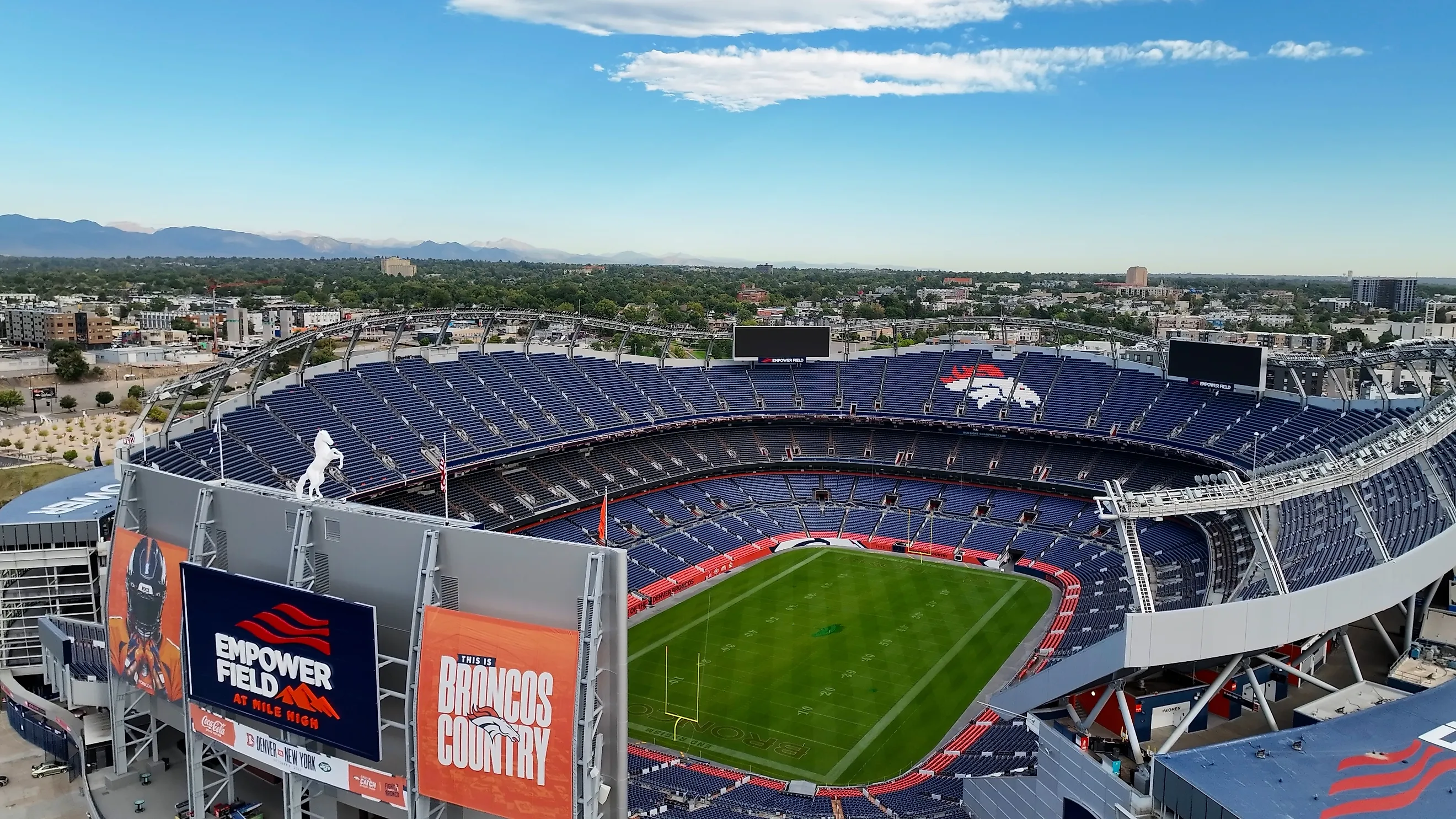
NFL: Empower Field at Mile High - Denver, Colorado - 5,280 Feet

Denver's Empower Field at Mile High stands 5,280 feet (1,609 meters) above sea level and has served as the Denver Broncos' home since 2001. The stadium officially opened on August 11 that year, replacing the original Mile High Stadium less than 50 feet (15 meters) away.
The building's curved upper profile echoes the Rocky Mountains to the west, while its decorative exterior combines steel, glass, and aluminum. Inside, it has 76,125 seats spread across five levels, including 8,200 club seats and 144 luxury suites, and cost $400.7 million to construct. The finished venue encompasses approximately 1.8 million square feet (167,225 square meters), more than twice the size of its predecessor. But despite its much larger size now, its seating capacity increased by just two seats.
The Metropolitan Football Stadium District owns the stadium, while a Denver Broncos subsidiary manages it, maintaining the team's longstanding presence at this site just west of downtown.
MLB: Coors Field - Denver, Colorado - 5,280 Feet

The Colorado Rockies' home in Denver's Lower Downtown neighborhood opened on April 26, 1995, with an 11-9 victory over the New York Mets that lasted 14 innings. To add to its accolades, Coors Field also hosted the 1998 and 2021 MLB All-Star Games, plus Games 3 and 4 of the 2007 World Series against the Boston Red Sox.
Here, a purple row of upper-deck seats marks exactly 5,280 feet (1,609 meters) at Coors Field, while the playing surface itself sits roughly 5,200 feet (1,585 meters) high. Just beyond center field, pine trees, waterfalls, and fountains in the stands recreate elements of a mountainous setting, with the fountains erupting after Rockies home runs and victories. The aptly named "Rockpile" offers bleacher seating high above center field, while The Rooftop occupies part of the upper deck in right field. Added in 2014, this gathering area replaced several thousand seats with multiple bars and outdoor standing room.
NBA/NHL: Ball Arena - Denver, Colorado - 5,280 Feet

Basketball, ice hockey, and indoor lacrosse share Ball Arena, home to the Denver Nuggets, Colorado Avalanche, and Colorado Mammoth. Set in Denver's Central Platte Valley at approximately 5,280 feet (1,609 meters), the enclosed venue opened as Pepsi Center on October 1, 1999, with a sold-out Celine Dion concert. It adopted its current name in 2020 from local manufacturing giant Ball Corporation.
The arena accommodates 19,099 spectators for basketball and around 18,000 for hockey and lacrosse, with seating reconfigured between sports. Furthermore, concert configurations can accommodate more than 20,000 people, depending on how the stage is arranged.
Designed by HOK Sports Facilities Group, this five-level arena took 21 months to build and cost more than $180 million in private funding, and a separate, full-size Nuggets practice court is also housed inside the building. Beneath the main basketball floor, the hockey ice remains covered by around 600 protective fiberglass boards during other events.
MLS: Dick's Sporting Goods Park - Commerce City, Colorado - 5,280 Feet

DICK'S Sporting Goods Park gives the Colorado Rapids a dedicated soccer home in Commerce City, Colorado, around 5,200 feet (1,585 meters) above sea level, like many of the area's other arenas. The club inaugurated the stadium on April 7, 2007, defeating D.C. United 2-1 before a sellout crowd.
International soccer produced a memorable chapter here on March 22, 2013, when the United States defeated Costa Rica 1-0 in a World Cup qualifier played through heavy snowfall. Known as the SnowClasico, the match required crews to repeatedly clear the field markings as snow accumulated across the playing surface.
Today, the venue can seat over 18,000 spectators and forms the centerpiece of a much larger sports complex. Around it are 23 fully lit playing fields, including 21 with natural grass and two with synthetic turf, plus a separate Rapids practice pitch. These surrounding fields accommodate tournaments and recreational play beyond the professional team's home schedule.
College Football: Mountaineer Bowl Events Complex - Gunnison, Colorado - 7,771 Feet
At 7,771 feet (2,369 meters), Mountaineer Bowl Events Complex overlooks the Gunnison Valley from Western Colorado University's campus in Gunnison. Easily one of the highest sporting fields in the country and the highest college football stadium on Earth, games have been played here since 1948, when Western defeated Colorado School of Mines 20-0.
The now extensively renovated complex officially reopened in September 2024 after a couple of years, introducing artificial turf, stadium lighting, a resurfaced track, and a new video scoreboard. The playing surface itself, named Mojo Field, sits within the Mountaineer Bowl at the broader Rady Family Sports Complex.
Besides the field, the project added a gateway building with ticketing booths, locker rooms, and training facilities, plus a press building containing broadcast zones, coaches' boxes, and hospitality suites. The surrounding track also serves Western's track and field teams. But its role extends beyond competition, too, with incoming students attending orientation convocation here and graduating students returning to the Bowl for commencement and other general gatherings.
Association Football: Estadio Nemesio Díez - Toluca, Mexico - 8,750 Feet

Estadio Nemesio Díez stands approximately 8,750 feet (2,667 meters) in Toluca, Mexico (the highest major city in North America), where its steep stands place the audience remarkably close to the pitch. Home to Deportivo Toluca, the stadium opened on August 8, 1954, and hosted matches during both the 1970 and 1986 FIFA World Cups. Its 1970 fixtures also included Italy's quarterfinal victory over Mexico.
Corner towers support a roof that eliminated view-blocking columns, while also accommodating private boxes, video screens, and routes between seating levels. Moreover, a red-and-white exterior cladding reflects the club's colors. Another distinctive feature is the pitch's east-west orientation, which differs from the more usual north-south alignment (which often prevents sun from glaring in players' eyes).
The ground received its current name in 2000 to honor longtime club owner Nemesio Díez Riega, and renovations completed in 2017 transformed the venue into the modern era to coincide with the club's centenary celebrations that year. The club currently lists the renovated stadium's capacity at 30,000 spectators.
Catch a Game Above the Clouds at These Elevated Venues
Denver's reputation as a sports city a mile above sea level can overshadow just how much higher some other teams play within North America. Mountaineer Bowl stands roughly 2,500 feet above the Broncos' home ground, and Estadio Nemesio Díez is even higher again by over a thousand feet! As mentioned, both have undergone major updates and renovations over the decades, keeping collegiate football in remote Gunnison and soccer in Toluca on grounds their teams have used since the mid-1900s.