The Largest Domed Stadiums In The United States
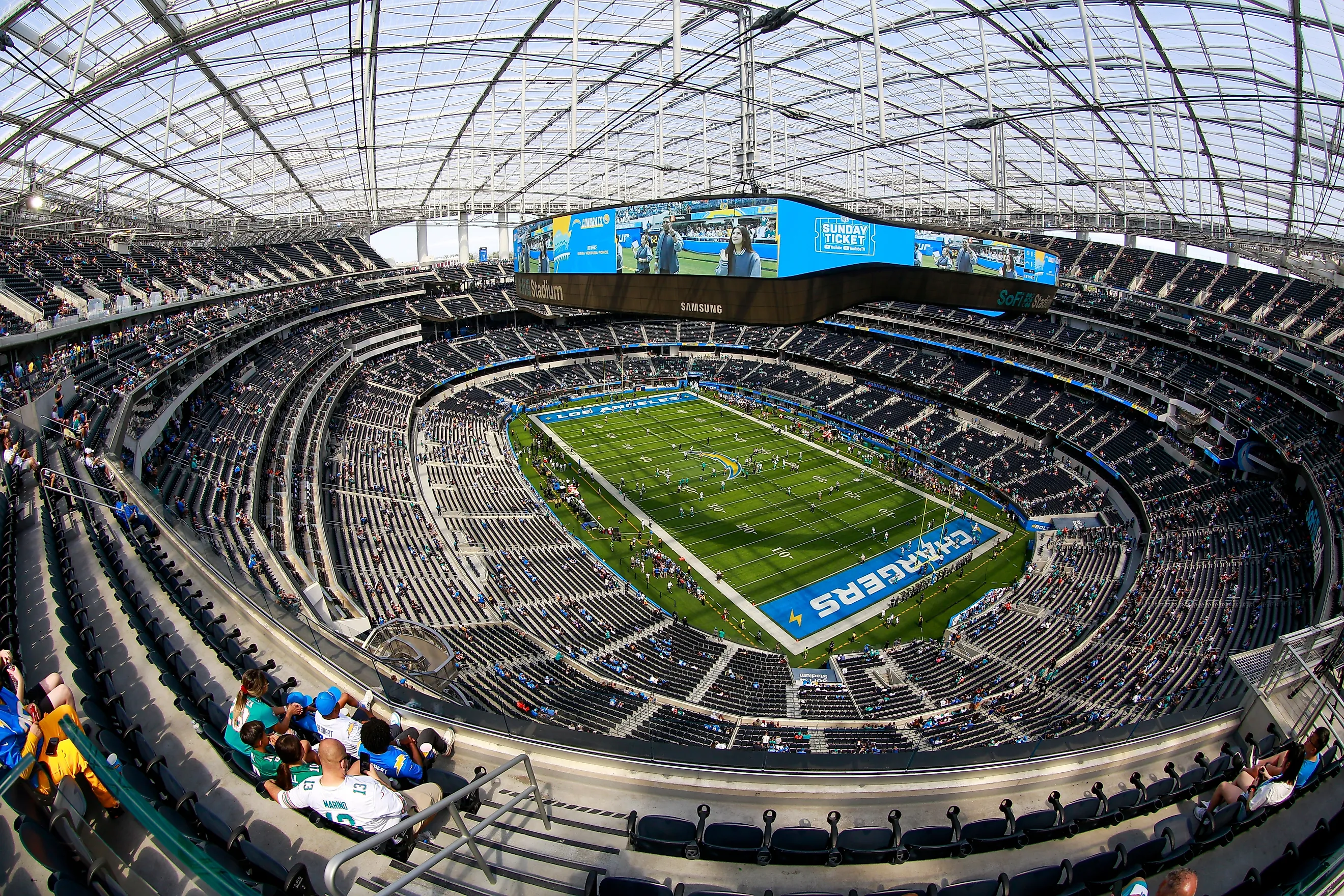
AT&T Stadium in Arlington, Texas, can accommodate more than 100,000 people and drew a record 108,713 fans for the 2010 NBA All-Star Game. In Inglewood, SoFi Stadium matches that scale, with room to expand to 100,000 and an estimated $5.5 billion construction cost, making it the world’s most expensive stadium. Its translucent canopy and open sides offer a very different experience from the rounded roof of the Caesars Superdome in New Orleans. That landmark opened in 1975 and sheltered thousands during Hurricane Katrina. These venues rank among America’s largest roofed stadiums by expanded event capacity. Their designs range from a traditional fixed dome to retractable roofs and enormous movable doors that let the outdoors into the stands.
AT&T Stadium, Arlington, Texas
Seating capacity 100,000

When you're home field to one of the world's most iconic sports teams, you need to be big. Completed at a cost of $1.15 billion in 2009, the state-of-the-art AT&T Stadium in Arlington, Texas, fills up during Cowboys home games on Sundays during the National Football League season, attracting fans from around the world. It is also home to college football's Cotton Bowl Classic and the Big 12 championship game. To help pay for the stadium, which was originally to cost $650 million, Arlington voters approved an increase of the city's sales tax by 0.5 percent, the hotel tax by two percent, and the car rental tax by five percent, and the city provided more than $325 million in funding. A pair of 1,225-foot (91-meter) arches spans the length of the stadium dome for the retractable roof, which is one of the tallest in the world, and massive glass doors at each end zone can be opened when the weather cooperates. The stadium has a base seating capacity of 80,000 people, but can be reconfigured to hold more than 100,000 people by increasing open areas behind each end zone, making it the largest stadium in the NFL by seating capacity. However, it was the 2010 National Basketball Association's all-star game that set an all-time basketball attendance record of 108,713 people.
SoFi Stadium, Inglewood, California
Seating capacity 100,000

If it's built in Los Angeles, it has to be the most expensive and glitzy. SoFi Stadium is no exception, costing $5.5 billion to make it the most expensive stadium in the world. Glitz might be an understatement with this design, which features a fixed translucent canopy made of ETFE panels and open-air sides, meaning there technically aren't any walls. The 3.1 million-square-foot stadium has the largest footprint in the NFL, and its base seat capacity of 70,000 can be expanded to host 100,000 people. Home to the Los Angeles Rams and Los Angeles Chargers, SoFi Stadium was host to Super Bowl LVI in 2022, which the home team Rams won, the College Football National Championship game in 2023, and is set to host Super Bowl LXI in 2027 and the Olympic Opening Ceremony and Paralympic Opening Ceremony for the 2028 Games. SoFi has won a number of industry awards for its design, including the Outstanding Architectural Engineering Project of 2021 by the American Society of Civil Engineers.
Caesars Superdome, New Orleans, Louisiana
Seating capacity 83,000

By far the oldest and least expensive stadium on this list, the Caesars Superdome in New Orleans is one of the last fixed-dome stadiums in the US. Completed in 1975 at a cost of over $130 million (originally budgeted at $46 million), the fixed dome structure covers a 680-foot diameter and 9.7 acres of steel framework, making it the world's largest fixed dome. Home to the NFL's New Orleans Saints, the stadium garnered international attention when it served as a refuge for more than 30,000 people during Hurricane Katrina in 2005. Despite suffering $185 million worth of damage from Katrina, including peeling off the Superdome's outer covering, the Superdome served as a symbol of New Orleans's resilience during the disaster. Today, the stadium continues to be a crown jewel for major events, and it has hosted eight Super Bowls, more than any other venue.
Mercedes-Benz Stadium, Atlanta, Georgia
Seating capacity 83,000

The exterior design of the Mercedes-Benz Stadium, with triangular shapes dominating the edifice, is about as opposite as you can get to a traditional dome shape, but it's still considered a domed stadium. Completed in 2017 at a cost of $1.6 billion, it is home to the NFL's Atlanta Falcons and Major League Soccer's Atlanta United FC. The unique retractable pinwheel roof is made of eight translucent triangular petals that open like a camera shutter. Closing the roof takes slightly less time than opening it since the roof has to disengage the seals at the start of the opening procedure. Architect Bill Johnson explained the circular opening in the roof was inspired by the Roman Pantheon, and the materials used were lightweight polymer with adjustable opacity to control natural light levels. Inside, the middle concourse and upper bowls were eliminated in the east end zone to allow for clear views of the Atlanta skyline.
Reliant Stadium (formerly NRG Stadium), Houston, Texas
Seating capacity 83,000

They like things big in Texas, and the NRG Stadium in Houston is no exception, with a seating capacity of 72,220 people. Completed in 2002 at a cost of $352 million, NRG Stadium was the first stadium in the NFL to employ a retractable roof. For more than 25 years, the city's previous professional football team, the Houston Oilers, played in the famous Astrodome, the nation's first multi-purpose domed stadium. But they moved to Nashville to become the Tennessee Titans after owner Bud Adams and local officials couldn't agree on whether to keep the Astrodome, which Adams deemed too small, or build a new venue. In 1999, the NFL granted an expansion franchise to Houston, and the Texans were born, playing the first regular-season game in the stadium against cross-state rivals, the Dallas Cowboys. The stadium's retractable roof was designed to mitigate Houston's intense summer heat, and it can open and close in just over seven minutes. The design features two flat panels operating on a ridge-and-valley truss system that meet over the 50-yard line when closed and retract above the end zones when open. NRG Stadium hosted Super Bowl LI in 2017, when the New England Patriots rallied from a 28-3 deficit to defeat the Atlanta Falcons 34-28 in overtime.
US Bank Stadium, Minneapolis, Minnesota
Seating capacity 73,000

Minnesota's frigid winter climate had to be considered for the design and construction of U.S. Bank Stadium, completed in 2016 on the site of the former Metrodome. The owners of the Minnesota Vikings wanted an outdoor stadium because cold weather gave the team an advantage, especially in the playoffs, but state and local governments would only consider funding for an indoor stadium capable of hosting major sports and entertainment events. In the 2010s retractable roofs were the trend for football stadiums, but retractable roofs weren't designed to be open and closed in sub-freezing temperatures as it put too much stress on the roof and its components. Instead, designers chose ethylene tetrafluoroethylene (ETFE) panels and giant pivoting doors, which could open in nicer weather while the panels allowed natural light into the stadium. It was a compromise that worked. The $1.06-billion stadium hosted Super Bowl LII in 2018 when the Philadelphia Eagles defeated the New England Patriots.
The Largest Domed Stadiums In The United States
| Rank | Stadium | Capacity | Location |
|---|---|---|---|
| 1 | AT&T Stadium | 100,000+ | Arlington, Texas |
| 2 | SoFi Stadium | 100,000 | Inglewood, California |
| 3 (tie) | Caesars Superdome | 83,000 | New Orleans, Louisiana |
| 3 (tie) | Mercedes-Benz Stadium | 83,000 | Atlanta, Georgia |
| 5 | Reliant Stadium (formerly NRG Stadium) | 80,000 | Houston, Texas |
| 6 | US Bank Stadium | 73,000 | Minneapolis, Minnesota |
When it comes to modern sports venues, the term "dome" still lingers, but today's stadiums are too high-tech to really be domes. With retractable roofs, ETFE panels, and giant retractable doors, fans can get the best of both the natural outside elements and indoor environment controls while watching their favorite team or entertainer. The term and concept for the domed stadium began in the 1960s, culminating with Houston's Astrodome in 1965. After that, there was Seattle's Kingdome, Detroit's Silverdome, and New Orleans's Superdome, all of which were completely enclosed, climate-controlled boxes, and have now given way to today's modern indoor-outdoor stadiums.