The Highest Cities In North America
North America has an average elevation of roughly 294 meters (965 feet) above sea level, which ranges widely across landforms. Many areas far above this level are home to large communities. While the title of highest town in North America may go to Leadville, Colorado, at over 3,000 m (10,000 feet), the highest city in North America, with a population greater than 100,000, is Toluca de Lerdo in Mexico, which sits at an elevation of 2,663 meters (8,737 feet) above sea level, nearly ten times the continent’s average. All the top 10 highest cities in North America sit well above the continent’s average elevation and support large populations in high-altitude environments.
These cities are concentrated in highland regions, particularly across central Mexico and parts of Central America, where elevation strongly shapes climate and settlement.
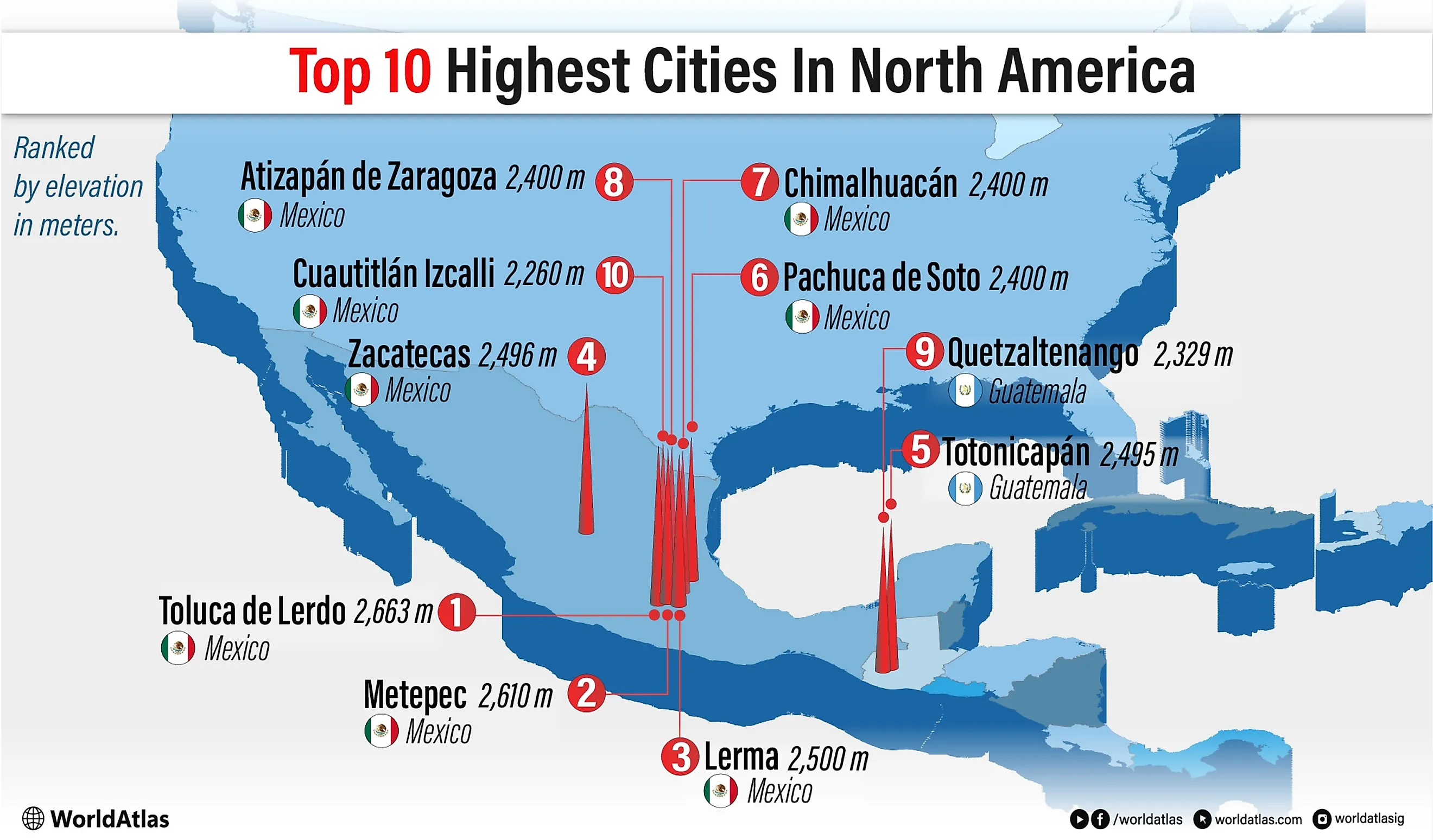
The Highest Major Cities In North America (Elevation)
| Rank | City | Country | Elevation |
|---|---|---|---|
| 1 | Toluca de Lerdo | Mexico | 2,663 m (8,737 ft) |
| 2 | Metepec | Mexico | 2,610 m (8,563 ft) |
| 3 | Lerma | Mexico | 2,500 m (8,202 ft) |
| 4 | Zacatecas | Mexico | 2,496 m (8,189 ft) |
| 5 | Totonicapán | Guatemala | 2,495 m (8,186 ft) |
| 6 | Pachuca de Soto | Mexico | 2,400 m (7,874 ft) |
| 7 | Chimalhuacán | Mexico | 2,400 m (7,874 ft) |
| 8 | Atizapán de Zaragoza | Mexico | 2,400 m (7,874 ft) |
| 9 | Quetzaltenango | Guatemala | 2,329 m (7,641 ft) |
| 10 | Cuautitlán Izcalli | Mexico | 2,260 m (7,415 ft) |
1. Toluca de Lerdo, Mexico — 2,663 m (8,737 ft)

Toluca de Lerdo, also known as Toluca, is the state capital of the State of Mexico and the highest large city as well as the highest capital city in North America. It sits at an average elevation of around 2,663 meters (8,737 feet) above sea level. The city is located at the base of the massive Nevado de Toluca volcano, in the high-altitude Toluca Valley. To this end, the surroundings feature large plateaus and volcanic structures, which are some of the highest in the state. The high altitude also leads to a colder climate, with an average annual temperature of 12.5°C (54.4 °F). This is a stark drop from nearby Mexico City, which averages around 16°C (60.7 °F) year-round due to its lower elevation.
Thanks to its extreme elevation, Toluca is a popular spot for high-altitude training and activities. Athletes come here to train in the thinner air, although it can be troublesome for people without practice, leading to altitude sickness. Apart from its elevation, the municipality is home to over 900,000 people and is one of the largest in the region.
2. Metepec, Mexico — 2,610 m (8,563 ft)

Metepec is a high-altitude city in the State of Mexico and part of the Toluca metropolitan area. It sits at an average elevation of about 2,610 meters (8,563 feet) above sea level, placing it among the highest large cities in North America. The city has a population of over 240,000, meeting the threshold for a major urban center at an elevation. Similar to Toluca, its location in the Toluca Valley of the Mexican Plateau strongly influences local climate.
The temperature here averages 14.3°C (57.7°F). In a year, most rainfall falls during the summer months, while winters remain cooler and relatively dry. Cold nights are common, especially from November to February, and occasional frost can occur at higher altitudes. These conditions contrast sharply with those of lower-elevation cities in central Mexico. Metepec has expanded steadily as a residential and commercial center. Much of this growth is linked to its proximity to Toluca and Mexico City, with many residents commuting to nearby industrial and business districts. Despite urban development, the city remains known for traditional pottery, including the “Tree of Life” ceramic sculptures.
3. Lerma, Mexico — 2,500 m (8,202 ft)

Lerma is a high-altitude city located in the State of Mexico, about 20 kilometers east of Toluca. It sits at an average elevation of approximately 2,500 meters (8,202 feet) above sea level, placing it among the highest large cities in North America. The city lies within the Lerma Valley, part of the broader Mexican Plateau, and is surrounded by elevated terrain, including the Sierra de las Cruces. This geography directly shapes local climate and settlement patterns.
Lerma has a population of over 170,000 people and has grown steadily in recent decades. Much of this growth is linked to industrial development and its position within the Greater Mexico City commuter belt. The city hosts several industrial parks and logistics centers, which attract workers from nearby municipalities. Due to elevation, temperatures are cooler than in lower-lying parts of the Valley of Mexico. In fact, the average temperature is 11.4°C (52.4°F), which is even lower than Toluca.
4. Zacatecas, Mexico — 2,496 m (8,189 ft)

Zacatecas is the highest city in North America outside the Toluca Valley, located in north-central Mexico. It is the capital of the state of Zacatecas and has an elevation of 2,496 m (8,189 feet). The city’s elevation is due to its location in the Mexican Plateau, a mountainous region. The city’s steep streets and dramatic elevation changes are a direct result of its mountainous plateau setting. Unlike flatter highland cities, Zacatecas rises and falls sharply, creating lookout points and neighborhoods perched above deep ravines.
Being both high and inland, Zacatecas receives less rainfall than many other Mexican highland cities. The average annual rainfall is 594 mm (23.4 inches). This has historically influenced reservoir construction, water management systems, and settlement density, tying elevation directly to urban planning constraints. Its historic silver mines operated successfully despite altitude-related challenges such as colder temperatures and reduced oxygen.
5. Totonicapán, Guatemala — 2,495 m (8,186 ft)

Totonicapán is the capital of the department of Totonicapán in Guatemala. It is one of the few major cities in North America outside of Mexico at an elevation of over 2,200 meters (7,218 feet), sitting at 2,495 m (8,186 ft) above sea level. Similar to other high cities, Totonicapán sits in mountainous terrain in the Sierra Madre mountain range. Thus, the surrounding regions boast peaks over 3,000 meters (9,843 feet), including the 3,045-meter-high (9,990-foot-high) Cerro de Coxóm. The elevation contributes to a cool, temperate climate and an average annual temperature of 13.8°C (56.8°F).
Guatemala’s highland cities sit well above the country’s coastal plains and low-lying jungle regions, where elevations drop below 500 meters (1,640 feet), and temperatures rise sharply. At heights exceeding 2,300 meters (7,546 feet), thinner air results in lower oxygen levels, which can cause mild altitude effects for visitors but poses little issue for long-term residents adapted to life in the highlands. Agriculture in these regions has evolved around elevation, favoring cold-tolerant crops such as potatoes, maize, wheat, and highland vegetables rather than tropical produce.
6. Pachuca de Soto, Mexico — 2,400 m (7,874 ft)

Pachuca de Soto is the capital and largest city of the Mexican state of Hidalgo. It is located in south-central Mexico in a region of rugged, hilly, and mountainous terrain. To this end, the town sits at an elevation of around 2,400 m (7,874 ft), making it one of the highest major cities in North America. Because Pachuca sits on an exposed high-altitude plateau along the Sierra de Pachuca, air moving between surrounding valleys accelerates over the terrain, producing frequent and sometimes strong winds that have long defined the city’s climate and earned it the nickname “La Bella Airosa.”
At its extreme elevation, Pachuca de Soto has lower air pressure than Mexico’s coastal and lowland cities, which reduces oxygen availability during physical exertion. The city has a population of approximately 300,000, demonstrating that large communities can function at this elevation. Surrounding agricultural areas are adapted to the altitude, with barley, maize, and alfalfa commonly grown instead of tropical crops.
7. Chimalhuacán, Mexico — 2,400 m (7,874 ft)

Chimalhuacán, Mexico, is located roughly 80 kilometers south of Pachuca de Soto, and both cities rest at the same average elevation. It is located in the eastern part of the State of Mexico, Mexico, at an elevation of 2,400 m (7,874 ft). It lies in the high-altitude Valley of Mexico, outside Mexico City, and has a landscape similar to that of other communities in nearby regions. Despite its elevation, Chimalhuacán is one of the most densely populated municipalities in the area, showing how large urban populations can develop and persist in high-altitude basin environments.
The city has a population of over 700,000 people, making it one of the largest high-elevation urban areas in North America. Its location within a closed basin limits air circulation, which contributes to cooler nights and seasonal temperature inversions. Elevation plays a role in shaping both climate conditions and urban density across the municipality.
8. Atizapán de Zaragoza, Mexico — 2,400 m (7,874 ft)

Atizapán de Zaragoza is an elevated municipality located northwest of Mexico City in the State of Mexico. It sits on a high plateau at an average elevation of around 2,400 meters (7,874 feet) above sea level. This is notably higher than the nearby Mexico City, which has an average elevation of around 2,240 meters (7,350 feet). The city has a population of around 500,000, making it among the largest high-altitude cities in North America.
Its elevation results in milder daytime temperatures and cooler nights compared to Mexico City’s lower districts. Seasonal temperature swings are more noticeable during winter, when cold mornings are common. Atizapán has developed as both a residential and commercial center, with major highways linking it directly to Mexico City. Industrial parks, shopping centers, and dense housing developments dominate much of the landscape.
9. Quetzaltenango, Guatemala — 2,329 m (7,641 ft)

Quetzaltenango is a city in Guatemala, home to around 180,000 people as of the 2018 census. Along with being one of the most populous cities in the nation, this municipality in southwestern Guatemala is among the highest cities on the continent. Quetzaltenango has an elevation of 2,329 m (7,641 ft) above sea level, making it the second-highest city in the country and the ninth-highest in North America. The city’s elevation is due to its location in the Sierra Madre Occidental, a high-altitude mountain range with several volcanoes. It is also located near the foot of the Santa Maria volcano, notable for its high elevation of 3,772 m (12,375 ft).
Its elevation contributes to lower oxygen levels than coastal regions, which influences daily activity and gives the city a climate more similar to temperate zones than tropical Central America. The city has a mean annual temperature of 14.8 °C (58.6 °F), notably less than nearby communities like Villa Nueva, which has a mean annual temperature of 18.7 °C (65.7 °F). Quetzaltenango is also a major educational center in Guatemala, home to several universities and technical institutes that serve the western highlands.
10. Cuautitlán Izcalli, Mexico — 2,260 m (7,415 ft)

Cuautitlán Izcalli is a planned city located in the northern part of the State of Mexico. It sits at an average elevation of about 2,260 meters (7,415 feet) above sea level, placing it among the highest large cities in North America. The city lies on the northern edge of the Valley of Mexico, where elevated plains gradually rise away from Mexico City.
The city was developed in the 20th century to manage population growth outside the capital. Its layout reflects this planning, with wide roads, industrial zones, and large residential areas. Elevation plays a vital role in local conditions. Nights are cooler than in lowland cities, and mornings can feel cold during winter. The thinner air at this height can also make physical activity feel more demanding for visitors. Cuautitlán Izcalli has a population of over 500,000 people and functions as a major residential and industrial center. The average annual temperature is 14.8 °C (58.7 °F), reflecting its high elevation rather than Mexico’s coastal climate.
The Highest Cities In North America
These cities show how large populations can thrive far above sea level in North America. Most are located on high plateaus and mountain valleys in Mexico and Central America, where elevation shapes climate, daily life, and urban growth. Cooler temperatures, thinner air, and unique geography influence everything from housing to agriculture. Despite these challenges, each city supports hundreds of thousands of residents, proving that high elevation has not limited long-term settlement or development in the region.