Islamic Countries Of The World
The Muslim world is the term used, sometimes interchangeably with the Islamic world, to describe Muslims collectively, the civilisation they have built since the seventh century, and the geographic span of states where Muslims make up the majority. As of 2020, Pew Research Center's most recent comprehensive estimate, approximately 2.0 billion people identified as Muslim, equivalent to 25.6 percent of the world's population. Islam has been the world's fastest-growing major religion over the past decade, with the global Muslim population increasing by an estimated 347 million between 2010 and 2020, and projections suggest parity with Christianity by mid-century. This article covers the religious, geographic, and political dimensions of the Muslim world, with a comprehensive country-level breakdown at the end.

A Brief History of Islam
Islam was founded by the Prophet Muhammad in the western Arabian city of Mecca in 610 CE, the year in which the tradition holds that he received his first revelation from the angel Gabriel. After persecution in Mecca, Muhammad and his followers migrated to Medina in 622, an event known as the Hijra, which marks the start of the Islamic lunar calendar. By the time of Muhammad's death in 632, most of the Arabian Peninsula had converted. The four Rashidun ("rightly guided") caliphs who followed him oversaw a rapid expansion: Damascus fell to Muslim armies in 635, Jerusalem in 638, and Alexandria in 641. By the early eighth century, the Umayyad Caliphate ruled an empire stretching across Arabia, the Levant, North Africa, Persia, and into Iberia. Later dynasties (the Abbasids in Baghdad, the Fatimids in Cairo, the Ottomans in Anatolia, the Safavids in Persia, and the Mughals in India) carried the religion further across Asia, Africa, and into parts of Europe.
The Sunni-Shia Divide
The largest theological division within Islam dates to the immediate aftermath of Muhammad's death in 632 and the question of succession. Sunni Muslims (from the Arabic sunnah, meaning the practice or tradition of the Prophet) hold that the first caliph Abu Bakr was rightly elected by community consensus; Shia Muslims (from shi'at Ali, "the party of Ali") hold that leadership should have passed directly to Muhammad's cousin and son-in-law Ali ibn Abi Talib. The two branches share the same fundamentals of belief and most ritual practice (the Five Pillars: shahada, salat, zakat, sawm, and hajj), but differ on questions of religious authority, the role of imams, and several legal interpretations. Sunnis comprise roughly 85 to 90 percent of all Muslims globally, or about 1.7 to 1.8 billion people. Shia Muslims make up the remaining 10 to 15 percent, somewhere between 200 and 300 million people, concentrated in Iran (around 90 percent of the population), Iraq (60 to 65 percent), Azerbaijan, Bahrain, and Lebanon, with significant minorities in Pakistan, India, Saudi Arabia's Eastern Province, and Yemen.
Smaller Branches and Movements
Several smaller branches and movements exist alongside the Sunni-Shia majority. Ibadi Islam, descended from an early seventh-century movement and distinct from both Sunni and Shia traditions, is the dominant form in Oman (approximately 75 percent of the population) and has small communities in East Africa and parts of Algeria. The Ahmadiyya movement was founded by Mirza Ghulam Ahmad in Punjab, British India in 1889; it has roughly 10 to 20 million adherents worldwide but is legally barred from identifying as Muslim in Pakistan (under a 1974 constitutional amendment) and faces severe restrictions in several other countries. Sufism, the inward, contemplative tradition within Islam, cuts across both Sunni and Shia identities and is practised by an estimated several hundred million Muslims, with strong traditions in Turkey, North Africa, South Asia, and parts of Sub-Saharan Africa. The Alawi (in Syria) and the Alevi (in Turkey) are heterodox traditions historically classified as offshoots of Shia Islam, though both maintain distinct theology and ritual.
Where Most Muslims Live
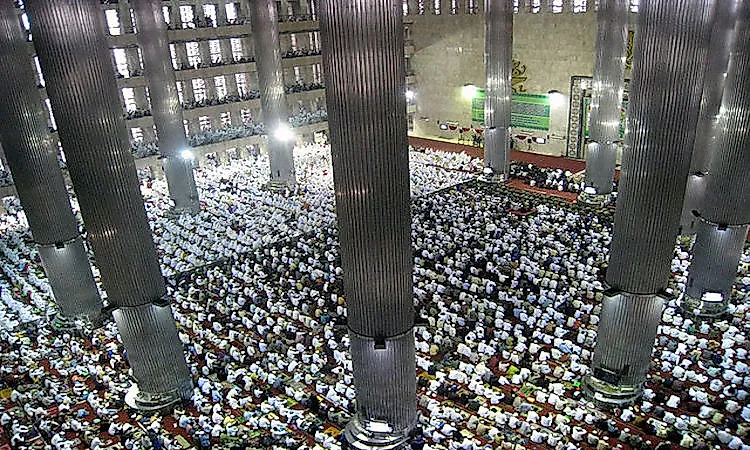
The geographic distribution of Muslims surprises readers who associate Islam primarily with the Arab world. As of 2020, the Asia-Pacific region was home to roughly 1.2 billion Muslims, by far the largest regional concentration. The Middle East and North Africa region held 414 million; Sub-Saharan Africa held 369 million; Europe held about 50 million; the Americas held smaller numbers. Indonesia alone has more Muslims (approximately 242 million, around 87 percent of its population) than the entire Arab Middle East combined. Pakistan ranks second worldwide with roughly 232 million Muslims (about 96 percent of the population); India, despite Muslims making up only about 15 percent of its population, ranks third with around 213 million; Bangladesh ranks fourth with about 150 million; Nigeria, Egypt, Iran, and Turkey each have 80 to 100 million. The ten countries with the largest Muslim populations together account for roughly 1.3 billion people, or 65 percent of the world's Muslims, and only one of those (India) is not a Muslim-majority country.
Islamic States
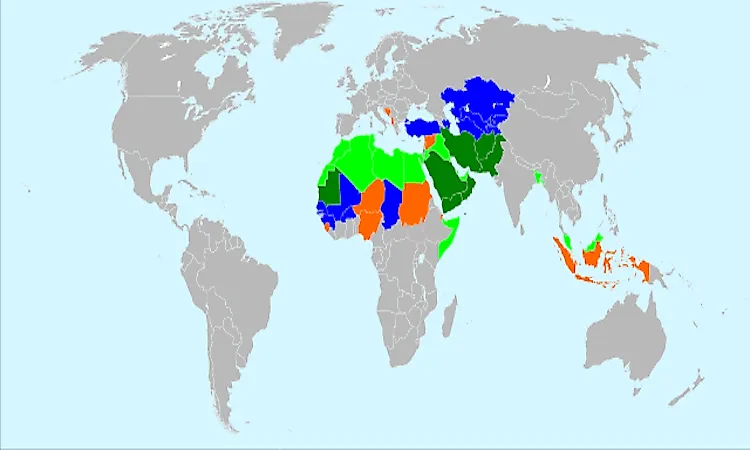
An Islamic state, in the most restrictive constitutional sense, is a country that derives its legal system, government structure, or both directly from Islamic jurisprudence (sharia) and identifies the state itself with Islam, often through constitutional language declaring the country an "Islamic Republic" or "Islamic Emirate." The most clear-cut current examples are Iran (Islamic Republic since the 1979 revolution that overthrew the Shah, with a Supreme Leader who is an Islamic legal scholar), Pakistan (Islamic Republic since 1956), Mauritania (Islamic Republic since 1958), Saudi Arabia (Kingdom whose Basic Law identifies the Quran and Sunnah as the constitution), and Afghanistan (Islamic Emirate under the Taliban administration that retook power on August 15, 2021, after the US-led coalition's withdrawal). Yemen is constitutionally an Islamic state, although the country has been divided between competing administrations since 2014 and the constitution's practical effect varies sharply by area of control.
Countries With Islam As The State Religion
A larger category consists of countries that declare Islam the state religion in their constitution but operate civil legal systems alongside (or partly derived from) Islamic law, rather than identifying themselves as full Islamic states. The list includes Algeria, Bahrain, Bangladesh (declared Islam the state religion in 1988 while maintaining secular legal codes), Brunei Darussalam, Comoros, Djibouti, Egypt, Iraq, Jordan, Kuwait, Libya (Islam declared the state religion across post-2011 constitutional drafts, though no permanent constitution has been ratified amid continued political division), Malaysia, Maldives, Morocco, Oman, Qatar, Somalia, Tunisia, and the United Arab Emirates.
Syria moved into this category in March 2025. After the fall of Bashar al-Assad's government on December 8, 2024, Syria's interim president Ahmed al-Sharaa signed a temporary constitution on March 13, 2025, which retained the previous constitution's stipulation that the head of state must be Muslim and made Islamic jurisprudence the main (rather than a main) source of legislation. The arrangement is scheduled to remain in force during a five-year transitional period.
Secular and Neutral Muslim-Majority Countries
A third category includes countries with overwhelmingly Muslim populations whose constitutions do not establish a state religion, either by formal separation of religion and state or by remaining silent on the question. Constitutionally secular Muslim-majority states include Turkey (secular since the Atatürk reforms of the 1920s, though the AKP era since 2002 has shifted the practical balance), Azerbaijan, Albania, Kazakhstan, Kosovo, Kyrgyzstan, Tajikistan, Turkmenistan, Uzbekistan, Senegal, Mali, Guinea, Burkina Faso, The Gambia, Chad, Sierra Leone, and Niger. Indonesia, despite hosting the world's largest Muslim population, is not constitutionally an Islamic state: its 1945 constitution recognises six official religions (Islam, Protestantism, Catholicism, Hinduism, Buddhism, and Confucianism) under the Pancasila state philosophy. Lebanon operates a confessional power-sharing system that recognises 18 different religious sects, with the presidency, prime ministership, and parliament speakership constitutionally reserved for Maronite Christian, Sunni Muslim, and Shia Muslim leaders respectively. Bosnia and Herzegovina, the only Muslim-plurality country in Europe, is constitutionally secular and tripartite.
Significant Muslim Minorities
Some of the largest Muslim populations in the world live as minorities. India's roughly 213 million Muslims (15 percent of the national population) make it the country with the third-largest Muslim population globally, behind only Indonesia and Pakistan, and account for more Muslims than any Arab country. Nigeria's Muslim population (estimated at 47 to 53 percent of the population, depending on source) ranks among the world's largest in absolute terms. China hosts an estimated 22 to 28 million Muslims, predominantly the Hui (a Chinese-speaking Muslim ethnic group) and the Turkic-speaking Uyghurs of Xinjiang. Russia has roughly 15 to 20 million Muslims, mainly Tatars and various peoples of the North Caucasus. Ethiopia has around 35 million Muslims, and Tanzania, Mozambique, and Côte d'Ivoire each have substantial Muslim populations alongside Christian majorities. Europe's largest Muslim populations are in France (an estimated 5.7 million), Germany (around 5.5 million), and the United Kingdom (about 4.0 million per the 2021 census).
The Organisation of Islamic Cooperation

The Organisation of Islamic Cooperation (OIC), founded in Rabat, Morocco, in September 1969, is the largest multilateral organisation in the Muslim world and the second-largest intergovernmental organisation after the United Nations. The OIC has 57 member states across four continents and represents a collective population of around 2 billion. Headquartered in Jeddah, Saudi Arabia, the OIC describes its mission as protecting the interests of the Muslim world while promoting international peace and harmony. Not all OIC members are Muslim-majority: eight member states (Benin, Cameroon, Gabon, Guyana, Ivory Coast, Mozambique, Suriname, Togo, and Uganda) have substantial Muslim minorities rather than majorities. Conversely, several Muslim-majority territories with limited international recognition (including Northern Cyprus and Western Sahara) are not full members.
Muslim-Majority Countries By Population
The table below lists Muslim-majority countries with population estimates for 2024 and approximate Muslim population shares from Pew Research Center's 2020 baseline data, the CIA World Factbook, and individual national censuses. Countries are listed in descending order of total Muslim population.
| Country | Muslim share (%) | Muslim population (millions) | Constitutional status |
|---|---|---|---|
| Indonesia | 87 | 242 | Secular (Pancasila) |
| Pakistan | 96 | 232 | Islamic Republic |
| India* | 15 | 213 | Secular |
| Bangladesh | 91 | 150 | Islam as state religion |
| Nigeria* | 47-53 | 97 | Secular federation |
| Egypt | 90 | 95 | Islam as state religion |
| Iran | 99 | 87 | Islamic Republic |
| Turkey | 98 | 84 | Secular |
| Algeria | 98 | 44 | Islam as state religion |
| Sudan | 91 | 42 | In constitutional transition |
| Iraq | 96 | 42 | Islam as state religion |
| Afghanistan | 99 | 41 | Islamic Emirate |
| Ethiopia* | 32 | 37 | Secular |
| Morocco | 99 | 37 | Islam as state religion |
| Saudi Arabia | 93 | 33 | Islamic Kingdom |
| Uzbekistan | 96 | 33 | Secular |
| Yemen | 99 | 34 | Islamic Republic (disputed) |
| Tanzania* | 35 | 22 | Secular |
| Malaysia | 61 | 21 | Islam as state religion |
| Mali | 95 | 20 | Secular |
| Niger | 99 | 30 | Secular |
| Senegal | 96 | 17 | Secular |
| Syria | 87 | 20 | Islam as state religion (transitional) |
| Tunisia | 99 | 12 | Islam as state religion |
| Somalia | 99 | 17 | Islam as state religion |
| Guinea | 89 | 12 | Secular |
| Azerbaijan | 97 | 10 | Secular |
| Burkina Faso | 63 | 14 | Secular |
| Tajikistan | 97 | 10 | Secular |
| Sierra Leone | 78 | 7 | Secular |
| Libya | 97 | 7 | Islam as state religion |
| Jordan | 97 | 11 | Islam as state religion |
| United Arab Emirates | 76 | 8 | Islam as state religion |
| Turkmenistan | 93 | 7 | Secular |
| Kyrgyzstan | 88 | 6 | Secular |
| Kazakhstan | 70 | 14 | Secular |
| Chad | 56 | 10 | Secular |
| Albania | 59 | 1.7 | Secular |
| Lebanon | 60 | 3.5 | Confessional |
| Oman | 86 | 4 | Islam as state religion |
| Mauritania | 100 | 4.8 | Islamic Republic |
| Kuwait | 74 | 3.2 | Islam as state religion |
| Qatar | 76 | 2.2 | Islam as state religion |
| Bahrain | 70 | 1.0 | Islam as state religion |
| The Gambia | 96 | 2.5 | Secular |
| Bosnia and Herzegovina | 51 | 1.7 | Secular |
| Djibouti | 94 | 1.0 | Islam as state religion |
| Comoros | 98 | 0.9 | Islam as state religion |
| Brunei | 78 | 0.4 | Islam as state religion |
| Kosovo | 95 | 1.8 | Secular |
| Maldives | 100 | 0.5 | Islam as state religion |
*India, Nigeria, Ethiopia, and Tanzania are not Muslim-majority countries; they appear here because of the absolute size of their Muslim populations. Figures are based on Pew Research Center's 2020 estimates updated to 2024 country populations from the United Nations World Population Prospects 2024 revision; the CIA World Factbook for religious composition percentages; and national statistical office data where available.
Growth Projections
Pew Research Center projects the global Muslim population to reach 2.2 billion by 2030 and approximately 2.76 billion by 2050, representing nearly 30 percent of the world's total population. By the early 2070s, on current trajectories, Islam may overtake Christianity to become the world's largest religion. Three factors drive the growth: a notably younger median age (24 years for Muslims globally compared with 33 for non-Muslims), higher fertility rates in most Muslim-majority countries (although these are declining as urbanisation and women's education expand), and very low rates of religious disaffiliation. Pew surveys conducted in 117 countries between 2008 and 2024 estimate that only about 1 percent of those raised Muslim leave the faith, the lowest disaffiliation rate among major world religions, with that loss largely offset by people joining Islam from other backgrounds. Geographically, the largest growth is expected to occur in Sub-Saharan Africa and South Asia; Europe's Muslim population is also projected to grow, although from a much smaller base.
The political and cultural diversity of the Muslim world is, on the evidence of these numbers and the constitutional arrangements summarised above, considerably greater than the term itself often suggests. The Muslim world includes secular constitutional democracies (Indonesia, Turkey, Albania, Senegal), Islamic republics (Iran, Pakistan, Mauritania, Afghanistan), monarchies organised around Islamic law (Saudi Arabia, Morocco, Brunei), confessional power-sharing systems (Lebanon, Bosnia), and a long list of countries in between. The label refers to a religion, a civilisation, and a geography. Each of those three meanings tracks a different boundary, and the boundaries do not always overlap.