What The Centaur Chariklo's Rings Reveal About The Outer Solar System
When astronomers detected two narrow rings around the centaur 10199 Chariklo during a stellar occultation on June 3, 2013, they upended a long-standing assumption that ring systems were the exclusive province of the giant planets. Chariklo is neither a planet nor a moon. It is an icy body roughly 250 kilometers (155 miles) in diameter, orbiting between Saturn and Uranus, and it had no business hosting a ring system by the textbook physics of the time. More than a decade later, with confirmation by the James Webb Space Telescope in 2022, Chariklo remains the smallest body known to possess a ring system and the test case for whether such systems are rare or common among small icy bodies in the outer Solar System.
What Chariklo Is

Chariklo belongs to a class of objects called centaurs, named after the half-human, half-horse creatures of Greek mythology because they share characteristics of both asteroids and comets. In astronomical terms, centaurs orbit between Jupiter and Neptune (roughly 5 to 30 astronomical units from the Sun) and are considered transitional bodies. Most are thought to originate in the Kuiper Belt or scattered disc beyond Neptune, then to migrate inward through gravitational encounters with the giant planets before either being ejected from the Solar System or evolving into short-period comets. Their orbits are dynamically unstable on timescales of about one to ten million years.
Chariklo itself was discovered on February 15, 1997, by James V. Scotti of the Spacewatch project at the University of Arizona, and given the minor-planet designation (10199) Chariklo. At about 248 kilometers across (estimates vary by a few kilometers depending on observation technique), it is the largest known centaur. Its orbit carries it from a perihelion of about 13.1 AU (inside Saturn's orbit) to an aphelion of about 18.7 AU (approaching Uranus's orbital distance), with a period of about 63 Earth years. The surface is dark and red-brown, consistent with water ice mixed with organic compounds, and the body is cold enough (about 90 K) that volatile ices remain stable in solid form.
The June 2013 Stellar Occultation

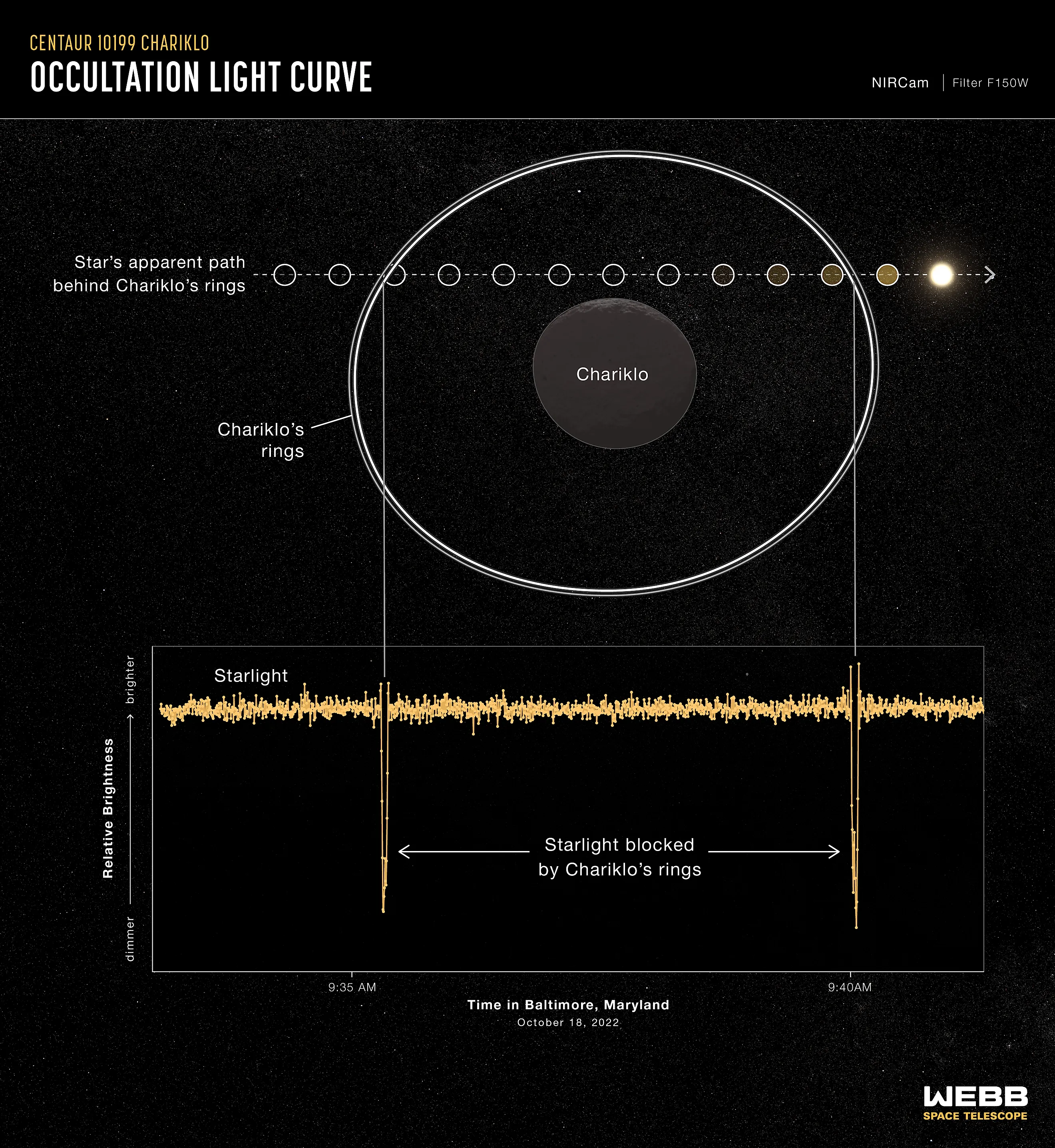
Chariklo's rings were not found by direct imaging (the object is far too small and distant for any current telescope to resolve it visually) but by stellar occultation. On June 3, 2013, Chariklo passed in front of the background star UCAC4 248-108672 as seen from observatories in South America. As predicted, Chariklo itself blocked the star's light for several seconds, but the star also blinked twice more, both before and after the main occultation. The pattern was symmetrical on either side of Chariklo and consistent with two narrow, dense rings.
The detection was confirmed by multiple telescopes including the Danish 1.54-meter telescope at La Silla Observatory in Chile, and the discovery was led by Felipe Braga-Ribas of the Observatório Nacional in Rio de Janeiro. The team published the result in Nature on March 26, 2014, under the title "A ring system detected around the Centaur (10199) Chariklo." This was the first ring system ever detected around a small Solar System body, and it forced the astronomical community to reconsider what kinds of objects can support rings.
C1R And C2R: Two Narrow Rings With A Gap Between Them
The two rings have been designated C1R and C2R (for "Chariklo Ring 1" and "Chariklo Ring 2"). C1R, the inner ring, orbits at about 391 kilometers from Chariklo's center and is approximately 6 to 7 kilometers wide. C2R, the outer ring, orbits about 405 kilometers from the center and is significantly narrower at roughly 3 kilometers wide. A clear gap of about 9 kilometers separates the two rings.
For comparison, Saturn's main rings span tens of thousands of kilometers in width but contain ring particles of broadly similar composition (water ice). Chariklo's rings, despite their much smaller scale, share the same basic chemistry. The optical depth of C1R is also unusually high for such a small body, meaning the ring contains enough material to block a substantial fraction of background starlight as it passes.
The 2022 JWST Confirmation Of Crystalline Water Ice

On October 18, 2022, the James Webb Space Telescope observed its first stellar occultation, with Chariklo passing in front of the star Gaia DR3 6873519665992128512. The campaign was led by Pablo Santos-Sanz of the Instituto de Astrofísica de Andalucía in Granada, Spain, as part of Webb's Guaranteed Time Observations Program 1271. Two weeks later, on October 31, 2022, Webb observed Chariklo directly with the Near-Infrared Spectrograph (NIRSpec) to capture the reflected sunlight spectrum.
The spectroscopy revealed three distinct absorption bands of crystalline water ice in the Chariklo system. This was the first clear detection of water ice in the rings (previous observations had been suggestive but not definitive). The crystalline form of the ice is significant: crystalline water ice is fragile and would be expected to convert to amorphous ice over time under exposure to cosmic-ray radiation, so its persistence implies relatively recent processing, possibly by small impacts that exposed fresh ice or by thermal cycling during Chariklo's orbit around the Sun.
How A Small Body Holds A Ring System
The central puzzle remains why an object as small as Chariklo possesses rings at all. The gravitational field at the ring distance (about 400 kilometers from a body of 248-kilometer diameter) is weak, and any ring material should disperse over short timescales unless something keeps it confined.
Three main hypotheses compete. The first is collision: an impact between Chariklo and another small body, perhaps within the past few million years, could have ejected debris into stable orbits that gradually settled into the current ring structure. The 2014 discovery paper favored this scenario, and the JWST detection of crystalline water ice (which suggests relatively fresh material) is consistent with it. The second hypothesis is cryovolcanic activity: outgassing or surface eruption from Chariklo itself could have released material that fell into orbit. The third is gravitational disturbance from a close encounter with one of the giant planets, which could have lofted surface material into orbit.
The rings may also be transient. Numerical models suggest the current configuration could be stable for thousands to millions of years, but not indefinitely. If Chariklo's rings are a short-lived feature, observers in 2013 caught a snapshot of a phase that will end within a geologically short window.
The Shepherd-Moon Question
The sharp edges of Chariklo's rings present a separate puzzle. Without confinement, ring particles should spread laterally through gravitational interactions and collisions, producing diffuse boundaries within thousands of years. C1R and C2R remain sharply edged.
The standard explanation in planetary science is shepherd moons, small bodies whose gravity confines ring particles to narrow bands. Saturn's F ring, for instance, is shepherded by Prometheus and Pandora. Uranus's epsilon ring is shepherded by Cordelia and Ophelia. If Chariklo's rings are similarly maintained, the implied shepherd moons would be very small (perhaps a few kilometers across) and would orbit just inside and outside the rings. No such moons have been directly detected, but the JWST occultation data is being analyzed for signatures of additional small bodies near the ring edges.
An alternative explanation involves orbital resonances with Chariklo itself, where the rotation rate of Chariklo's slightly non-spherical shape interacts gravitationally with ring particles to maintain stable orbits. Chariklo rotates roughly every 7.0 hours, which combined with its irregular shape could generate the resonant trapping needed to keep the rings narrow. This mechanism, similar to what shapes Saturn's "propeller" features and the inner edge of the A ring, may operate at Chariklo without any need for shepherd moons.
What Chariklo Suggests About The Outer Solar System
The Chariklo discovery prompted a search for ring systems around other small bodies. In 2015, an analysis led by José Luis Ortiz at the Instituto de Astrofísica de Andalucía reported strong evidence for a ring system around 2060 Chiron, the second-largest known centaur (discovered in 1977 by Charles Kowal). The Chiron rings remain a candidate detection rather than a confirmed discovery, complicated by Chiron's own cometary activity. In 2017, the same Ortiz-led team confirmed a ring around the dwarf planet Haumea via a January 21 stellar occultation, published in Nature. Haumea became the first trans-Neptunian object known to possess a ring.
The implication is that ring systems among small icy bodies may be more common than the pre-2013 view allowed. Whether they form most often by collision, by cryovolcanic activity, or by tidal disruption during close planetary encounters, the outer Solar System now appears to be a more dynamic environment than it did before the Chariklo result. Centaurs in particular sit at a useful intersection: close enough for high-precision observation from Earth (and from Webb), while still preserving primitive material from the Solar System's early history.
The Smallest Ringed World
Chariklo's rings rewrote the rules for where ring systems can exist. The 2013 occultation discovery by Braga-Ribas's team, confirmed and extended by the JWST observations led by Santos-Sanz nine years later, established that a 248-kilometer-wide icy centaur can host the same kind of structured, narrow ring system seen at the giant planets. Whether the rings represent a long-lived feature shaped by undetected shepherd moons or a transient phase that will dissipate within geological time, they have already provided a working laboratory for studying ring physics on small bodies, the persistence of crystalline water ice in cold space, and the dynamic history of the outer Solar System. The next observed occultations (Webb's program continues, and ground-based observations through the next ringed centaur passes are scheduled through 2030) should sharpen the picture further.