What The 2024 Asteroid Warning Actually Revealed About Earth's Defenses
The asteroid warning surrounding 2024 YR4 showed something interesting about Earth's defenses: planetary defense is now a real, functioning system, though one still built on early detection, uncertainty, international coordination, and time.
Discovered on December 27, 2024, by the ATLAS telescope in Chile, 2024 YR4 briefly appeared to have a non-trivial chance of striking Earth on December 22, 2032. It was estimated at roughly 40 to 90 meters wide, later refined by the James Webb Space Telescope to about 60 meters, large enough to cause severe regional damage if it hit the wrong place, though too small to threaten civilization. NASA later described the episode as a valuable test of planetary-defense science and notification processes.
Lesson #1: Asteroid Risk Can Look Scarier Before It Gets Safer

The first lesson was about how asteroid risk evolves in public view. As astronomers collect early observations, the "uncertainty region" around a new asteroid's future path can shrink in ways that temporarily make Earth occupy a larger share of the possible trajectories. That is why 2024 YR4's impact probability rose before it collapsed. ESA's assessment reached 2.8 percent, while IAWN's final notification described a peak of 3.1 percent, before later observations reduced the Earth-impact probability to 0.004 percent in NASA/IAWN calculations and 0.001 percent in ESA's assessment. The asteroid also dropped from Level 3 to Level 0 on the Torino scale.
The story did not end there. Once an Earth impact was ruled out, a small chance remained that 2024 YR4 might instead strike the Moon on the same date, and as the orbit was refined that lunar-impact probability actually climbed, reaching about 4.3 percent by mid-2025. Because the asteroid had by then moved too far away to observe, that figure held until the James Webb Space Telescope caught it again in February 2026, when the new measurements ruled out a lunar impact as well. The asteroid is now expected to pass roughly 21,000 kilometers from the Moon. The same rise-and-fall played out twice, for the same underlying reason.
That pattern exposed a communications challenge. Public attention tends to treat "odds went up" as "danger is growing," when in asteroid tracking it can simply mean the orbit is being measured better. The 2024 YR4 case showed that planetary defense needs not only telescopes and orbital models, but also public explanations of probabilistic risk. A warning system that works will sometimes announce a possible threat before it is fully understood. That is the whole point of early warning.
Lesson #2: Detection and Tracking Have Become Much Stronger

The second lesson was that the detection-and-tracking layer has matured. NASA's Near-Earth Object Observations Program funds searches for undiscovered NEOs, orbit refinement, physical characterization, and deflection research. In the 2024 YR4 episode, observations flowed through the Minor Planet Center and were assessed by systems including NASA CNEOS, ESA NEOCC, and NEODyS. A NASA technical white paper later called 2024 YR4 the most apparent near-term asteroid risk since Apophis and argued that, decades earlier, a similar object might have been missed or lost before its orbit could be pinned down.
Lesson #3: International Coordination Exists, But Data Gaps Remain
The third lesson was that the international machinery actually exists, and several bodies coordinated in real time. The International Asteroid Warning Network, recommended through the UN process, coordinated observations and notifications, while the Space Mission Planning Advisory Group monitored whether mission planning might be needed. IAWN's warning threshold is an impact probability above 1 percent for an object roughly larger than 10 meters; SMPAG watches potential mission-response cases involving objects larger than about 50 meters with more than 1 percent impact probability within 50 years. 2024 YR4 crossed enough of those lines to activate the system.
The episode also exposed weaknesses. One was physical characterization. An asteroid's orbit tells you where it is going, but says little about what it is made of. A dark, dense, metallic object and a rubble pile of the same brightness can imply different sizes, masses, and deflection strategies. IAWN noted that 2024 YR4 would become too faint for Earth-based observation after early April 2025 until 2028, and that it would not come within deep-space radar range until 2032. That gap matters: the earlier scientists know size, shape, spin, density, and composition, the more credible any response becomes.
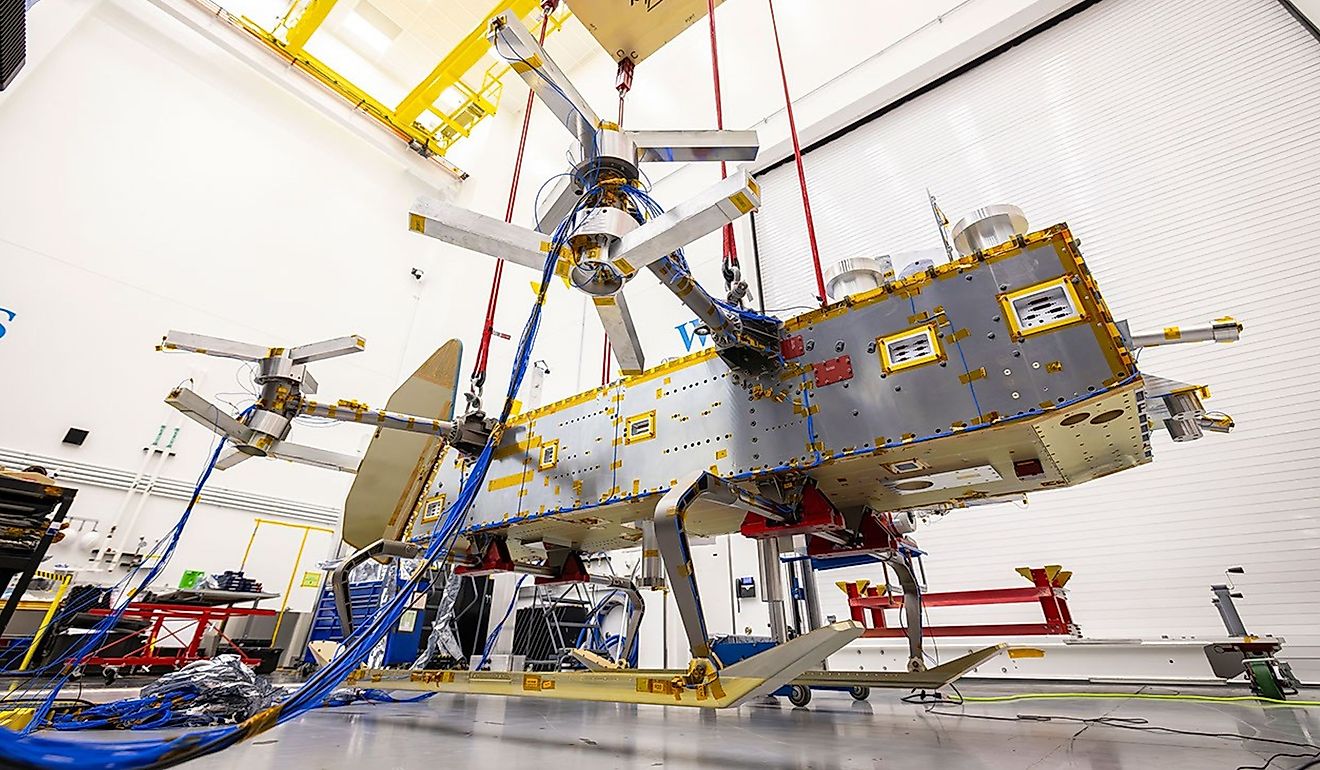
That is why future survey systems matter. NASA's NEO Surveyor, described as its first infrared space telescope built specifically to find potentially hazardous asteroids and comets, is intended to detect objects that ground-based optical telescopes can miss, including dark objects and those near the Sun's glare. NASA says its launch is set for no earlier than September 2027, and the spacecraft is designed to scan from the Sun-Earth L1 region for at least five years. 2024 YR4 showed that better surveys will probably generate more alerts, as humanity sees more objects that used to pass unnoticed.
Lesson #4: Deflection Is Possible, But It Takes Time

The fourth lesson was about deflection. Earth is past the purely theoretical stage here: NASA's DART mission deliberately struck Dimorphos in 2022 and changed its orbit by 32 minutes, the first full-scale demonstration of asteroid deflection technology. ESA's Hera mission, launched in October 2024 and scheduled to rendezvous with Dimorphos in 2026, is meant to turn the DART experiment into a better-understood planetary-defense technique. That is genuine progress. Even so, Earth has no instant asteroid shield. Deflection depends on warning time, launch readiness, the object's properties, and international agreement on where to move the risk.
Lesson #5: Planetary Defense Also Means Civil Protection
The final lesson was political and practical. A 40-to-90-meter asteroid could devastate a city or region, even if it falls well short of dinosaur-killer size. The "defense" might come down to evacuation, airburst modeling, disaster planning, and deciding which governments must act when the impact corridor spans borders. 2024 YR4 showed that planetary defense works as a chain: discover early, track precisely, characterize physically, communicate honestly, coordinate internationally, then choose between deflection and civil protection.
So the warning's real message sat somewhere between "panic" and "relax." Earth's defenses have become serious enough to catch, evaluate, and retire a genuine asteroid concern in public view. The system's strength is time. Give Earth years, good data, and coordinated institutions, and a dangerous asteroid becomes a solvable problem. Lose the warning time, and even a much smaller object becomes far harder to manage.