The Longest Canal Still In Use In America
This sounds like a simple trivia question until you try to answer it, because so much depends on what you are willing to call a canal. Some of the longest artificial waterways ever dug in the United States have been abandoned for a century, while the single longest thing you might loosely call a canal is mostly made of natural bays and rivers. Set those aside and stick to genuine, purpose-built canals that boats still travel today, and one answer rises clearly to the top: the Erie Canal in New York, which just celebrated its 200th birthday and remains the longest canal still in use in America. Here is the full story, asterisks included.
The Answer: The Erie Canal

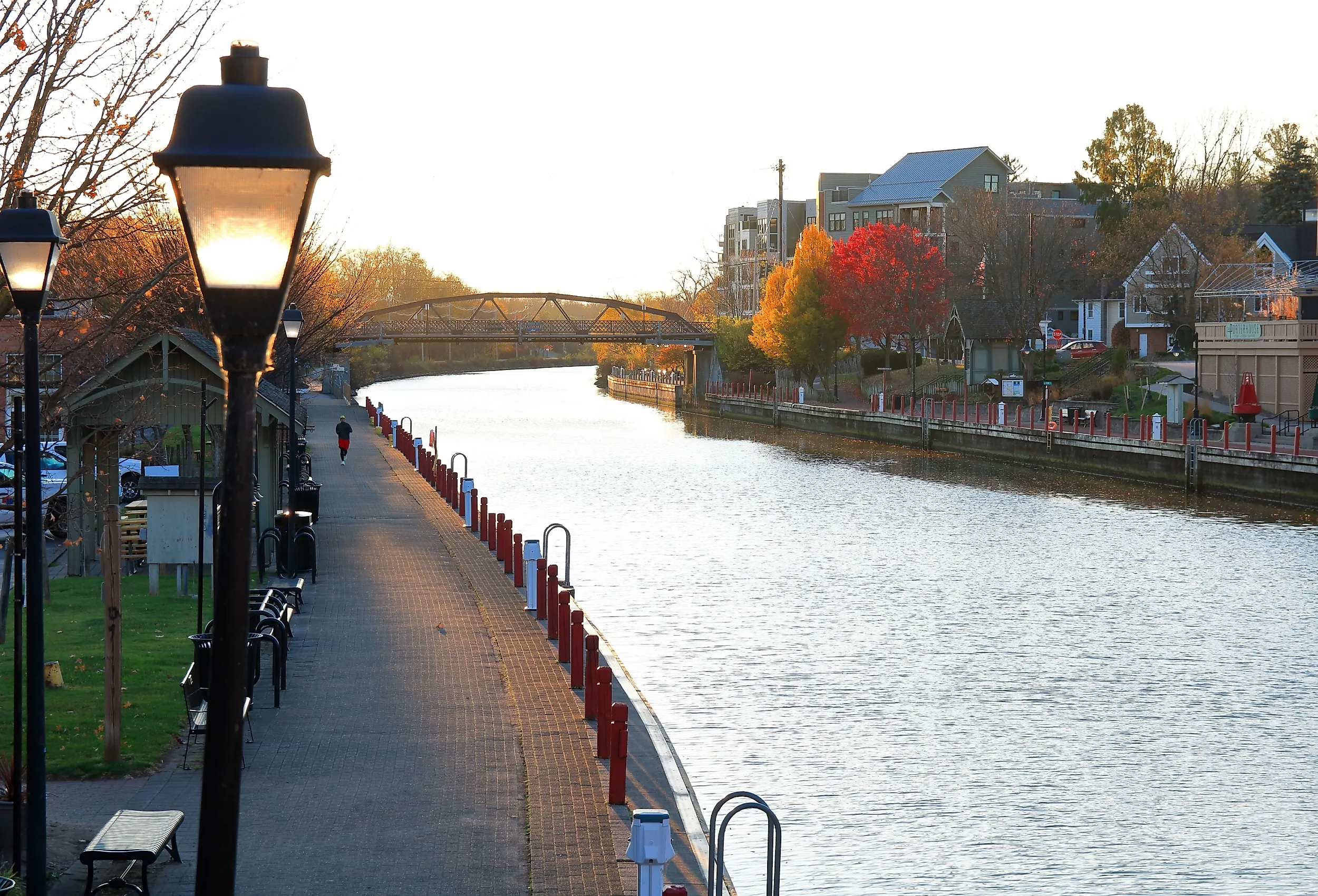
When it was completed on October 26, 1825, the Erie Canal ran 363 miles across New York State, connecting the Hudson River at Albany to the Great Lakes at Buffalo. After a major early-20th-century rebuild that rerouted and abandoned more than half of the original ditch, the modern navigable canal measures about 351 miles, with 35 locks lifting and lowering boats along the way. Crucially, it is still open. Managed today by the New York State Canal Corporation, it operates a full navigation season every year, mostly for recreational boaters and tourists rather than the freight barges of old. No other true canal still working in the country comes anywhere close to its length.
The Canal That Built New York

It is hard to overstate how much this canal changed the country. Before it opened, moving goods from the Midwest to the East Coast was slow and ruinously expensive, but the Erie slashed freight costs by roughly 80 to 90 percent almost overnight. It turned New York City into the busiest port in the nation, transformed villages like Rochester, Syracuse, and Buffalo into booming cities, and opened the Great Lakes farmland to eastern markets. Remarkably, it was all dug by hand, with picks, shovels, wheelbarrows, and horses, years before earthmoving machinery existed. Skeptics had mocked the project as "Clinton's Ditch," after Governor DeWitt Clinton, but its runaway success set off a canal-building frenzy across the young United States.
Why It Outlasted the Longer Ones

Here is a twist: the Erie was never actually the longest canal America ever built. That title belonged to the Wabash and Erie Canal, which stretched over 460 miles from Ohio to Indiana, while Ohio's own canal network and the 184-mile Chesapeake and Ohio Canal added hundreds more miles of artificial waterway. The catch is that every one of those longer canals is now dead. The Wabash and Erie, the Ohio and Erie, and the Miami and Erie were all driven out of business by the railroads and abandoned by the early 1900s, and the Chesapeake and Ohio Canal is now preserved as a national historical park rather than a working route. The Erie survived precisely because New York kept reinvesting in it, most notably rebuilding it as the enlarged Barge Canal in the early 20th century.
The Great Asterisk: The Intracoastal Waterway

Now for the honest caveat. If you allow a looser definition of "canal," the real record-holder is the Intracoastal Waterway, a roughly 3,000-mile navigable route running along the Atlantic and Gulf coasts, and one of the busiest commercial waterways in the country. The reason it does not settle the debate is that it is not really one canal. It is a stitched-together network of natural bays, sounds, and rivers connected by man-made canal cuts like the Chesapeake and Delaware Canal and the Dismal Swamp Canal. So while parts of it are genuine canals, the waterway as a whole is more of a protected coastal highway than a single dug channel. Judge it as a canal and it dwarfs the Erie; judge it fairly and it belongs in its own category.
So, Which Wins?

The cleanest answer to the question is the Erie Canal. Among genuine, discrete canals that are still open and navigable, its 351 miles are in a league of their own, since the only American canals that ever surpassed it in length have long since been drained, filled, or turned into hiking trails. If you stretch the definition to include hybrid coastal waterways, the Intracoastal Waterway wins on raw mileage, but that is a different kind of thing entirely. Either way, the Erie Canal remains a genuine marvel: a 200-year-old artificial river, dug by hand, that still carries boats across an entire state. Two centuries on, "Clinton's Ditch" is still flowing, and still winning.