This Bridge In The US Is The Longest In The World
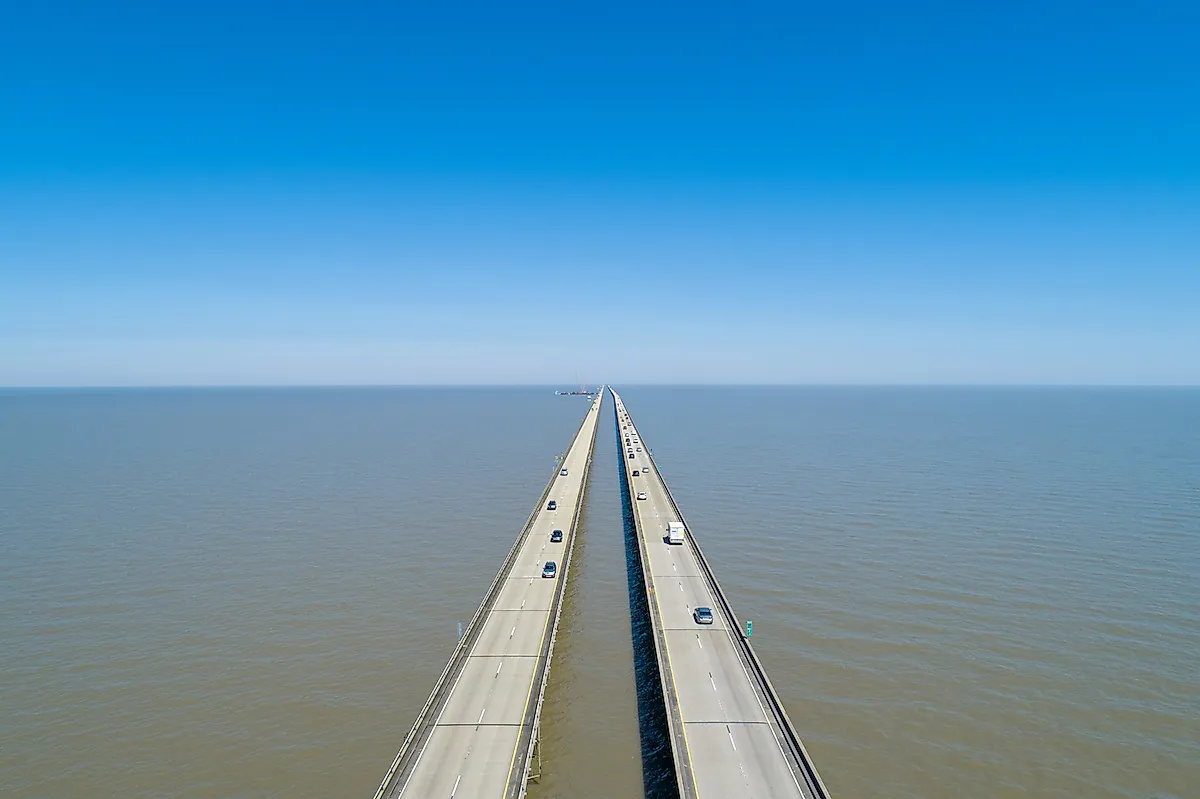
Drive far enough out onto the Lake Pontchartrain Causeway and the land simply vanishes. For a stretch in the middle, there is open water in every direction and nothing else, just a thin gray ribbon of concrete running under your tires toward a horizon that refuses to arrive. That ribbon stretches just shy of 24 miles, long enough to make Louisiana's Causeway the longest bridge in the United States and the Guinness World Record holder for the longest continuous bridge over water anywhere on Earth. It is actually two parallel spans, riding on more than 9,500 concrete pilings about 15 feet above a shallow, brackish lake. Drivers have been known to lose their sense of time out there, and once you grasp the scale of the thing, it is easy to understand why.
Where Is The Lake Pontchartrain Causeway?

The Causeway links two suburbs of New Orleans that happen to sit on opposite shores of the same enormous lake. Its southern end lands in Metairie, in Jefferson Parish, and its northern end touches down in Mandeville, in St. Tammany Parish. Between them lies Lake Pontchartrain, a wide, shallow, brackish estuary connected to the Gulf of Mexico, and the bridge slices almost dead center across it. The reason for all that concrete is simple math. Driving around the lake is a slog of roughly 50 miles, while shooting straight over it on the Causeway is about 24. For commuters on the north shore, that gap is the whole story.
Building A Road Across The Lake

Long before the Causeway existed, New Orleans wanted a faster way to its north shore, and some of the early ideas were genuinely strange. One plan called for building a chain of artificial islands across the lake and stitching them together with roads and sellable real estate. Developers were so confident that they sold plots of this imaginary land before a single island was built. The islands never materialized, the plots stayed underwater, and the dream of an easy crossing had to wait.
The real bridge came together with surprising speed. The Louisiana Bridge Company formed in 1954, the first of more than 9,500 concrete pilings went into the lakebed on May 23, 1955, and the ribbon was cut on August 30, 1956. For a 24-mile structure built over open water, barely 15 months of construction is its own kind of record. The first span cost about $46 million, and it worked so well that traffic quickly outgrew it.

Within a decade, daily traffic had climbed past 5,000 vehicles, and two lanes were no longer enough. A second parallel span opened on May 10, 1969, running about 50 feet longer than the original and carrying its own two lanes in the opposite direction, at a cost of roughly $30 million. Today the pair of bridges moves tens of thousands of vehicles across the water every day.
For most of its length, the Causeway floats only 15 to 16 feet above the lake, close enough to the surface to make all that open water feel even closer. A few raised sections give boats room to slip underneath, and a bascule drawbridge handles the taller traffic. Crossing is not free, though the system is friendlier than it once was. Tolls are now collected in only one direction, on vehicles heading south toward Metairie, after northbound tolls were dropped in 1999. As of late 2023, the trip runs $6 in cash or $3.40 with an electronic toll tag.
So Is It Really The Longest Bridge In The World?
Sort of, and the fight over that one word is half the fun. When the Causeway's second span opened in 1969, Guinness World Records crowned it the longest bridge over water, and the title stuck for decades. Then in 2011, China's Jiaozhou Bay Bridge opened and Guinness handed the record east. Louisiana cried foul, pointing out that the Chinese bridge ran partly over land. Guinness settled the standoff by splitting the category in two. The Causeway kept the crown for the longest continuous bridge over water, while Jiaozhou Bay took the new aggregate title. That aggregate record has since passed to the Hong Kong-Zhuhai-Macau Bridge, which opened in 2018. So the honest answer is that a handful of bridges are technically longer, but none beats the Causeway for an unbroken run over open water, and nothing in the United States is longer by any measure at all. For a bridge that spends most of its length out of sight of land, that is a remarkably solid place to stand.