The Oldest Hotel Still Taking Guests In America
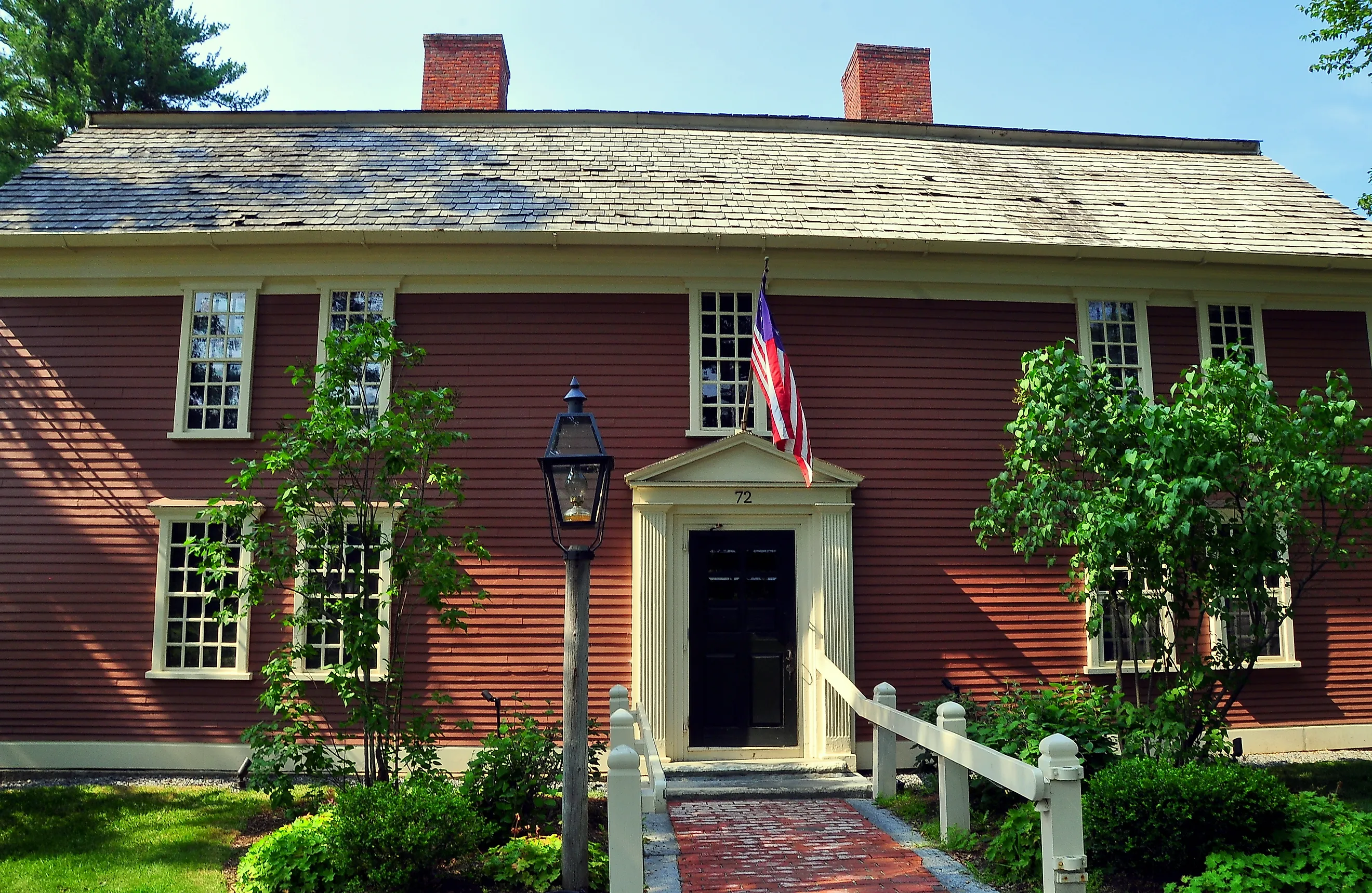
In 1716, the Sudbury selectmen licensed David How 'to keep a house of entertainment for travelers' in a two-room house on the Old Boston Post Road. That house is now Longfellow's Wayside Inn in Sudbury, Massachusetts, and it still rents rooms, which makes it the oldest lodging establishment in America by founding date, predating the United States by 60 years. It has been known as Howe's Tavern and the Red Horse Tavern along the way.
This article measures age by the earliest documented founding date, the year a town tavern license was granted and an institution opened, combined with the requirement that the place still takes overnight guests. That is not the same as continuous operation, and the distinction matters: the Wayside Inn stopped taking lodgers for roughly 36 years in the nineteenth century and again for two and a half years in the 1950s.
The Fascinating History of The Hotel Older Than The United States

In 1661, John How was granted a license to run a house of public entertainment in Marlborough. He was among the first settlers of the Massachusetts Bay Colony, and he began the family's innkeeping tradition. The family spelled the name How for its first generations and later added an "e", however, most published accounts use Howe throughout.
His son, Samuel, also kept an inn before his home was destroyed in the burning of Sudbury during King Philip's War in 1676. Samuel afterward bought land at the site the Wayside Inn occupies today.
In 1700, Samuel gave his son David lot number 50 of the Sudbury New Land Grant to build on, and records show a two-room building standing there by 1703. In 1716, David received the town tavern license, and he is believed to have doubled the size of the dwelling in response.
By the 1740s, David's son, Ezekiel, held the license, and it was Ezekiel who renamed the place the Red Horse Tavern, around 1746. Records show he once charged four pence for lodging and 15 pence for breakfast. Before 1760 the building had grown to eight rooms.
Its most consequential moment came on April 19, 1775, when Ezekiel How led two companies of Sudbury militia to Concord in answer to Paul Revere's alarm. He later served as colonel of the Fourth Middlesex Regiment under George Washington, and he kept the tavern until his death in 1796.
Washington is said to have ridden past that summer on his way to Cambridge to take command of the Continental forces, and by local account the Marquis de Lafayette called more than once.
Ezekiel's son, Adam, took over as innkeeper, and by 1830 Adam's son, Lyman Howe, was running the inn with his sister Jerusha. Lyman died in 1861, unmarried and childless, the last of the Howe innkeepers. The property was auctioned along with most of the family's heirlooms, and for the next three and a half decades it was not an inn at all but a private house sublet to tenants.
It was in that state that Henry Wadsworth Longfellow saw it after coming out from Cambridge for a single day on October 31, 1862, touring the building with his publisher James T. Fields, and calling it "a rambling, tumble-down building." He never stayed the night and never returned but the Tales of a Wayside Inn appeared in 1863, and the inn's renown followed.
Lyman Howe is the model for the Landlord who narrates The Landlord's Tale, better known as Paul Revere's Ride, a poem Longfellow had already published in The Atlantic in 1861 and folded into the collection.
In 1896, the wool merchant Edward Rivers Lemon bought the property and reopened it to guests, renaming it Longfellow's Wayside Inn in 1897 and running it as a retreat for literary pilgrims, with a circle of artists and writers meeting there regularly. It also became an early waypoint for motorists with photographs from the first years of the century showing electric automobiles drawn up outside.
Lemon died in 1919, and in 1923 his widow, Cora, sold the property to Henry Ford.

Ford expanded the property to nearly 3,000 acres across Sudbury, Marlborough, and Framingham, spending close to $3 million to turn it into a living museum of early America. He commissioned the fieldstone Grist Mill with its overshot wheel, designed by J. B. Campbell in 1926 and grinding by the end of the decade, along with the Martha-Mary Chapel, an ice house, and a cider mill.
He moved a one-room schoolhouse from Sterling to the grounds, believing it to be the school in Sarah Josepha Hale's poem Mary Had a Little Lamb. The Wayside Inn Boys School opened on the property in 1928 and closed less than 20 years later.
Ford held the inn until 1944, when it passed to a nonprofit Massachusetts corporation formed to own and operate it, with Ford family members on the board. Governance was moved to the National Trust for Historic Preservation in 1957 and to local trustees in 1960.
A fire on December 22, 1955, gutted the main structure, sparing some original beams but destroying much of the antique furniture Ford had assembled. A Ford Foundation grant financed the rebuilding, and the inn reopened on June 7, 1958.
The board took the name The Wayside Inn Foundation in 2019. The surrounding Wayside Inn Historic District was added to the National Register of Historic Places in 1973.
Booking a Room at Longfellow's Wayside Inn
The Wayside Inn Foundation today preserves nine historic buildings across more than 100 acres, with accommodations, dining, an event tent, and a chapel for weddings. There is an archives and research center on site, along with a museum and several exhibits.
Lodging consists of ten rooms with rooms nine and ten being original to the inn. Each has its own bathroom, furnished with a mix of original and reproduction antiques, but none have a television. Guests get free Wi-Fi and a guests-only sitting room on the second floor, and breakfast is served in the historic Old Tap Room, where the baked goods use flour and cornmeal ground at the Grist Mill.
A Closer Look At Other Historic Contenders

The Beekman Arms & Delamater Inn in Rhinebeck, New York, traces its origins to 1704, when William Traphagen built a traveler's inn at the village crossroads. However, in 1766, was when his descendant, Arent Traphagen, moved the tavern to the site the Beekman Arms occupies today.
It has taken guests without interruption ever since, which is why Historic Hotels of America credit it as the country's oldest continuously operating inn. Known as the Bogardus Tavern during the Revolution, it hosted George Washington, Alexander Hamilton, and Benedict Arnold, with Franklin D. Roosevelt later launching his campaigns from its front porch.
The Omni Homestead Resort & Spa in Hot Springs, Virginia, was also founded in 1766, when Captain Thomas Bullitt built an 18-room lodge near the mineral springs. Its roots go back further, to the Gentlemen's Pool House of 1761, the earliest spa in the country, which supports its claim to be America's first resort.

Some sources draw a firm line between a hotel and an inn while others treat an inn as a small hotel. On the first reading, Historic Hotels of America credits the Red Lion Inn as the oldest continuously operating hotel in the country. Silas Pepoon built it in Stockbridge, Massachusetts, in 1773 and hung a red lion on the sign out front, and townspeople gathered there the following year to protest the Intolerable Acts, the laws Parliament passed in 1774 to punish Massachusetts for the Boston Tea Party.
Fire gutted the original building in 1896, though much of its celebrated collection of colonial antiques was saved, and the business reopened in a new structure in 1897. By a fourth qualifier, longest continuously operating full hotel, the title goes to the Omni Parker House in Boston, open since 1855.
Three Centuries of American Lodging
Every one of these titles turns on its qualifier, and the Wayside Inn holds the earliest founding date rather than the longest unbroken run. What it does hold outright is the longer story.
When the How family began keeping travelers, they created a service stop on the Boston Post Road, and the three centuries since saw the inn adapt to guests arriving on horseback, by stagecoach, and eventually by car. It also survived the shift from one family's ownership to a trust without becoming a museum of itself. Later hotels grew enormous; this one kept its ten rooms, and the difference is the point.