The Oldest Bridges Still Carrying Traffic In America
The oldest working bridge in America was already a century old when the country declared independence. It still carries U.S. Route 13 across a creek in Philadelphia every single day. It is not alone, either. Scattered across the Northeast are stone crossings from the 1600s, 1700s, and early 1800s that never retired into museum pieces. They still take real traffic, widened and repointed and reinforced over the centuries but never replaced. Here are the survivors still open to cars, not the ones roped off for pedestrians or bypassed by newer roads.
Frankford Avenue Bridge, Pennsylvania, 1697

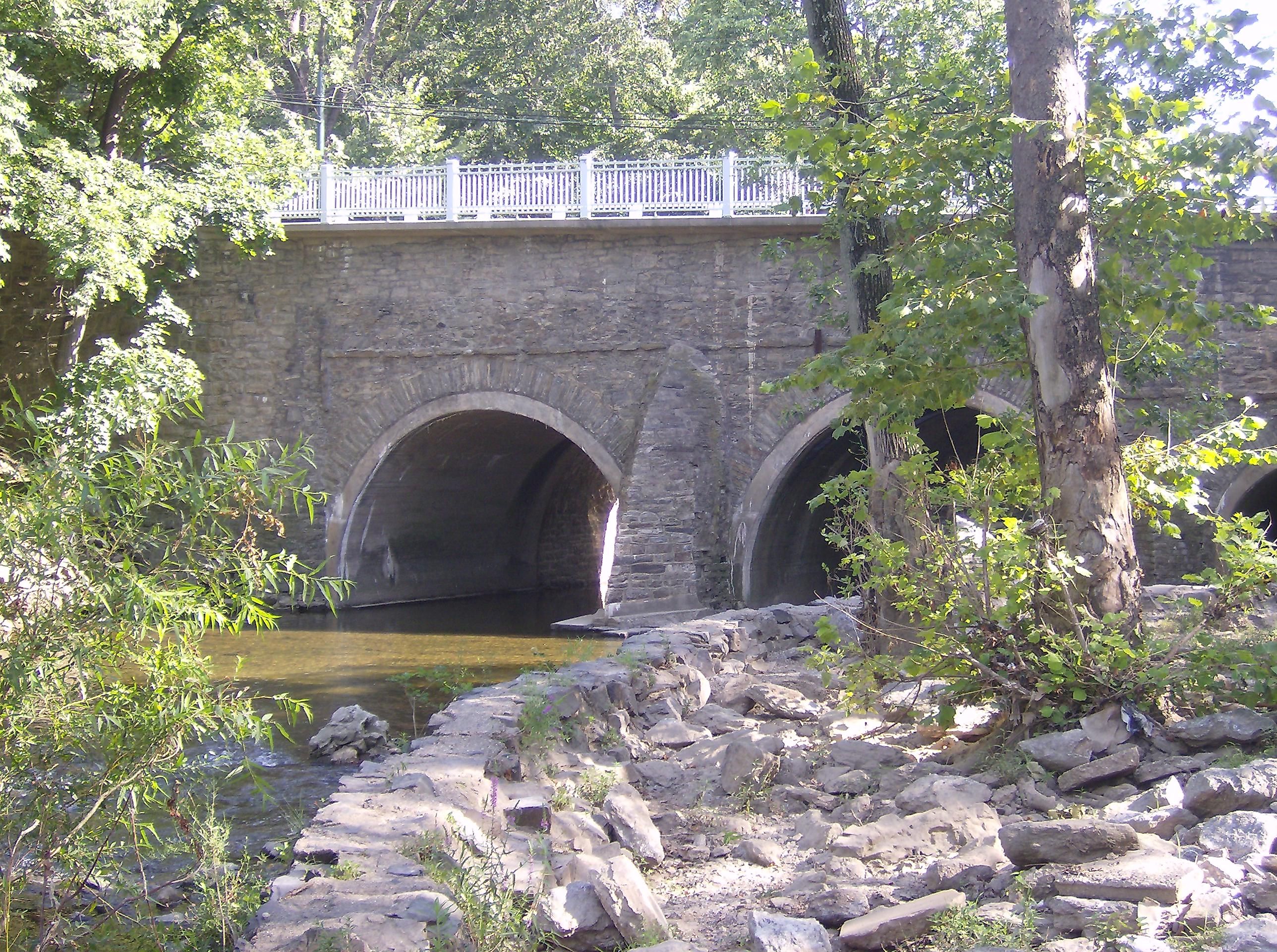
Drivers on Frankford Avenue in northeast Philadelphia pass over a bridge built in 1697, decades before the United States existed. The stone crossing carries U.S. Route 13 over Pennypack Creek, and the American Society of Civil Engineers recognizes it as the first known stone arch bridge built in the country (you can read more about where the oldest bridge in the United States stands). It originally served the King's Highway, the colonial route running between Philadelphia and settlements farther north. The first roadway was only about 18 feet wide, enough for horse-drawn traffic but far short of what a modern urban road required.
Instead of replacing the bridge, Philadelphia adapted it. Crews widened the crossing in 1893 to accommodate trolley traffic and expanded it again in 1950 as automobiles took over the road. The historic masonry arches stayed in place beneath those changes. The site also holds Revolutionary-era history: an express rider is traditionally said to have crossed here in April 1775 while carrying news of the fighting at Lexington. Today, ordinary traffic still rolls over a structure more than three centuries old.
Choate Bridge, Massachusetts, 1764

Choate Bridge stands in the middle of Ipswich rather than on a forgotten back road. Completed in 1764, the granite crossing carries South Main Street and Massachusetts Routes 1A and 133 over the Ipswich River. The American Society of Civil Engineers identifies it as the oldest documented two-span masonry arch bridge in the United States. Colonel John Choate oversaw construction after earlier wooden crossings at the site repeatedly needed repair. The new bridge measured roughly 80 feet long and about 20 feet wide, with two sturdy stone arches replacing those less durable predecessors. Traffic eventually outgrew the original roadway, so the bridge was widened in 1838. The older western portion and its parapet survived the work, leaving an unusual mix of 18th- and 19th-century construction still visible in the present crossing. Cars now pass over the same river route that Ipswich residents were using before the American Revolution.
Trinity Lane Bridge, Pennsylvania, 1789

Trinity Lane Bridge in Upper Merion Township is modest in size but unusually old for a structure still handling daily road traffic. Built in 1789, the single stone arch carries Trinity Lane, part of Route 320, over Gulph Creek near Gulph Mills. The span is short, only about 22 feet, yet its place in a busy part of suburban Montgomery County has kept it firmly connected to modern transportation rather than turning it into an isolated relic.
PennDOT preservation records show how much work goes into keeping a bridge of this age useful. A major rehabilitation in 2021 included rebuilding deteriorated masonry, repairing the arch, repointing stonework, resurfacing the road, and preserving the bridge's historic plaque. Crews reused salvaged stone where possible to maintain the historic appearance.
Traffic counts at the crossing have run past 7,000 vehicles per day. That makes Trinity Lane very different from a preserved country bridge visited only for photographs. Its 18th-century masonry still supports a road that carries everyday suburban travel around the Philadelphia region.
Skippack Bridge, Pennsylvania, 1792

Skippack Bridge crosses Skippack Creek on eight stone arches beneath Germantown Pike. Construction started in 1792, and the crossing opened later that year. Pennsylvania conservation records describe it as one of the oldest bridges in continuous heavy use in the country. Its length, roughly 200 feet, made it a major piece of transportation infrastructure at a time when many creek crossings were still handled by ferries, fords, or smaller timber structures.
The bridge sat on a road that connected farms and small settlements with Philadelphia markets, and taverns grew up near the route as traffic increased. That commercial history is still easy to read from the setting. Germantown Pike runs straight over the old masonry inside the wooded landscape of Evansburg State Park, so motorists meet the bridge as part of the road rather than as a separated historic site. Its eight arches remain one of the clearest surviving examples of how ambitious late-18th-century road building could be.
Stony Brook Bridge, New Jersey, 1792

South of central Princeton, U.S. Route 206 crosses Stony Brook on masonry arches first completed in 1792. New Jersey transportation records identify it as the state's oldest state-owned bridge still in use. Masons used local stone for the original structure, which sat on an important road approaching Princeton from the south. Increasing traffic eventually forced major changes, including a 1916 widening that let the historic route keep working as vehicles grew larger and faster.
By the 21st century, engineers faced a harder problem: preserving the old masonry while strengthening the crossing for modern highway loads. Rehabilitation work added structural reinforcement within the fill above the arches, so the bridge could keep its historic stone exterior while meeting contemporary demands.
The road above is no quiet village lane. U.S. 206 is an active regional highway, which makes Stony Brook Bridge one of the most striking examples of early American masonry under a modern transportation corridor. Its survival depends as much on careful engineering as on the quality of the original stonework.
Centre Avenue Bridge, Pennsylvania, 1796

Centre Avenue Bridge crosses Newtown Creek between Newtown Borough and Newtown Township on two stone arches dating to 1796. PennDOT has recorded daily traffic at more than 4,000 vehicles, a substantial workload for a bridge completed during George Washington's presidency. That traffic also exposes the old masonry to risks its builders could never have anticipated. After a vehicle struck the structure, PennDOT carried out masonry repairs in 2024 and temporarily closed the road while crews finished the work. Once the repairs were done, traffic returned to the crossing. The bridge is easy to overlook because it stays embedded in an ordinary Bucks County street network rather than sitting inside a historic park. That is exactly what makes it notable. Centre Avenue still handles the same basic task it did in the 18th century: carrying local travelers over a small Pennsylvania creek.
Perkiomen Bridge, Pennsylvania, 1799

Perkiomen Bridge was an unusually substantial public works project for the end of the 18th century. Completed in 1799, it carries Ridge Pike across Perkiomen Creek in Montgomery County. PennDOT records the masonry structure at roughly 453 feet long, its broad semicircular arches spanning the creek and floodplain. John Lewis designed the bridge, and surviving documentation names masons John Pugh, Samuel Beard, and John Burk among the craftsmen involved in construction.
The crossing did not stay frozen in its original form. Crews widened it in 1928 to handle changing road traffic, and later rehabilitation kept it in service. Those projects kept Ridge Pike on the historic alignment rather than shifting it to a replacement nearby. Stone plaques and the massive semicircular arches still hold the character of the early structure beneath the broader roadway.
Its size sets Perkiomen apart from many surviving bridges of the same period. This was not simply a short arch over a village stream, but a major crossing built before 1800 that stayed useful enough to be repeatedly adapted for later generations of traffic.
Cope's Bridge, Pennsylvania, 1807

Pennsylvania Route 162 reaches the East Branch of Brandywine Creek on a three-arch stone bridge west of West Chester. Cope's Bridge went up in the first decade of the 1800s, with historic surveys placing construction between 1805 and 1808 and the commonly accepted completion date at 1807. It replaced earlier crossings near a spot once known as Taylor's Ford. The central arch is larger than the two flanking openings, giving the bridge a distinctive profile across the creek.
Its working life has required major intervention. PennDOT carried out a significant rehabilitation beginning in 2009 to keep the historic crossing suitable for contemporary road use. The bridge remains on Route 162, part of a road winding through the Brandywine Valley. That setting makes it particularly rewarding for travelers interested in early engineering: rather than viewing the arches from a pedestrian path beside an abandoned roadway, drivers cross them as part of the state highway.
Elm Grove Stone Arch Bridge, West Virginia, 1817

The Elm Grove Stone Arch Bridge sits on one of America's most historically important roads. Moses Shepherd built the three-arch limestone crossing in 1817 to take U.S. Route 40 over Little Wheeling Creek in Wheeling. The route follows the National Road, the federally supported highway created to connect the eastern states with territories farther west. West Virginia transportation and historical records identify Elm Grove as the oldest surviving bridge in the state.
Expansion came with heavier traffic. In 1931, crews removed the original parapets as they widened the crossing and added sidewalks. Later reinforcement helped the arches keep supporting vehicles, while the historic limestone structure stayed recognizable below the roadway. The bridge runs about 200 feet, with a larger central arch flanked by two smaller openings.
U.S. Route 40 still passes directly over it. A modern drive through Elm Grove follows the same National Road corridor that once carried stagecoaches, freight wagons, migrants, and other travelers moving west during the early 19th century.
Old Stone That Still Earns Its Keep
What ties these crossings together is not age alone but the fact that people never stopped using them. A bridge preserved as a monument shows what the past looked like; a bridge still under load is proof of how well the past was built. The oldest of the group predates the republic, the youngest went up while the National Road was still pushing west, and every one of them has been widened, repointed, or reinforced to meet demands its masons never imagined. They endure because each generation found it cheaper and better to adapt the old stone than to tear it out, which is its own quiet argument for how much these early builders got right.