The Densest Forest In America
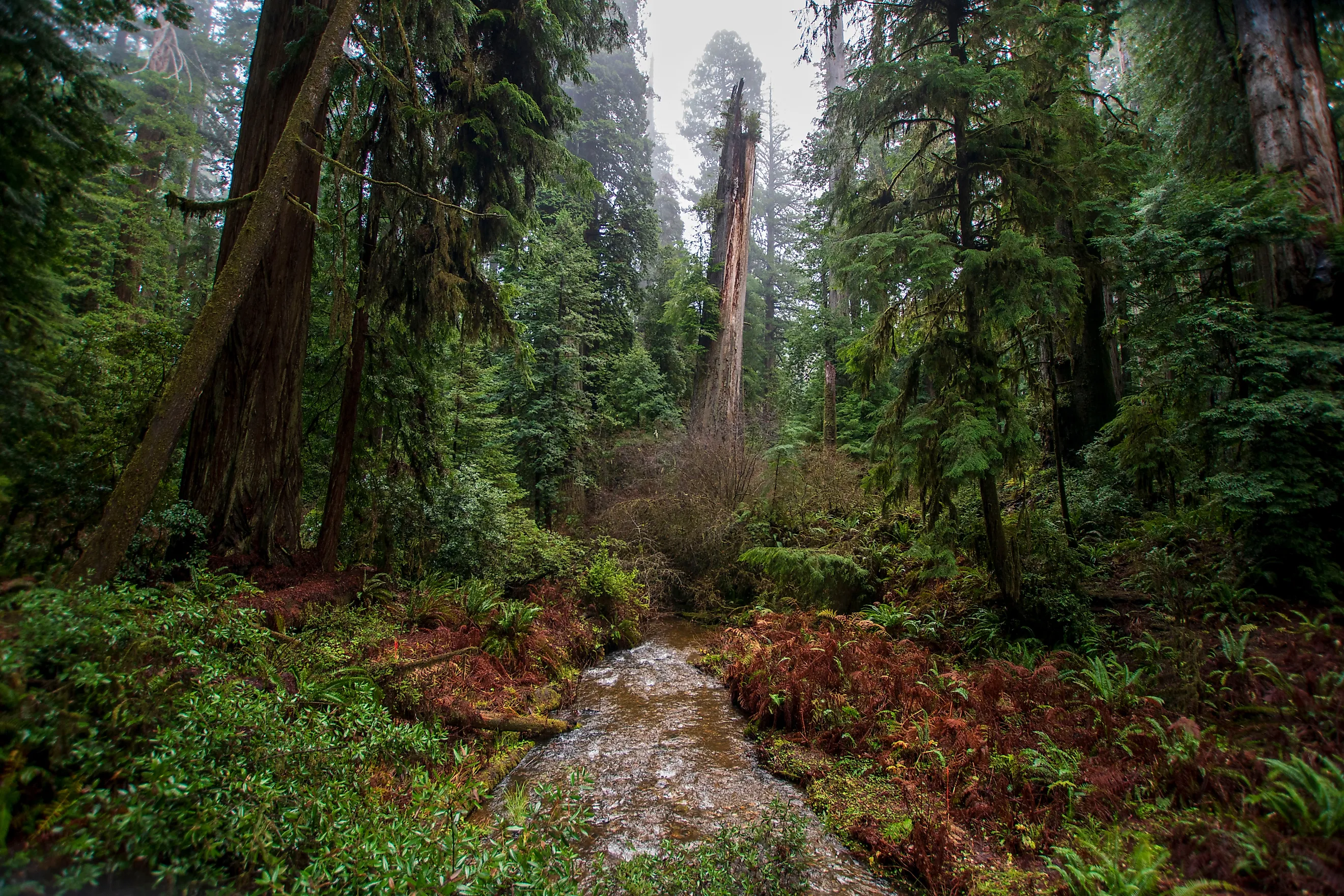
Old-growth coast redwoods in California's Del Norte County pack more than 2,000 metric tons of wood, bark, and leaves into a single acre. No forest anywhere on Earth has topped that record. The heart of it sits on the slopes of Jedediah Smith Redwoods State Park, where scientists have recorded the highest aboveground carbon storage of any forest ever measured. By the yardstick foresters use to judge how much forest fills a patch of ground, this is the densest forest in America. It holds the world title, too.
What "Densest" Actually Means

A "dense" forest can mean two different things, and they point to very different places. The first is mass, or how much living material, mostly wood, is packed into each acre. Scientists measure this as aboveground biomass, and it is the standard way to compare how much forest a piece of land actually holds. The second is crowding, or how many individual trees are squeezed into the same space.
By mass, the redwoods win easily. The record-holding forests near Jedediah Smith hold more than twice as much carbon as typical forests elsewhere in the world, according to researchers with the Redwoods and Climate Change Initiative, a long-running study by Save the Redwoods League and Cal Poly Humboldt. Oddly enough, these forests don't look crowded at all. Their giant trees stand fairly far apart, with ferns and smaller trees filling the space between them.
Jedediah Smith Redwoods State Park

The record forest is not a national forest. Jedediah Smith Redwoods State Park is a California state park, and it is one of four parks that make up Redwood National and State Parks, managed together by the National Park Service and California State Parks. That matters, because parks like these are protected for preservation, while national forests, run by the US Forest Service, can also be logged, grazed, and mined.
The park sits along the Smith River, one of California's last major undammed rivers, just east of Crescent City. Its most famous patch is Stout Grove, a flat stand of enormous redwoods beside the river, and the narrow, unpaved Howland Hill Road winds right between the giant trunks. Visitors can walk among some of the most massive trees on Earth in a matter of minutes.
Why Redwoods Pack In So Much Wood

Coast redwoods are the tallest trees on the planet, and they grow only in a narrow coastal strip from central California to southern Oregon. Plenty of rain and summer fog keep them supplied with moisture for most of the year, and individual trees can live for more than 2,000 years, adding wood the entire time. Their thick, red heartwood resists rot so well that fallen logs can last for centuries, which keeps all that material on the forest floor long after a tree dies.
The researchers found that these forests owe their record to their very largest trees. Widely spaced giants keep deep, leafy crowns all the way up their trunks, which lets them keep growing at a remarkable pace even when they are many centuries old.
The Runner-Up Is A Different Tree

Second place goes to the giant sequoia, the coast redwood's closest relative, and the two are easy to mix up. Coast redwoods are the tallest trees in the world and grow near the coast. Giant sequoias are the largest trees by volume and grow in the western Sierra Nevada, hundreds of miles inland. Both build some of the heaviest forests on Earth, but the record belongs to the coast redwoods.
The Most Crowded Forests Grow After Fire

If "densest" means the most trees crammed together, the answer moves to the Rocky Mountains, and it usually starts with a wildfire. Many lodgepole pines produce cones sealed with resin that open in the heat of a fire, releasing huge numbers of seeds onto the freshly burned ground. The seedlings that sprout can grow so thickly that foresters call them "doghair" stands, packed tight enough that it can be hard to walk between the trunks. Many of these stands grow on national forests, where fire is a natural part of how the forest renews itself. Over the decades, most of those young trees are crowded out, and the stand thins into a mature forest.
A Record That Took Millennia
Only about 113,000 acres of old-growth coast redwood forest remain, mostly protected in parks and preserves, while about 1.5 million acres of younger, previously logged redwood forest grow across the rest of the range. Researchers have found that those second-growth forests are already storing wood quickly, but matching the record forests of Jedediah Smith takes something no forest can rush. It takes thousands of years of steady growth. For anyone wondering what the densest forest in America looks like, the answer is a quiet grove of giants beside the Smith River.