Why Copperheads Turn Up In Yards And Garages In Fall
A copperhead in the garage is almost never a snake looking for somewhere warm. Unlike rodents, copperheads do not seek out human buildings for heat. They follow cover and they follow prey, and in autumn a typical suburban yard supplies both in quantity at exactly the moment the snakes are traveling. University of Georgia extension put the diagnosis in one line decades ago: if you are seeing snakes, you may have a rodent problem. The snake is a symptom. The mice are the condition.
They Are On Their Way Somewhere
The single biggest reason sightings spike in September and October is that copperheads are moving, and a yard is frequently in the way.
Copperheads overwinter in communal dens and those dens are frequently outside the range they hunt in during summer, which means a genuine seasonal journey twice a year. Autumn is the return leg, and it crosses whatever is between the summer range and the winter rock.
In much of the eastern United States, what is in between is now lawns, driveways and garden beds. The route was established long before the subdivision was.
Autumn Hands Them Perfect Camouflage

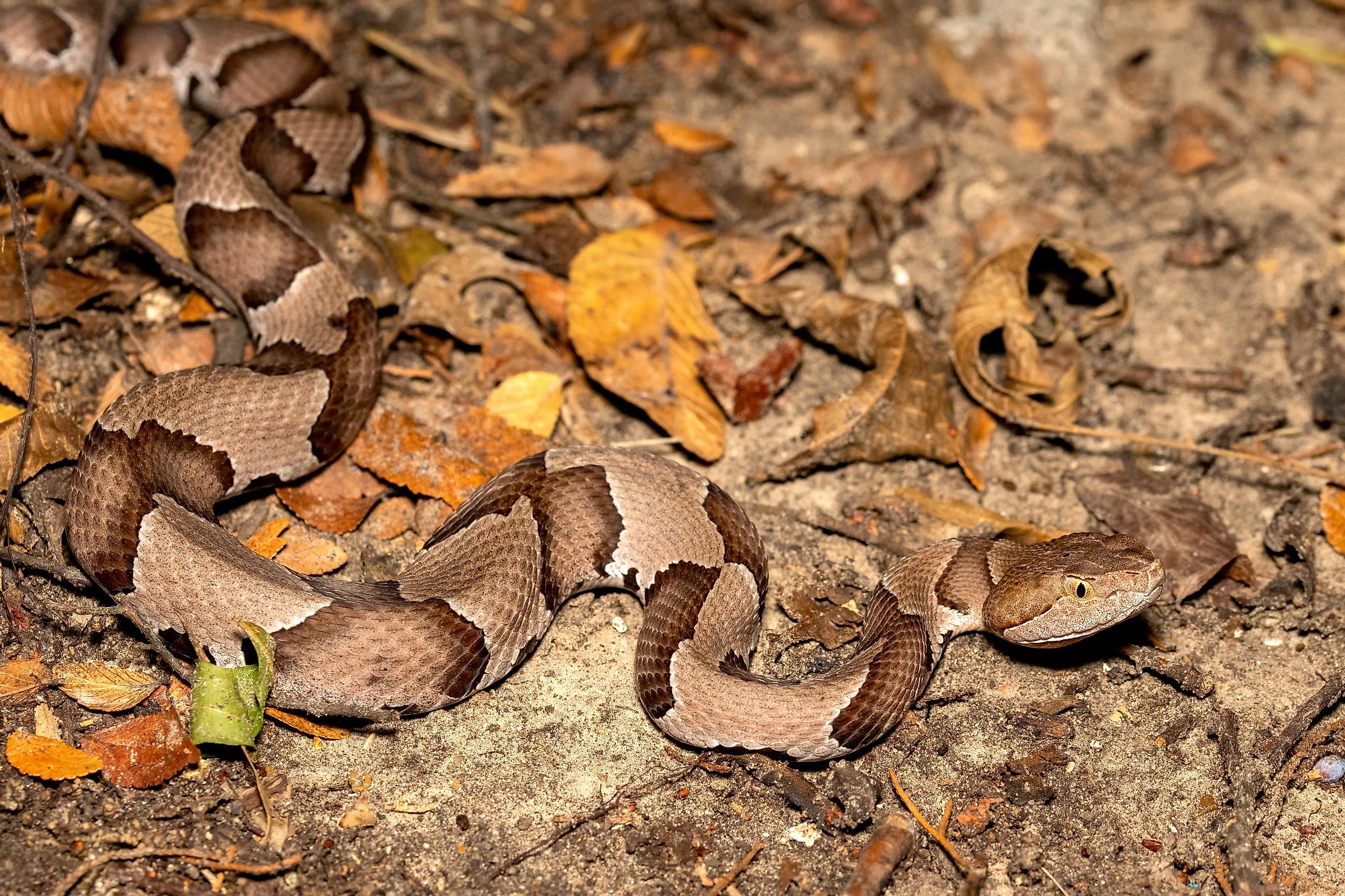
The second reason is seasonal and almost comically well timed. The copperhead's hourglass banding is built to disappear against dead leaves, and in October dead leaves arrive everywhere at once. A snake that was reasonably visible on a mown lawn in July becomes effectively invisible on the same lawn in October.
That changes nothing about snake numbers and everything about how close people get before noticing. Most copperhead bites happen to people who never saw the animal.
Yards Accidentally Build Snake Habitat

Landscaping choices made for entirely unrelated reasons turn out to be exactly what the species wants.
NC State extension notes that rock piles and rock walls create pockets, caves, tunnels, basking sites and protected travel corridors for reptiles. Alabama extension observes that copperheads are fond of old rock or wood piles as shelter and feeding areas, and that pine straw and woody debris provide the same cover.
A retaining wall is artificial talus. A woodpile is a rodent colony with a roof. Mulch beds hold moisture, insects and the small animals that eat them, and stay cooler than open ground.
Bird Feeders Are The Common Thread

The item that turns up in every extension publication on this subject is not a rock or a log. Spilled birdseed feeds mice. Pet food left on a deck feeds mice. Unsecured bins feed mice. Mice draw copperheads, which eat voles, chipmunks and other small mammals that move through yards.
Removing cover makes a yard less comfortable. Removing the food supply makes it less worth visiting, and that is the more effective of the two.
A Quarter Of An Inch Is Enough

For garages and crawl spaces specifically, the entry points are far smaller than most people assume.
Snakes get in through foundation cracks, gaps under doors, utility penetrations, crawl space vents and garage openings of a quarter inch or larger. They are following rodent trails rather than seeking shelter for its own sake, which is why rodent-proofing and snake-proofing are the same job.
Steel wool and hardware cloth close those gaps. A garage door that does not seal to the concrete is an open invitation at ground level.
The Numbers That Actually Work
Extension guidance is unusually specific about dimensions, which makes it easy to act on. Keep mulch under two to three inches deep and pull it back several inches from the foundation, or leave a six-inch gravel-free strip around the house entirely. Stack firewood twelve inches off the ground and away from walls. Plant shrubs at least four feet from the foundation.
None of that is about snakes directly. All of it removes the cover and moisture that rodents need, which removes the reason a copperhead would stop.
September Brings The Babies Too

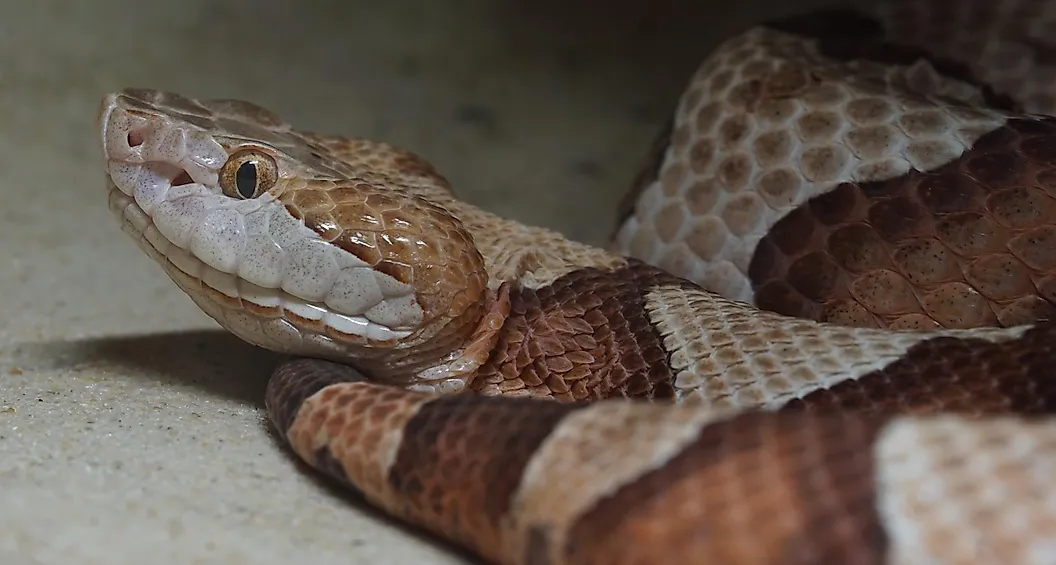
Autumn sightings include a size class that is simply absent for most of the year. Copperheads give birth between late August and early October, and the newborns disperse almost immediately. They are seven to ten inches long, brightly banded, carry a yellow tail tip and are venomous from birth.
They are also small enough to use spaces nobody checks, and they vanish completely into leaf litter. A September yard can contain both the adults heading for dens and that year's young looking for anywhere at all.
The Dog Is More At Risk Than You Are

One group encounters copperheads far more often than people do, and it is worth planning around them.
Dogs are statistically more likely than humans to meet a copperhead, because they investigate at ground level and push their faces into exactly the woodpiles, mulch beds and wall bases that snakes use.
Supervising pets in autumn, keeping them out of debris piles and clearing the specific features above does more for a household's risk than anything aimed at the snakes themselves.
Most Of Them Are Passing Through

Before anybody starts clearing the garden at speed, the proportion is worth knowing. Most snakes seen in yards are transient, moving through rather than resident. Plenty of what turns up in mulch beds and under porch steps in autumn is harmless: ring-necked snakes, brown snakes and young rat snakes all use the same cover.
And a copperhead that has been noticed will usually stay exactly where it is. The species freezes and relies on camouflage rather than pursuing anyone, which is why giving it room and walking away works reliably.
The Short Version

Copperheads appear in yards and garages in autumn because they are migrating to winter dens, the falling leaves make them invisible, that year's young are dispersing, and the average property supplies rock crevices, woodpiles, deep mulch and a reliable rodent population along the route.
They are not coming inside for warmth. They are following mice through cover that somebody built without meaning to. Thin the mulch, lift the woodpile, secure the birdseed and seal the quarter-inch gaps, and the yard stops being worth the detour.