The Oldest Public Gardens In America
Every spring, the same argument flares up again when the azaleas start to bloom in Charleston and those classic Swan Boats go back on the water in Boston: which of America's gardens is the oldest? At least four public gardens claim the title, and each one is kinda-sorta right, at least if judged on its own definition of "oldest."
We've nailed the answer here with one simple measure: the year a garden was first planted on the ground it still occupies, counting only those that were open to the general public in 2026. The year each one first let visitors through the gate is included, but that tells a different story, for a different day. Here are the oldies that come out on top, so charge your phone, download a plant ID app like Seek by iNaturalist, and leave the pruning shears at home.
1. Magnolia Plantation and Gardens, Charleston, South Carolina (1680)
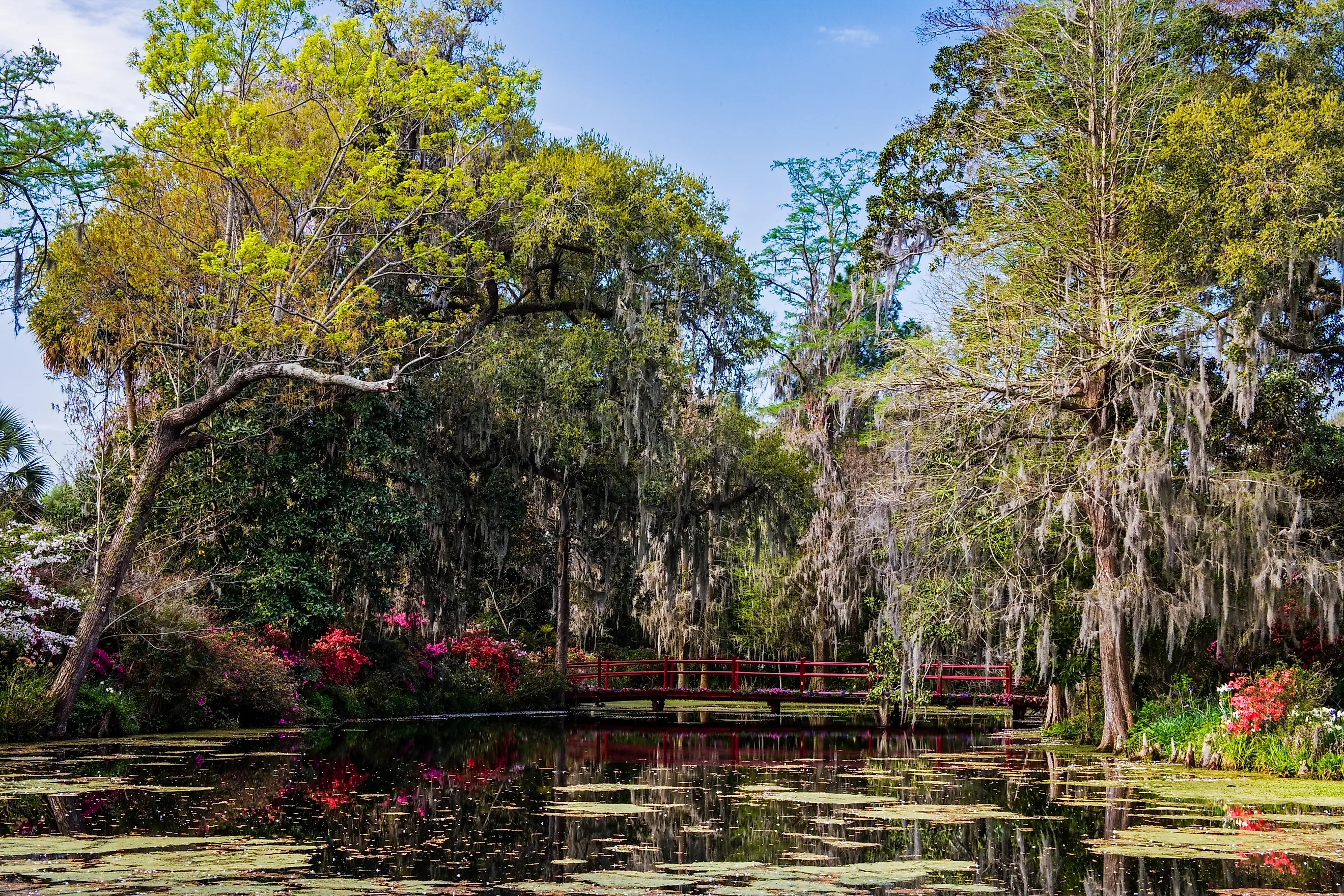
Magnolia Plantation and Gardens, on the Ashley River northwest of downtown Charleston, has belonged to the Drayton family since 1676, and the first small formal garden beside the house was completed in 1680. The oldest section, known as Flowerdale, still follows that early plan.
Most of the gardens visitors walk through today were planted in the 1840s by the Reverend John Grimké Drayton, who set out azaleas and camellias in the open at a time when both were kept in northern greenhouses, and his were among the first of their kind planted outdoors in South Carolina.
Union troops burned the house during the Civil War, and in 1870 Drayton began admitting paying steamboat passengers from Charleston to keep the place afloat. The Long White Bridge, built in the 1840s by enslaved workers, is one of the most photographed spots on the grounds, and the 60-acre Audubon Swamp Garden is named for the painter John James Audubon, who collected waterfowl specimens here. The gardens are open every day except Thanksgiving and Christmas.
2. Bartram's Garden, Philadelphia, Pennsylvania (1728)
John Bartram, a self-taught Quaker farmer later named Royal Botanist for North America by King George III, bought 102 acres on the west bank of the Schuylkill River in 1728 and laid out what is now Bartram's Garden between his stone house and the water. He filled it with plants collected on trips from New England to Florida, and three generations of Bartrams ran it as a nursery, shipping boxes of seeds and roots to estates across Britain and Europe.
The family sold the property in 1850, and the City of Philadelphia took it over as a public park in 1891. The John Bartram Association, founded by descendants in 1893, now runs it with the city's parks department. A ginkgo planted in 1785 is believed to be the oldest in North America, and every Franklinia tree (a species named for Benjamin Franklin) alive today descends from seeds gathered in Georgia.
The 50-acre site in Southwest Philadelphia was the first landscape in the country designated a National Historic Landmark. The grounds are open daily as a city park, and house tours are ticketed.
3. Middleton Place, Charleston, South Carolina (1741)

A few miles upriver from Magnolia, Middleton Place has what the National Park Service describes as the nation's oldest extant landscaped gardens. Henry Middleton, later president of the First Continental Congress, began them in 1741 on land that came with his marriage to Mary Williams, working from a French garden manual with an English gardener and a crew of enslaved laborers.
The result was a 65-acre classical garden built on a central axis that steps down in turf terraces to a pair of Butterfly Lakes beside the Ashley River. Later members of the Middleton family added camellias brought by the French botanist André Michaux in 1786, the first planted in an American garden. Today, more than 100,000 azaleas grow here.
Union troops burned the main house in 1865, and the gardens went untended for six decades until descendant J. J. Pringle Smith, who inherited the property in 1916, began restoring them in the mid-1920s. The Cultural Landscape Foundation gives 1952 as the year the gardens first opened to the public, and the nonprofit Middleton Place Foundation, set up in 1974, now owns and runs the site, which is open every day except Christmas.
4. George Washington's Mount Vernon, Virginia (1760s)
The only presidential estate on this list, Mount Vernon overlooks the Potomac River 15 miles south of Washington, DC. George Washington laid out the Upper Garden and the Lower Garden in the 1760s as walled, rectangular plots for fruit, nuts, and vegetables, then reworked the whole landscape after returning from the Revolutionary War in 1783.
The Upper Garden was enlarged and reshaped in 1785 and turned into a flower garden with a brick greenhouse as its centerpiece. The English-born architect Benjamin Latrobe, who later worked on the US Capitol, described it in 1796 as "a neat flower garden laid out in squares, and boxed with great precision."
The Lower Garden has been cultivated for vegetables without a break since the 1760s. The Mount Vernon Ladies' Association bought the run-down estate from the Washington family in 1858 and opened it to the public in 1860. It still runs the Mount Vernon estate, which is open every day of the year.
5. Mount Auburn Cemetery, Cambridge and Watertown, Massachusetts (1831)

While a cemetery may look out of place on a list of old public gardens, Mount Auburn Cemetery, split between Cambridge and Watertown, meets the criteria perfectly. The first large-scale designed landscape in the United States open to the public, it still operates as an accredited arboretum.
The cemetery was established in 1831 by the Massachusetts Horticultural Society on 72 acres a mile west of Harvard Square. Its roads and paths were laid out along the natural contours of the hills by the society's president, Henry Dearborn, and the civil engineer Alexander Wadsworth. The society's original plans for an experimental garden never saw the light of day, but the grounds grew into one of the most horticulturally varied cemeteries in the country.
Today, it covers 175 acres with 5,000 trees, and welcomes 200,000 visitors a year. Nine other park-like burial grounds on the edge of town were modeled on it, and the public parks movement grew out of them. The gates are open every day of the year at no charge, and the Friends of Mount Auburn offer walking tours and lectures.
6. Boston Public Garden, Boston, Massachusetts (1837)

Across Charles Street from Boston Common, which dates to 1634 and is the country's oldest public park, the Public Garden was the first botanical garden in America laid out for the public from the start. In 1837, the city of Boston leased 20 acres of filled marsh to a group of 17 Bostonians led by the horticulturist Horace Gray, and the site was named the Public Garden the following year.
Little was built until 1859, when the city secured the land for park use and chose a design by the architect George Meacham, who won a public competition and a $100 prize. The 24-acre garden that resulted has a four-acre lagoon crossed by a suspension bridge built in 1867, an equestrian statue of George Washington unveiled in 1869, and the Ether Monument of 1867, which commemorates the first public demonstration of anesthesia at Massachusetts General Hospital in 1846.
The famous pedal-powered Swan Boats? They've been operated by the same family since 1877 and can be rented from April to September. The bronze Make Way for Ducklings sculptures, based on Robert McCloskey's 1941 children's book, were installed in 1987 and are one of the most popular spots in the park.
7. Missouri Botanical Garden, St. Louis, Missouri (1859)
The youngest garden on the list, Missouri Botanical Garden is the one that's most often referred to as the nation's oldest botanical garden in continuous operation. Henry Shaw, an English-born hardware merchant, built his country house, Tower Grove House, in St. Louis in 1849 and opened the grounds around it to the public in June 1859, taking the Royal Botanic Gardens at Kew and Chatsworth in England as his models.
The 79-acre garden in south St. Louis is home to Linnean House, built in 1882 as Shaw's orangery, built for wintering citrus trees. It's now dedicated to camellias and is the oldest continuously operating public greenhouse west of the Mississippi River.
The Climatron, a geodesic-dome greenhouse opened in 1960, was the first of its kind in the world, and the 14-acre Seiwa-en, dedicated in 1977, is one of the largest Japanese gardens in North America. Shaw is buried in a mausoleum on the grounds. The garden is open every day, and its 2,400-acre Shaw Nature Reserve at Gray Summit, 35 miles to the southwest, is also worth a visit.
Honorable Mention: United States Botanic Garden, Washington, DC (1820)
The United States Botanic Garden is owned by Congress, and the idea for it goes back to a letter George Washington wrote in 1796 pointing out a site for one in the new capital. And in May 1820, President James Monroe signed a bill setting aside five acres west of the Capitol for the Columbian Institute, a scientific society, to grow and distribute useful plants.
That first garden folded in 1837 when the institute stopped meeting, and the collection was revived in 1842 to house plants brought back by the Wilkes Expedition, the US Navy's four-year survey of the Pacific. A conservatory went up in 1850, and the garden has operated continuously since, which is the basis of its claim to be the oldest continuously operating public garden in the country.
Four plants from that 1850 collection are still alive, among them two Queen Sago cycads in the Garden Court. The present glass Conservatory on Maryland Avenue in Washington, DC, opened in 1933, and admission is free every day of the year, federal holidays included.
Why'd we include it? While it misses the list because the collection moved across Maryland Avenue when the National Mall was rebuilt in the 1930s, it's the same institution, just on neighboring ground. And as it has been operating continuously since 1850, its claim is too strong to leave out.
Where The Argument Stands

While the question of where exactly the oldest public gardens in America reside is the subject of much debate and largely depends upon who you ask, it's a moot point if all you're interested in is catching the first spring blossoms. We settled on Magnolia as the oldest because its first garden was planted in 1680, before any other on the list.
Others have claims that work if you reframe the question. The country's oldest continuously operating public garden? That's our honorable mention, the United States Botanic Garden. The oldest botanic garden still growing on its original ground? Bartram's. And the first botanical garden built for the public from the outset? The Boston Public Garden wins that one.
But for visitors, these dates matter less than the calendar. The camellias at Magnolia and Middleton Place flower from October through March, the azaleas peak in late March and April, and the Swan Boats return to the Public Garden lagoon each April. Plan a spring trip, download that plant ID app, and leave the argument over which is the oldest at the gates.