The National Parks With A Ski Area Inside The Boundary
National parks in the US and Canada prioritize ecological conservation, making the development of commercial ski resorts highly restricted. Yet historical exceptions have allowed several lift-serviced ski areas to remain within park boundaries. All of these destinations were ski areas before the land was designated as a national park, and the ski areas within Canada's park are vastly larger than their US counterparts.
Yosemite's Badger Pass opened in 1935, during an era when national parks actively promoted winter tourism. That same enthusiasm for skiing helped establish Hurricane Ridge in Olympic National Park, while Canada's Banff National Park became home to major resorts like Sunshine Village and Lake Louise. Today, these ski areas offer a rare opportunity to hit the slopes within protected national park boundaries.
US National Parks With Ski Areas
Yosemite National Park, Badger Pass Ski Area

Opened in 1935, Badger Pass Ski Area is the oldest ski area in a U.S. national park. It is a small, family-oriented hill with five lifts and a focus on beginner and intermediate terrain. The creation of Badger Pass inside Yosemite National Park, created in 1890, reflects a time when the National Park Service actively promoted motorized tourism and winter recreation to boost public support and park funding.
The ski area's development came together through a mix of park-promotion strategies, infrastructure updates, and a strong push from the president of the Yosemite Park and Curry Company, Donald Tresidder. Following a trip to the 1928 Winter Olympics in St. Moritz, Switzerland, Tresidder was inspired and brought home a vision that would transform Yosemite into the "Switzerland of the West." With the help of iconic photographer Ansel Adams, Tresidder even made a formal bid to host the 1932 Winter Olympics in Yosemite. While the bid ultimately lost to Lake Placid, New York, the campaign generated a lot of publicity and widespread interest in alpine skiing.
The Wawona Tunnel was completed and plowed for the first time in 1933, followed by the completion of Glacier Point and Badger Pass roads in 1935, which gave vehicles a direct, plowed route straight to the high elevation alpine meadows where snow was reliable. During the Great Depression, the National Park Service openly encouraged the development of winter sports facilities to increase park usage, and because Badger Pass was situated in a gentle, natural bowl, the NPS deemed it an approachable location that would keep environmental destruction to a minimum. The federal government supported the expansion, and the Civilian Conservation Corps, under the New Deal program, was deployed to clear the ski runs, build ski jumps, widen roads, and construct the lodge and buildings.
Olympic National Park, Hurricane Ridge Ski And Snowboard Area

Olympic National Park was officially established on June 29, 1938, when President Franklin D. Roosevelt signed the act into law. Prior to becoming a national park, the landscape was already protected as the Olympic Forest Reserve in 1897, and then as Mount Olympus National Monument in 1909, when a portion of the reserve was protected to safeguard the declining population of Roosevelt Elk in the area.
Prior to being designated as a national park, however, a small ski area named Deer Park on Blue Mountain operated from the early 1930s to the 1950s. The first lift was a crude rope tow powered by a motorcycle engine (which the owner of the engine put back in his motorcycle for the summer months). The problem with Deer Park, however, was that it sat in a microclimate that didn't receive much snow, its south-facing slopes were exposed to the sun, and the access road was just too narrow, with a parking lot that could only fit 50 cars.
By the early 1950s, Olympic National Park's superintendent, Fred Overly, wanted to boost public visitations, so they looked toward Hurricane Ridge, which had a reliable snowpack and better terrain, but lacked infrastructure. As part of Mission 66, a massive federal funding program aimed at upgrading national park infrastructure, a new road was built and opened to winter traffic, and the Hurricane Ridge Lodge was built. The rope tows and engines were packed up, moved from Deer Park, and reassembled at Hurricane Ridge, which opened for skiing on January 1, 1958.
Cuyahoga Valley National Park, Boston Mills/Brandywine Resort
Unlike Badger Pass and Hurricane Ridge, which were planned by the National Park Service, the story of Boston Mills/Brandywine is much different. They began as independent, competitive private businesses that were later absorbed by the same owner, which eventually united the ski areas into a single ski area.
In 1963, the recreational ski boom hit Ohio, and seeing a business opportunity, separate business groups developed Boston Mills and Brandywine as independent, competing ski areas just two miles apart in the Cuyahoga River Valley. Boston Mills was built on the steeper side of the valley, eventually becoming famous for creating the run Tiger, the steepest ski slope in Ohio. Brandywine was built nearby with a wider footprint, with a more spread-out layout and a large tube park. Both areas relied heavily on snowmaking.
In 1974, Congress established Cuyahoga Valley National Recreation Area to protect the valley's natural and recreational landscapes, with federal land acquisition beginning the following year. Because the ski areas were already very popular, they were allowed to continue operating as private businesses on leased land within the federal park boundaries. In 1990, after 30 years of intense competition, the owners of Boston Mills purchased Brandywine and combined both operations into a single business model with interchangeable lift tickets. The recreation area was elevated to full National Park status in 2000.
Canadian National Parks With Ski Areas
Banff National Park, Sunshine Village, Lake Louise, Mount Norquay

Banff National Park was established in 1885 and was Canada's first national park. It was originally a 10-square-mile (26-square-kilometer) reserve surrounding natural hot springs before growing to a world-class 2,564-square-mile (6,641-square-kilometer) national park in the heart of the Canadian Rockies. With a deep history of skiing within the park, led by the Banff Ski Club, there are three large, distinct, legendary ski areas—Sunshine Village, Lake Louise, and Mount Norquay.
Like the early days of the U.S. National Park Service, early 20th-century Canadian park policies actively encouraged development to justify the park's existence and bring in revenue. The presence of these commercial ski areas inside Canada's flagship wilderness park is a product of historical timing, early tourism mandates, and legislative grandfathering rules.
Mount Norquay is the pioneering ski area of the three, and it holds the title of the birthplace of alpine skiing in Western Canada. Skiers first started hiking its steep slopes in 1926, and the first lift was built in 1948. Because it faces directly toward the town of Banff, its slopes offer some of the most dramatic views of the valley, especially from the top of the North American run. Today's Mount Norquay also offers the only night skiing in Banff, and despite being the smallest ski area of the three, it offers some of the longest, steepest runs in the region.
Sunshine Village is a high-alpine powder keg that boasts an abundantly natural snowpack that provides skiing from mid-November into May, and often into the summer months, making it North America's longest ski season. Built right on the Continental Divide, skiers can cross from Alberta into British Columbia mid-run. It's famous for its wide open bowls, deep snow, and Delirium Dive, one of the world's most challenging free skiing zones that requires an avalanche beacon, shovel, and probe just to pass the access gate.
Sunshine Village began as an exploration campsite in the early 1920s and later became recognized as great skiing terrain. To protect the environment, there is no access road. Instead, skiers take a 20-minute gondola ride to the base at 7,200 feet.

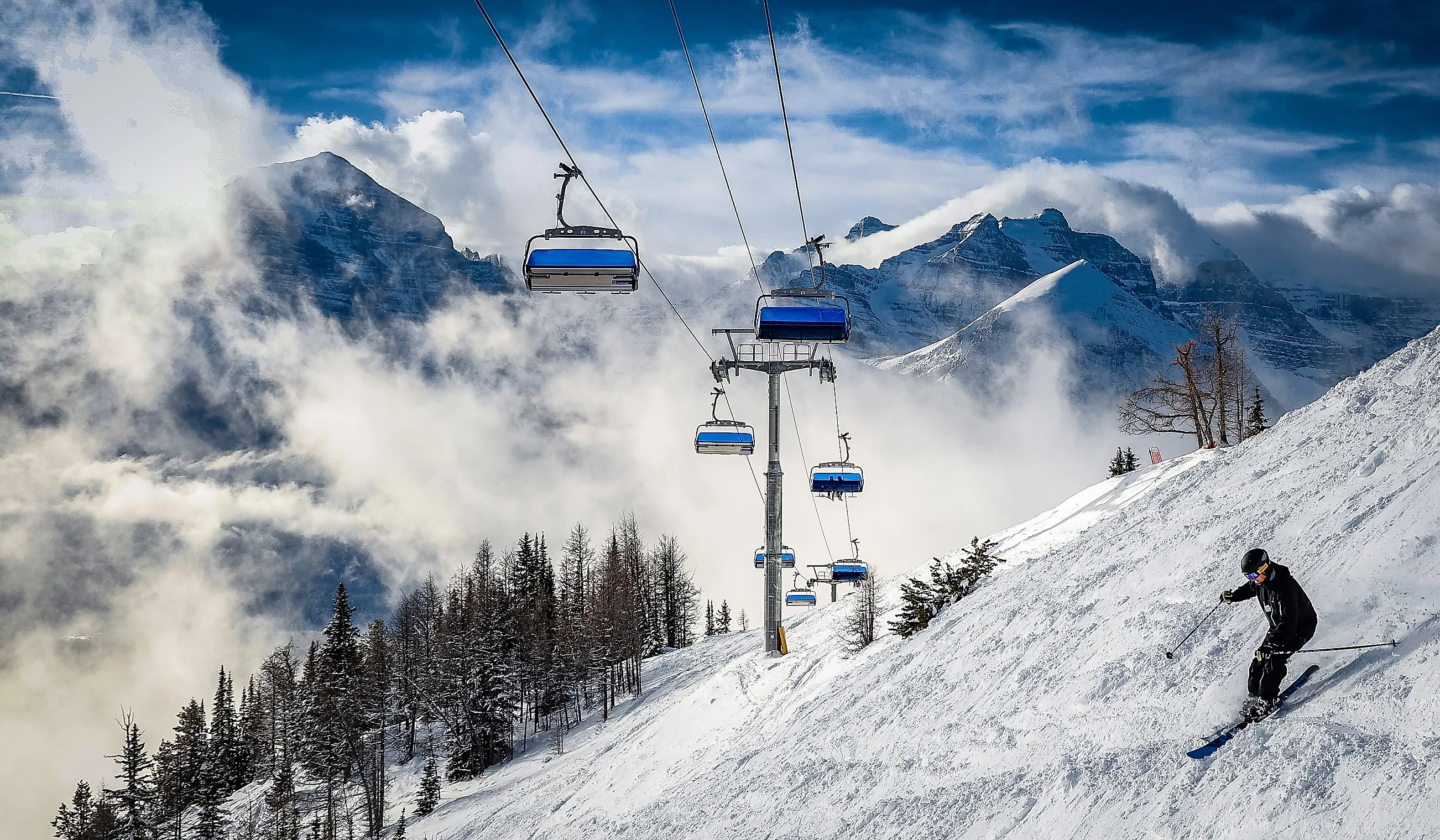
Lake Louise is the undisputed giant of the three areas, spanning 4,200 skiable acres across three mountain faces, making it one of the largest ski areas in North America. It evolved out of early Swiss mountain guide culture in the 1920s and is now legendary for its sprawling back bowls and, until 2024, as a stop on the FIS ski circuit. Despite challenging terrain throughout the area, its layout is unique: every single chair offers at least one beginner run winding down from it, allowing beginner skiers to enjoy the entire mountain.
Jasper National Park, Marmot Basin

The northernmost major Rocky Mountain resort, Marmot Basin, is located just outside the town of Jasper and inside the boundaries of Jasper National Park. It is currently owned by Rocky Mountain Skiing Incorporated and operates on public land leased from the Canadian government under strict ecological guidelines put forth by Parks Canada. The peak and ski area were named in the 1920s by Swiss ski pioneer Joseph Weiss after the large rodent, the hoary marmot, that often whistled among the rocks in the area.
The park had achieved protected status in 1907 as Jasper Forest Park, established to protect the watershed of the Canadian Rockies and preserve the forest ahead of the upcoming construction of transcontinental railways. After achieving official National Park Status in 1930 through Canada's National Parks Act, it was locked in as a national wildlife sanctuary and operated under the strict rules of Parks Canada.
In 1942, during World War Two, the British Army's Scottish Lovat Scouts used the ski area for alpine winter training, using crude snowcats to get around while leaving behind an army truck that was later scavenged to build the resort's first rope tow lift. Parks Canada officially granted the resort a commercial operating license in 1964, cementing the resort's place.
Ski areas that operate within national parks, both in the US and Canada, have a core preservation mandate of putting nature first and are legally required to protect ecological integrity, native species, and natural habitats in an unimpaired state. Laws like Canada's National Parks Act prohibit building new commercial ski resorts inside national parks to prevent environmental degradation, while agencies like the U.S. Forest Service have a multiple-use mandate that allows commercial recreation, which is why the majority of public-land ski areas in the US operate on national forest land rather than national park land.
For the ski areas that do operate in national parks, strict environmental laws need to be followed to ensure people enjoy recreation in these pristine and protected areas, while the flora and fauna can live peacefully with the undisturbed resources they require to survive.