The Largest Shopping Malls in Europe
The standard ranking metric for shopping malls is gross leasable area (GLA), which is the floor space available for tenants and excludes parking, hallways, and non-tenant facilities. By that measure, Westfield London at about 240,000 square meters has been Europe's largest mall since its 2018 expansion. The other nine on the list below all break 175,000 square meters, which puts each at roughly the size of 25 to 33 standard football pitches under one roof. The geographic distribution is uneven: the United Kingdom holds four of the top 10 spots, Russia holds two, and Croatia, Austria, Hungary, and Spain each hold one. Some malls with larger total footprints (Istanbul Cevahir is the standard example) rank lower on GLA-based lists because more of their built area is taken up by non-retail use.
1. Westfield London (London, United Kingdom)

Westfield London opened on October 30, 2008, on a brownfield site in White City, west London, that had previously hosted the 1908 Franco-British Exhibition. The mall was developed by the Westfield Group at a cost of £1.6 billion. A 2018 expansion (which added another 740,000 square feet of retail space and finished six months ahead of schedule) brought the total leasable area to about 240,000 square meters and made Westfield London the largest shopping mall in Europe by gross leasable area. The center hosts more than 450 retailers, including a John Lewis flagship, the largest Apple store in the United Kingdom, and Gucci, Hamleys, and West Elm flagships. Westfield London is owned by Unibail-Rodamco-Westfield, the European arm of the international Westfield retail-property group.
2. Aviapark (Moscow, Russia)

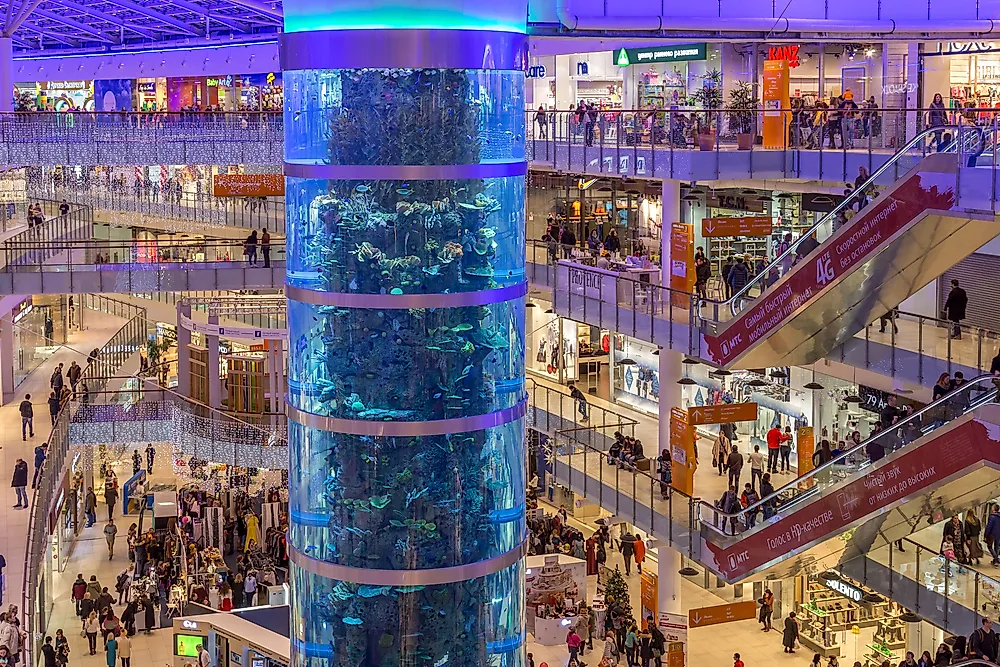
Aviapark opened on November 28, 2014, in Moscow's Khoroshyovsky District with about 230,000 square meters of leasable space across four levels. The mall's signature feature is a 23-meter-tall cylindrical aquarium running floor to ceiling at the central court, holding about 2,500 fish in roughly 370 cubic meters of seawater. At opening, Aviapark had more than 500 stores and held the title of Europe's largest mall by retail area for nearly four years until Westfield London's 2018 expansion. The mall lost most of its Western retailers after 2022 international sanctions on Russia, and many vacated spaces have since been filled with Russian, Turkish, and Chinese brands.
3. Westgate Shopping City (Zagreb, Croatia)

Westgate Shopping City opened in 2009 in Jablanovec, just outside Zagreb (the capital of Croatia), with about 226,000 square meters of leasable area and roughly 260 stores. It is the largest mall in Southeast Europe by gross leasable area and draws shoppers from across Croatia, Slovenia, Hungary, and Bosnia and Herzegovina. The mall was originally developed by the Croatian retail conglomerate Agrokor, which subsequently went through one of the largest corporate restructurings in Croatian history before being taken over by the Fortenova group. Westgate's anchor tenants include Interspar and major international fashion retailers including H&M, Zara, and Bershka, along with a 30-restaurant food district.
4. MEGA Belaya Dacha (Moscow, Russia)
MEGA Belaya Dacha opened in December 2006 in Kotelniki, southeast of Moscow, with about 225,000 square meters of leasable space. The mall is part of IKEA's MEGA chain, which operated 14 large shopping centers across Russia, each anchored by an IKEA flagship. MEGA Belaya Dacha was the chain's flagship for years, with one of the largest IKEA stores in Russia attached. IKEA suspended Russian operations in March 2022 following the invasion of Ukraine. The mall continued to operate under MEGA branding and has been re-leasing the former IKEA space to other large-format retailers.
5. Trafford Centre (Manchester, United Kingdom)

The Trafford Centre opened on September 10, 1998, west of Manchester, with about 200,000 square meters of leasable area and 280 stores across multiple themed floors. The mall is one of the most architecturally distinctive in the UK, designed in a neoclassical Las-Vegas-meets-Versailles style with a central dome, marble columns, gilded statuary, and a 1,600-seat food court done up like the upper deck of an ocean liner. The center was developed by Peel Holdings, sold to Intu Properties in 2011, and then partially acquired by the Canada Pension Plan Investment Board in 2020 after Intu's collapse. The Trafford Centre is the second-largest shopping mall in the UK by gross leasable area and one of the major regional retail destinations in northern England.
6. MetroCentre (Gateshead, United Kingdom)
The MetroCentre opened on October 27, 1986, in Gateshead, in northeast England across the River Tyne from Newcastle, with about 192,900 square meters of leasable area and roughly 370 stores. It was Europe's largest shopping mall at opening and held the title for over a decade before being overtaken by the Trafford Centre in 1998 and then Westfield London. The mall sits on a former power-station and ash-tip site and was developed by Sir John Hall as part of the regeneration of Tyneside following the decline of the region's heavy industry. MetroCentre includes a major indoor entertainment complex with cinemas, restaurants, a 380-seat theater, and a covered amusement section.
7. Westfield SCS (Vösendorf, Austria)

Westfield SCS (formerly Shopping City Süd) opened in October 1976 in Vösendorf, just south of Vienna in Lower Austria, with about 192,500 square meters of leasable space. It is one of the oldest large shopping malls in Europe, built before the modern megamall era and progressively expanded over five decades. The center has more than 360 stores anchored by Interspar and several international fashion retailers, along with the Pluscity entertainment complex on the same site. The mall was acquired by Unibail-Rodamco-Westfield and rebranded Westfield SCS in 2019 alongside the company's other major European malls.
8. Westend City Center (Budapest, Hungary)

Westend City Center opened in November 1999 in Budapest's 6th District, with about 186,000 square meters of leasable area and roughly 400 stores. The mall is connected directly to Nyugati pályaudvar, Budapest's Western Railway station, which was designed by the Gustave Eiffel firm and completed in 1877. The center includes a rooftop garden with views over central Budapest and a Hilton hotel directly above the retail floors. Westend was one of the first major Western-style shopping malls in Central Europe when it opened and remains the largest mall in Hungary.
9. Bluewater (Greenhithe, United Kingdom)

Bluewater opened on March 16, 1999, in Greenhithe, Kent, southeast of London, with about 185,000 square meters of leasable area after a recent expansion. The mall was built in a former chalk quarry, and the developer (Australian firm Lend Lease) preserved the original quarry walls and surrounding lakes as the landscape design. The parking lots and gardens use the original cliff faces as boundary features. Bluewater has more than 300 stores including a department-store flagship from John Lewis, a 17-screen Showcase cinema, and a 13-restaurant food village. The mall is owned by Landsec, the largest commercial real-estate company in the United Kingdom.
10. Marineda City (A Coruña, Spain)
Marineda City opened in June 2011 in A Coruña, in the Galicia region of northwestern Spain, with about 176,000 square meters of leasable area and 200 stores. It is the largest shopping mall in Spain by gross leasable area and one of the most prominent in southern Europe. The center includes a 13-screen Cinesa cinema, an Inditex flagship (Inditex is the parent company of Zara, headquartered in nearby Arteixo, and A Coruña is the brand's hometown), and an extensive food court along with a bowling alley and karting facility.
What These Ten Have In Common
Five of the top 10 largest shopping malls in Europe were built between 1998 and 2014, during the construction boom that preceded the rise of e-commerce, and a sixth (Westfield London) reached its current size in a 2018 expansion completed during the same period. The size race in European malls has effectively stopped since the COVID-19 pandemic and the broader shift to online retail, with no significant new mega-mall openings on the continent since 2016. Several of the malls on this list have been working to convert excess retail space into entertainment, food halls, residential, or office uses to maintain footfall. The geographic concentration in the United Kingdom (four of the top 10) reflects the country's particularly high per-capita retail floor space, which is among the highest in Europe and roughly double the European average. The post-2022 sanctions on Russia have removed most Western brands from Aviapark and MEGA Belaya Dacha, though both continue to operate at scale with regional and non-Western tenants.