The Largest Living History Museums In The United States
There's a pretty good chance you once stood in a one-room schoolhouse on a field trip while a woman in a frock and a bonnet explained what a slate was for. Living history museums, where costumed interpreters cook, forge, farm, and teach inside restored or reconstructed buildings, have been a staple of school trips for generations of kids, and the biggest of them are whole towns.
We've ranked the largest such attractions in the United States by the number of historic buildings, original and reconstructed, that each publishes for its grounds (acreage, though important, doesn't always reflect their true scale). The numbers are the museums' own and are not standardized (one site's outbuildings are another's single farmstead). So, climb aboard our virtual school bus and enjoy a trip back in time to America's biggest living history museums.
1. Colonial Williamsburg, Williamsburg, Virginia

The restored capital of colonial Virginia, Williamsburg is in a class of its own. The Colonial Williamsburg Foundation counts more than 300 buildings in its 301-acre Historic Area, 89 of them original 18th-century structures, and the rest reconstructed on their original foundations after archaeological and documentary research.
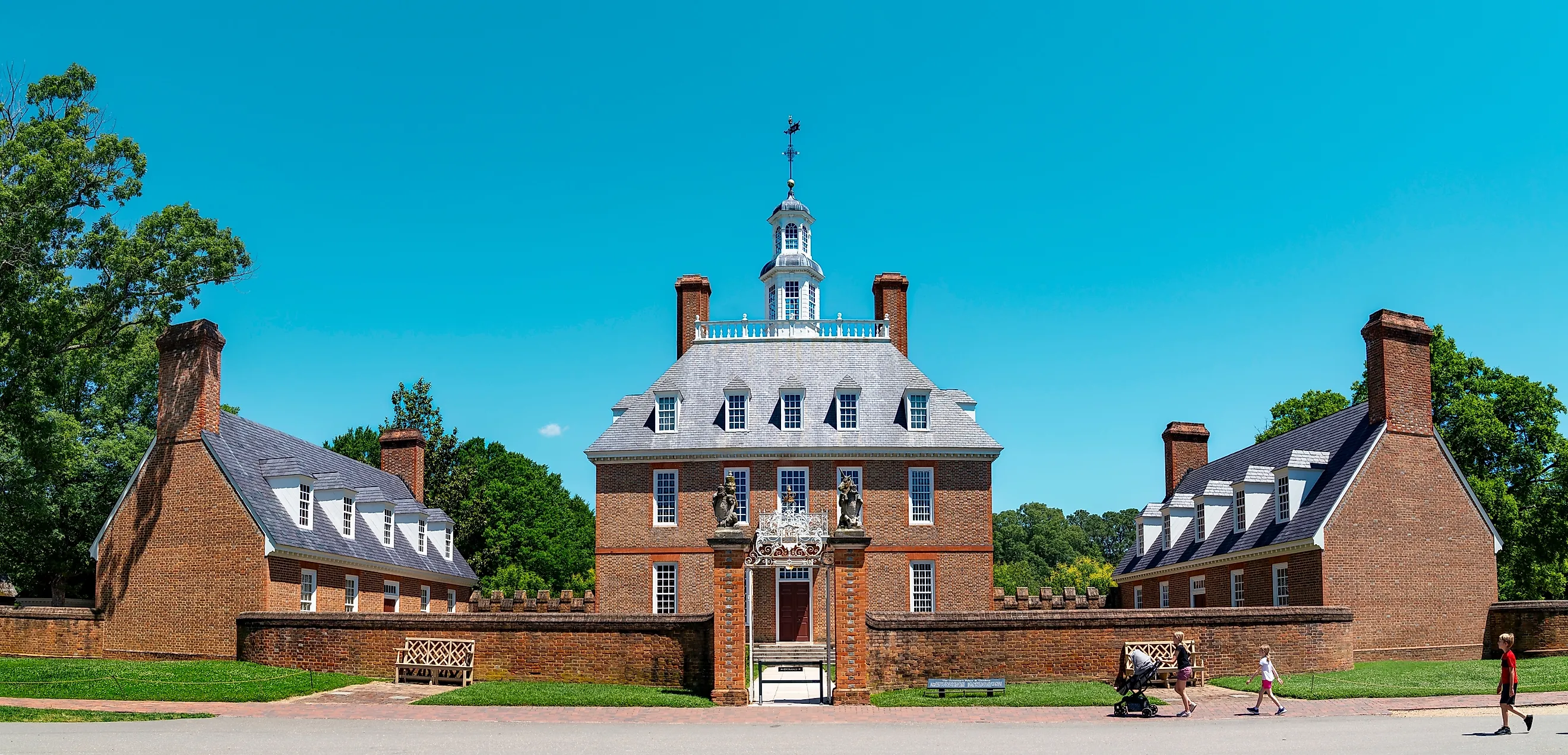
It all started in 1926, when the Rev. W.A.R. Goodwin, rector of Bruton Parish Church, the town's Anglican church, persuaded John D. Rockefeller Jr., the Standard Oil heir, to pay for the purchase and restoration of a town that had been Virginia's capital from 1699 to 1780. The reconstructed Governor's Palace opened in 1934, and the Capitol, where Virginia's delegates voted for independence on May 15, 1776, stands on its original foundations at the east end of the car-free Duke of Gloucester Street.
The newest original building is also the oldest of its kind: the Williamsburg Bray School, which taught Black children from 1760 to 1774, was moved into the Historic Area from the campus of William & Mary, the college next door. Colonial Williamsburg's Historic Area is open every day of the year.
2. Greenfield Village, Dearborn, Michigan

Henry Ford, founder of the Ford Motor Company, didn't so much restore a town as assemble one. Greenfield Village in Dearborn, the outdoor half of the museum complex now called The Henry Ford, has 83 historic structures on 80 acres, nearly all of them moved there from somewhere else. Ford began collecting in 1919, and President Herbert Hoover dedicated the village and its indoor museum, then called the Edison Institute, in October 1929, and opened it to the public in 1933.
The collection is arranged in seven districts and includes the inventor Thomas Edison's Menlo Park laboratory complex, rebuilt from photographs and surviving materials from its New Jersey site; the Dayton, Ohio, bicycle shop where the Wright brothers built their first airplane; the Logan County Courthouse from Illinois, where Abraham Lincoln practiced law; and the Connecticut house in which Noah Webster wrote the first American dictionary.
The complex was declared a National Historic Landmark in 1982. Visitors get to ride in classic Model Ts and behind steam locos on the Weiser Railroad.
3. Sauder Village, Archbold, Ohio

Ohio's entry started when Erie Sauder, founder of the ready-to-assemble furniture maker Sauder Woodworking in Archbold, bought 9.7 acres of a neighboring farm in January 1971. His goal was to show schoolkids how woodworking was done before electricity, and the Sauder Farm and Craft Village opened in 1976.
Today, the museum features more than 75 historic structures and nearly 50,000 artifacts spread across the Historic Village's 235 acres. The Walk Through Time experience includes Natives & Newcomers, an area dealing with the fur-trade years around Ohio statehood; a Pioneer Settlement with a school, church, sawmill, and jail; and a 1920s Main Street.
Tours start at Erie's Farm Shop, the shed where the founder built a foot-powered lathe as a teenager. The complex also includes the 98-room Sauder Heritage Inn so visitors can make a weekend of it.
4. Genesee Country Village & Museum, Mumford, New York

Twenty miles southwest of Rochester, the 68 buildings of Genesee Country Village & Museum came from 11 western New York counties and were reassembled on 600 acres in the hamlet of Mumford. John L. Wehle, president of the Genesee Brewing Company, founded the museum in 1966, and it opened to the public in 1976. Today, it's billed as the largest living history museum in New York State.
The village is arranged as three neighborhoods: the Early Settlement of log and frame buildings, the Center Village of columned shops and homes, and the Gas Light District of Victorian houses, including the eight-sided Hyde House from the 1870s. The grounds also include the John L. Wehle Gallery of sporting and wildlife art, a 175-acre Nature Center with trails, and Silver Base Ball Park, where teams in period uniforms play vintage baseball using 19th-century rules.
5. Old World Wisconsin, Eagle, Wisconsin

Opened in 1976 as a bicentennial project, Old World Wisconsin is set on 600 acres inside Kettle Moraine State Forest, a glacial landscape of ridges and kettle ponds southwest of Milwaukee. Researchers from the Wisconsin Historical Society spent the early 1970s crossing the state looking for buildings put up by its first generation of immigrants, then dismantled more than 60 of them and rebuilt them here.
The result is 10 working farmsteads and 12 heirloom gardens representing Norwegian, Finnish, Danish, German, Polish, and New England settlers between the 1840s and the 1930s. There's also the 1880s Crossroads Village with a general store, blacksmith shop, church, inn, and the Raspberry Schoolhouse, moved from the Lake Superior shore in the far north of Wisconsin. The attraction is open from May to October.
6. Stuhr Museum of the Prairie Pioneer, Grand Island, Nebraska

Railroad Town, the living history half of Nebraska's Stuhr Museum of the Prairie Pioneer, covers four city blocks with more than 60 structures, with interpreters working as if the year were 1891. The museum, named for Leo Stuhr, a Hall County farmer and politician, opened in 1967 on more than 200 acres on the south side of Grand Island. Its main exhibit building, designed by Edward Durell Stone, the architect of the Kennedy Center in Washington, stands on an island in a man-made lake.
The Bell Cottage, built in 1884, is presented as an ordinary 1890s starter home. The Platte Valley Independent, the town newspaper, is still printed, and the dirt streets stood in for the 1890s in the television films Sarah, Plain and Tall (1991) and My Antonia (1995). Railroad Town is staffed from spring through fall, and the rest of the Nebraska museum stays open year-round.
7. Old Bethpage Village Restoration, Old Bethpage, New York

Nassau County, on Long Island, built its village from buildings that would otherwise have been demolished. The county bought the 165-acre Powell farm on the Nassau-Suffolk line in 1963, moved the Manetto Hill Methodist Church, built in 1857 in nearby Plainview, as the first rescue, and developed Old Bethpage Village Restoration around it. Of its 51 historic buildings and seven reconstructions, the Schenck House, a Dutch farmhouse from the 1730s and one of the oldest in the country, is a standout.
The grounds' 209 acres host the Long Island Fair each fall, a county agricultural fair that has been going on for over 184 years. HBO's period drama, The Gilded Age, has filmed its 1880s New York street scenes here, and in October 2025 the county announced the fourth season would continue to be filmed at the Old Bethpage Village Restoration. The village is open Friday through Sunday.
8. Old Cowtown Museum, Wichita, Kansas

Old Cowtown Museum is set on 23 acres beside the Arkansas River in central Wichita, Kansas. Of its 54 historic and re-created buildings, 27 are originals moved from around Kansas. They're grouped together to portray a cattle town of the period from 1865 to 1880 when the Chisholm Trail, the cattle-drive route from Texas to the Kansas railheads, passed along the town's east side.
The museum was established in 1950 by residents who objected to the demolition of the city's oldest buildings and was opened to the public in 1955. Highlights include Munger House, a two-story residence built in 1869 by one of the city's founders. Interpreters stage gunfights in the dirt street where the museum's two vintage baseball teams play near the 1880s DeVore Farm. Wyatt Earp, the frontier lawman, spent a year on the Wichita police force in the 1870s.
Why Williamsburg Still Wins

Colonial Williamsburg has more original 18th-century structures than any other museum on this list has buildings of any age. It's also the only one built around a real town’s original streets, rather than assembled on a farm. The other living musems were moved in from elsewhere, but nearly every one of them share one thing with Williamsburg: a one-room school to show a busload of kids on a field trip, just like you once were.