The Largest Cathedrals In The United States
What makes a cathedral so interesting is not that its a central place for dioceses but that it holds some of the most interesting pieces of history. Cathedrals have been the hubs of religious worship, classrooms that hold ancient relics. Nobility, generals, presidents and soldiers have graced their floors for decades.
Luckily for us, the United States holds some of the largest by size, along with historic significance with one having a moon rock encased in stained glass while another remains unfinished to this day.
These nine cathedrals tell their stories through intricate design, aged structure, and the people that echo throughout their halls.
Grace Cathedral

Grace Cathedral is an Episcopal place of worship located in San Francisco, California that serves as the seat of the Episcopal Diocese of California. Covering 36,132 square feet, it's the third-largest Episcopal cathedral in the U.S., measuring 329 feet long by 162 feet wide, with its facade towers measuring 174 feet from street level and its central spire measuring 117 feet.
The cathedral began construction in 1927 as a replacement for the former church building destroyed during the 1906 earthquake in San Francisco. It uses concrete and steel for its fabric to withstand future earthquakes. It was largely completed and consecrated in 1964, but had additional elements added in the 1990s and 2000s, such as the AIDS Interfaith Memorial Chapel, designed to welcome people impacted by AIDS.
The architecture takes a great deal of inspiration from French Gothic styles, with a cruciform design, twin towers, and a polygonal apse. It also takes inspiration from Spanish Gothic features with its wider nave on the interior.
Cathedral of Saint Paul

Located in Saint Paul, Minnesota, the Cathedral of Saint Paul gets its name not from the city but rather from the apostle Paul, the writer of several books in the New Testament. It acts as a co-cathedral of the Archdiocese of Saint Paul and Minneapolis. It covers a floor area of 43,560 square feet with its most prominent feature being the 60,000-square-foot copper dome.
Catholics have been in this area since at least 1840, when Father Lucien Galtier constructed a humble log chapel. The Cathedral of Saint Paul was built from 1906 to 1915 by French architect Emmanuel Louis Masqueray, an expert in the Beaux-Arts style, which mixed together Renaissance, Baroque, and neoclassical elements.
The interior dome is supported by four piers, each of which has a mosaic at the top with an angel representing Temperance, Fortitude, Justice, and Prudence.
The cathedral keeps an international character as many different immigrant groups settled in Minnesota. This is reflected in the Shrine of the Nations behind the main sanctuary, with Saint Anthony of Padua for Italy, John the Baptist for French Canadians, Saint Patrick for Ireland, Saint Boniface for Germany, Saint Cyril and Methodius for Slavic countries, and Saint Therese for all foreign missions.
Holy Name of Jesus Cathedral

Built in 2017 in Raleigh, North Carolina, it is one of the newest cathedrals on this list. It was built to replace the 1924 Sacred Heart Cathedral, which is one of the smallest Catholic cathedrals in the U.S., only able to support 300 people. At 44,000 square feet, it can support more than 2,000 people.
Despite its newer age, it harkens back to older Romanesque styles, with a 162-ton copper dome that was placed on top of the building. Another older style present is the stained glass windows, some of which were removed from Ascension Catholic Church in Philadelphia and brought to Raleigh. When measured from the bottom to the dome, the cathedral is 173 feet tall.
Like many cathedrals, it's designed in a cruciform shape, with a bell tower positioned to the right of its entrance. The cornerstone of the Cathedral was made of Santa Fiora marble from Italy and was blessed by Pope Francis in 2015.
Cathedral Basilica of the Sacred Heart

Located in Newark, New Jersey, the Cathedral Basilica of the Sacred Heart is a 45,000-square-foot Catholic Cathedral which was built over a 55-year period, beginning in 1899 until its consecration in 1954. Designed in the French Gothic Revival style, it actually competes with many of its forefathers in France through its rose window.
The 36-foot rose window over the main entrance is the largest in the Western Hemisphere. Its 232-foot towers flanking the entrance are taller than those of Notre Dame, and its copper spire is even taller at nearly 300 feet.
The interior of the cathedral has elements from many different countries. Its stained glass windows came from Munich, Germany, while its bells in the west tower originate from Italy, and the pews are made of Appalachian oak. Just behind the main altar is the Lady Chapel, with an altar carved from Carrara marble.
Cathedral of Our Lady of the Angels

Located in Los Angeles, the Cathedral of Our Lady of the Angels is 64,000 square feet, along with a 25,000-square-foot museum. Built in 2002, it was made to replace St. Vibiana's Cathedral, which was heavily damaged by the 1994 earthquake. Unlike many other Catholic cathedrals, which were built in older styles, or revivals of older styles, this cathedral was built in a modern style.
The central philosophy behind this building was to reflect the diversity of all people who come to this place with a modern style. As a result, the entrance is on the south side, rather than the center. Inside, there are almost no right angles. In fact, there are hundreds of non-repeating angles in the walls, which is intended to create a mysterious space that invites awe in parishioners and visitors.
The exterior has a tan color, which is a throwback to the adobe-style structures from the California missions established by early Spanish missionaries.
Cathedral Basilica of Saint Louis

Built in 1914 in a Neo-Byzantine style, this St. Louis, Missouri cathedral has a floor area of 74,460 square feet that features a central dome and flanking towers. But its real beauty lies on the inside with its Byzantine-style mosaics.
The Cathedral Basilica of Saint Louis is sometimes quoted as the most beautiful Cathedral in the U.S. because of its vast array of mosaics made from 1912 to 1988 with 41.5 million pieces of glass, covering 83,000 square feet.
These include art pieces of Jesus and the Cathedral's namesake, Saint Louis, a French King from the 13th century with recreations of Renaissance architecture, such as the Pietà by Michelangelo. One unusual feature in this Cathedral is the crypts that contain at least 100 people, including bishops and archbishops.
Christ Cathedral

Currently operated by the Roman Catholic Church, the Christ Cathedral stands as the third-largest cathedral in the U.S. at 78,397 square feet and is one of the few cathedrals of its kind that began as a Protestant church.
It began as a megachurch in Garden Grove, California, under Reverend Robert H. Schuller, who would host his televised Hour of Power Service in what he referred to as the Crystal Cathedral that was built in the 1970s and stands at 120 feet tall, 141 feet long, and 207 feet wide.
However, in 2012, the Roman Catholic Diocese of Orange purchased the building and rebranded it as Christ Cathedral.
The most striking aspect of this cathedral is that it is made entirely of glass and steel with 10,660 panels of mirror glass. Despite the change in ownership, the Catholic Diocese honors Robert Schuller with the Cathedral Memorial Gardens, where he is buried. It serves a population of more than 1.3 million Catholics in Orange County, California.
Washington National Cathedral

It took nearly 100 years to complete this Episcopal Cathedral in Washington, D.C. from its groundbreaking in 1907 to official completion in 1990. At 83,000 square feet, it's the second-largest cathedral in the U.S. Although known as the Washington National Cathedral, its official name is the Cathedral Church of Saint Peter and Saint Paul.
Built in the Neo-Gothic style, it has several familiar features such as arches, boss stones that act as load-bearing weights, flying buttresses, and less familiar ones that reflect its American character.
For example, on the exterior of the building are 112 gargoyles and more than 1,200 carved stone figures that were meant to ward off evil spirits in the medieval times. In the Washington Cathedral, they include dragons and even the sci-fi Dark Lord of the Sith, Darth Vader, from the Star Wars franchise.

Another interesting feature in this cathedral is the Space Window, a stained glass window honoring the works of scientists and astronauts. Embedded in the center of the window is a moon rock donated to the cathedral by the astronauts on Apollo 11.
Cathedral of St. John the Divine

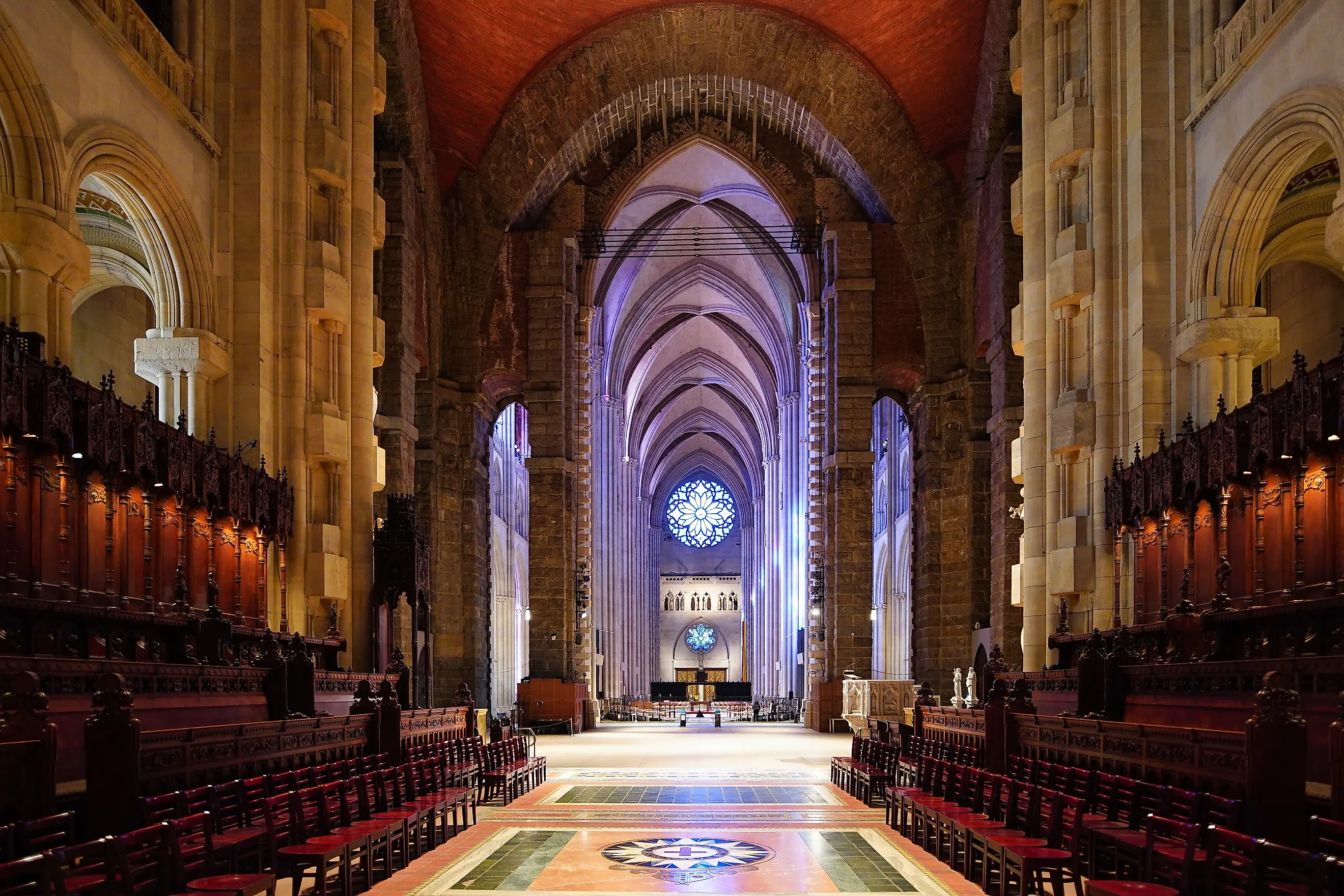
At 121,000 square feet, the Cathedral of St. John the Divine isn't just the largest Cathedral in the U.S., it's the largest Gothic church in the world. Located in New York City, it first began construction in 1892 in the Neo-Byzantine and Romanesque Styles. However, by 1909, plans changed to make it a Neo-Gothic Cathedral and, as of September 2026, the cathedral is still unfinished.
Some of the newest sections of the Cathedral were a south bell tower in 1979 and the Portal of Paradise, an entrance on the western facade featuring biblical figures and imaginative scenes. One shows a nuclear mushroom cloud destroying the skyscrapers of New York City, and below that is a scene of stonemasons building a cathedral from the ashes of the city, similar to Nehemiah rebuilding the walls of Jerusalem in the Old Testament.
Many of the cathedral features come in sevens, such as the seven lamps above the High Altar and seven chapels. In the Bible, the number of seven is of special importance, such as in the book of Revelation.
Storytelling through architecture
The design of these churches isn't just meant to be impressive to onlookers but to tell stories, hearkening back to days before widespread literacy where statues and architecture were some of the best ways to communicate Biblical themes and stories.
Stained glass, interior sculptures, and mosaics reveal many stories of the Old and New Testament, along with celebrated saints of the Catholic faith. Other cathedrals raise up cultural achievements, such as those of the astronauts who visited the moon, or to draw attention to maligned groups, including those impacted by the AIDS epidemic.
It's not just their size that makes these cathedrals impressive, it's the people, places, and stories that inspired their overall design that make these large cathedrals truly magnificent to be in the presence of.